Joining Plastics: Smarter Welding, Better Designs, Stronger Assemblies
Key Highlights:
- Modern joining technologies support complex geometries, miniaturization and integrated functionalities in plastic assemblies.
- Advanced process control and validation tools enable higher confidence, less over-engineering and improved long-term product performance.
- Internal inspection and non-destructive testing are crucial for understanding joint integrity beyond surface appearance, reducing reliance on destructive methods.
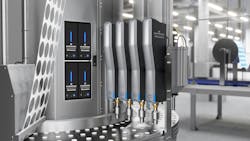
At the rate of current change, staying informed about all the developments in plastics engineering is not possible. However, plastics joining is one area where it’s a necessity for machine designers to keep up.
“Modern joining technologies give engineers much greater design flexibility,” explains Kerryn Harrington, global product manager, Branson Welding and Assembly at Emerson (which offers expertise in ultrasonic, vibration, laser and other advanced plastic welding processes). “They support more complex geometries, tighter tolerances and stronger structural integrity, enabling designs that simply weren’t practical years ago. Engineers can integrate more functionality into plastic assemblies, support product miniaturization and reduce the number of parts, which simplifies design and manufacturing.”
In addition, because today’s plastic joining systems provide stronger process control and validation tools, engineers can design with a higher degree of confidence, says Harrington. That often means less over-engineering, fewer unnecessary reinforcements and more efficient designs, she says, translating into lighter products, lower manufacturing costs and improved long-term performance.
READ MORE: Fastening & Joining: Emerson Ultrasonic Welder Is an Automation-Ready Asset
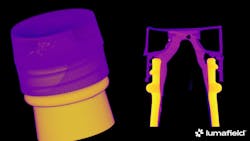
Andreas Bastian points to the fact that the context for using plastic/composite joints has changed. Bastian is a co-founder and head of product at Lumafield, which provides non-destructive internal part quality control, connecting internal inspection data directly to engineering and manufacturing decisions. He explains that today’s products increasingly rely on multi-material assemblies (plastic-plastic, plastic-metal and hybrid structures) with tighter tolerances, thinner walls and more complex geometries. Understanding the internal structure of these joints is therefore critical.
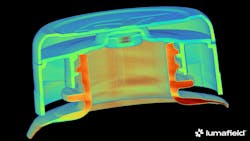
“Voids, incomplete fusion, fiber disruption or misalignment inside a joint can significantly affect strength and fatigue life, even when the exterior looks in specification,” Bastian explains. “That’s pushing teams to place more emphasis on understanding what’s happening inside the joint, not just at the surface.”
Three Main Joining Techniques
Similar to all areas of engineering, plastic joining techniques vary in terms of requirements (equipment needed, labor) to make the joint, restrictions related to end-use applications and more. For example, only higher-strength composites are suitable for mechanical fastening (screws, bolts, rivets, etc. in hinges, latches, etc.) because the plastic at the joint must withstand the stresses of assembly, service load and more.
While mechanical fastening provides initial ease of quality control for the joint, as well as easy disassembly, joints involving mechanical fastening are also vulnerable in some cases to weakening due to factors like corrosion and repeated use. For this reason, in recent years adhesive bonding and fusion bonding (welding)—the other two main categories of plastic joining—have received strong attention.
Design for Joining
But Harrington cautions that plastic joints are not simply a substitute for metal fastening in machines that have plastic components. She therefore advises that successful plastic welding starts with smart design. This means incorporating the correct weld joint geometry (such as shear joints or energy directors) early, ensuring material compatibility and accounting for tolerances, part variability and access for the welding process.
Harrington provides further insight into why this matters. “Today’s plastic joining technologies are extremely capable, but they perform best when design engineers and manufacturing engineers collaborate early in development,” she says. “When joint design, material selection and process capability are aligned from the beginning, manufacturers can achieve stronger, more reliable assemblies, reduce failure risk and significantly lower production and warranty costs. Modern process control has also advanced to a point where repeatability and validation are much stronger than many engineers realize, enabling high confidence in critical applications.”
READ MORE: An Application Engineer’s Insights on Fastening and Joining Components
Ongoing innovation in materials, lightweighting and application design is pushing joining technology forward, she says, requiring more flexible and capable systems than in the past.
Indeed, plastic joining has become highly digital and data-driven, with today’s plastic welding systems using advanced sensing, closed-loop control and real-time weld monitoring. “Engineers can capture detailed weld data, apply adaptive control logic and validate every weld,” says Harrington, “dramatically improving repeatability, quality assurance and traceability.”
These capabilities, she explains, align closely with smart manufacturing and Industry 4.0 initiatives. Weld data can be integrated into plant networks, enabling quality analytics, predictive maintenance and continuous process optimization.

Analysis is Key
Bastian’s thoughts are similar. At the same time modern joining methods are giving designers more freedom, this freedom comes with new responsibilities—but a whole new world of analytics exists to lean on. Engineers should think about inspection as part of the design and manufacturing process, he says, not just a quality control step at the end. “Integrated validation and inspection let teams make decisions about process parameters, vendors and processes faster than traditional destructive testing or field testing.”
That is, engineers can now design lighter, more compact assemblies, but they can only do this if they can validate that joints behave as intended under load and over time (which also prevents downstream re-designing or over-engineering). “What’s changing is the feedback loop,” Bastian reports. “Instead of designing a joint, building it, and relying solely on destructive testing or field failures to learn what went wrong, many teams are using internal inspection data to understand how joint geometry, material flow and defects correlate with fatigue and failure.”
In his view, “the key takeaway is that joint performance is not fully captured by material datasheets or process SOPs alone. Internal features—such as bond-line consistency, void distribution or plastic-metal interface quality—often determine real-world performance.”
Moving Past the Past
When asked about older paradigms about plastic joining that need to be expunged, Bastian points to a common “legacy” assumption that if a joint looks good externally, it’s structurally sound. That mindset worked when designs were simpler and safety factors were large, he says, but it breaks down with today’s composite assemblies.
“Another is heavy reliance on destructive testing as the primary validation method,” he says. “While destructive testing is still important, it’s slow, expensive and limits how many design variants can be evaluated. As designs become more complex, engineers benefit from complementary non-destructive methods that let them see internal structures directly and learn faster.”
For her part, Harrington points to a common and persistent misconception that plastic joining is less reliable than traditional fastening. “In reality, when designed correctly, modern plastic welding delivers extremely strong, durable and consistent joints, often stronger than the surrounding material,” she explains. “Another outdated belief is that plastic joining is heavily trial-and-error based. With today’s analytical tools, process intelligence and application expertise, engineers can take a far more predictable, science-based approach.”
Harrington adds that there’s also still a tendency among engineers to “design plastics like metal.”
“Plastics behave differently and require a different engineering mindset—particularly in how loads are transferred, how parts deflect and how joints are shaped,” she says. “Once engineers embrace that plastics require their own design logic rather than applying metal thinking, they can unlock better performance, more design freedom and greater reliability.”
Ultrasonic Welding Updates
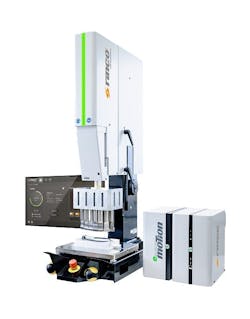
In ultrasonic welding, pulses are transmitted to the parts by a resonant vibrating tool, with the vibration causing heat that leads to the parts being fused together.
Bill Aurand, sales manager at Rinco Ultrasonics USA, notes that while effective for many years, traditional pneumatic ultrasonic welders (which rely on compressed air to drive motion) are now out of date. They are inherently limited by the physics of air compressibility, which introduces response delays and variability.
In contrast, today’s servo-driven ultrasonic welders use precisely controlled electric motors. “This fundamental change in actuation allows for exact control of position, speed and force,” says Aurand, “resulting in significantly more consistent welds and better overall process stability.”
READ MORE: Robotic Welding Technologies: What’s Possible Now, What’s Ahead
Studies show that servo welders achieve much lower standard deviations in collapse distance—values on the order of 0.9% compared to 3.9% for pneumatic systems. This tighter control directly translates into fewer rejects, reduced scrap and more stable production, especially critical for high-value or safety-critical plastic components.
Precise velocity/force control is another key benefit to servo-driven ultrasonic welding systems. The ability to program consistent, optimized collapse speeds throughout the weld cycle ensures that parts do not collapse too slowly which can degrade material) or too quickly (which can cause cold forming and weak joints), says Aurand.
Servo systems maintain a tightly regulated collapse profile from start to finish, and those systems that can adapt in real time as the melt layer forms at the joint interface improves joint integrity and weld strength by matching force to the actual state of the material.
Joining in the Future
Bastian and his colleagues believe that as plastic joining evolves, rather than one joining technology emerging as a replacement for others, there will be continued diversification and development of new joining capabilities. Different joining methods will be optimized for different materials, geometries and production scales.
“What will matter most is how quickly teams can move to adopt these new technologies and validate the joints that they produce,” he says. “Best practices are moving toward tighter integration between design, manufacturing and inspection. Engineers who can quickly connect internal inspection data back to design assumptions and process choices will be able to qualify joints faster, reduce risk and push performance further.”
In this sense, the future of joining plastics isn’t just about how parts are bonded per se, he notes, but about how engineers can quickly and confidently understand and improve those bonds.
About the Author
 Treena Hein
Treena Hein
Treena Hein is an award-winning science and technology writer with over 20 years’ experience.
Voice Your Opinion!
To join the conversation, and become an exclusive member of Machine Design, create an account today!
 Leaders Logo
Leaders relevant to this article: