AI Takes Center Stage at Hannover Messe 2026 Preview
Key Highlights:
- Hannover Messe 2026 positions AI as the organizing principle, emphasizing its role in transforming industrial manufacturing and automation.
- The event showcases physical AI systems that interact directly with the physical world, including advanced humanoid robots and AI-powered robotics for industrial tasks.
- Discussions highlight the current gap between AI hype and actual implementation, with a focus on scalable, production-ready solutions and disciplined data management.
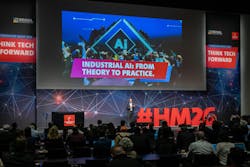
If the industry’s appetite for artificial intelligence remains anything but satisfied, Hannover Messe promises a full plate.
The event organizers, Deutsche Messe AG, a Germany-based trade fair company headquartered in Hannover, have made clear that AI is not just a featured topic this year, but the organizing principle shaping the program.
Across exhibition halls packed with automation, energy technologies and digital platforms, this year’s show is organized around a question occupying manufacturing decision-makers in search of a competitive advantage. Manufacturers are asking how AI can be deployed as a profitable, production-ready tool as opposed to a limited pilot project or proof of concept, said Dr. Jochen Köckler, chairman of the Managing Board of Deutsche Messe AG.
From April 20 to 26, 2026, Hannover Messe will transform into a hands-on proving ground for AI in industry. “Hannover Messe is the platform where visitors can experience concrete AI applications and learn through direct exchange with exhibitors how they can increase productivity by using AI,” Köckler noted during his opening remarks at the Hannover Messe Press Preview (Feb. 25, 2026).
He laid out the themes for this year’s event before an audience of about 100 trade journalists. In particular, the topic of physical AI will emerge as a defining focus, Köckler said. Physical AI refers to the AI systems that directly interact with the physical world. In the industrial environment, this means embedding AI into machines, plants and robots by moving beyond data analysis to enable real-time sensing, decision-making and physical action on the factory floor.
Current State of AI in Manufacturing
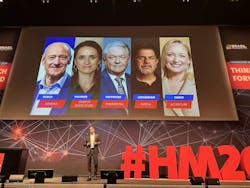
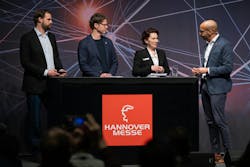
AI was the unifying theme of a panel discussion, “AI in Manufacturing,” moderated by Onuora Ogbukagu, director of Corporate Communications at Deutsche Messe. He highlighted the gap between media hype and actual implementation.
“We have this real hype, this real hope that AI may help us solve many of our questions, and yet everybody is kind of in pilot stage,” said Norbert Jung, CEO, Bosch Connected Industry. He stated that 95% of AI projects don’t deliver economic value today. “We have more and more data, but it doesn’t seem to produce significantly more value,” he said.
For Bosch, the solution lies in what the company terms as manufacturing co-intelligence, a framework that brings AI, machines and humans together. “We help customers with taking data out of their silos, out of their functions, into a shared semantic data layer across the product life cycle, and we industrialize agentic AI,” he explained.
Lilija Kucinskaja, product owner, AI & Analytics Solutions at German Edge Cloud, offered a complementary perspective. “In Germany, AI is already an industrial reality for large companies, but for small and medium-sized enterprises, smart factories remain somewhat out of reach,” said Kucinskaja. She noted that SMEs are adopting AI, but selectively, focusing on proven, high-ROI use cases and are “more cautious overall.”
READ MORE: 100 Years of Innovation: Festo’s Incredible Machine Impels Seamless Connectivity
On the topic of generative AI, Kucinskaja noted, the hype has already peaked. “According to Gartner, we are now in the ‘trough of disillusionment,’ which is actually a very productive phase,” she said. “Companies are beginning to see clearly what AI really means, the difference between proof-of-concept results and true industrial implementation.”
She added that the emphasis is shifting toward disciplined data management and strong data governance. These foundational measures, she said, are essential to move AI beyond experimentation and turn it into scalable industrial value.
A third panelist, Sven Parusel, head of Research Partnerships, Agile Robots, said that early adopters are demonstrating tangible value from AI in industrial production. This is seen at multiple levels, from machine-level intelligence to higher-level robotics systems, said Parusel, who further explained that a hierarchical approach is emerging. AI in vision systems have already proven its value, and adding AI to robotics systems will open opportunities for speed, flexibility and easier setup.
One example, he said, is performing gearbox assembly using an AI-powered dual-arm system. While such applications are still relatively few and far between, Parusel noted that measurable benefits are evident and that interest is growing among manufacturers eager to move beyond pilot projects. Scaling these solutions and translating demonstrations into everyday production is an ongoing challenge, he said.
AI Enables Humanoids in Industrial Roles
One prominent application area is humanoid robots. Exhibitors across the show will demonstrate how AI-driven humanoid systems can operate in dynamic industrial environments. Köckler noted that the emphasis at this year’s event will be on practical, deployable use cases rather than conceptual experimentation.
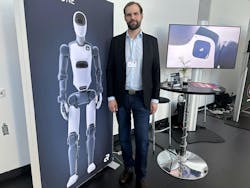
During a booth interview with Parusel, he discussed a new humanoid system designed for industrial environments. Agile One is tailored for specific applications such as logistics, material handling and assembly. It features a 20 kg payload, 174 cm height and advanced dexterity with torque-controlled five-finger hands. The system integrates high-level controls and AI for safe and efficient industrial tasks.
READ MORE: Hannover Messe 2025: Attend a Masterclass in Industrial Technology
According to Parusel, Agile Robots emphasizes in-house development, including joints, sensors and motors, but also collaborates with partners for certain components. The humanoid will be a feature at the Agile Robots booth in Hall 27, where it will make its debut on a catwalk designed for the show.
When probed to comment on Germany’s level of advancement with humanoid technologies in relation to the United States and China, Parusel responded that China leads the way when it comes to speed of development.
“Obviously we cannot compare in Europe, but what we can compete with and, why we’re really strong in Germany, is the high level of integration—so high-quality mechanics, mechatronics, the integration of software and AI,” he said. “These things together are something we’re really good at. And specifically, when it comes to industrial applications, with the wide variety of humanoids that are out there, we see huge achievements every day.”
He added that there appears to be a focus on locomotion. While this is important, he hoped to see more manual applications and more assembly. “I don’t see that big a difference on that level when it comes to Germany vs. China vs. U.S.,” Parusel said.
Beyond AI: Automation, Technology Transfer and Energy Shape the Show Floor
This year’s host partner is Brazil. German Chancellor Friedrich Merz and Brazilian President Luiz Inácio Lula da Silva will open the fair. The main exhibition areas will be Automation & Digitalization, Energy & Industrial Infrastructure, and Research & Technology Transfer.
Deutsche Messe reports that about 3,500 companies from mechanical engineering, the electrical and digital industries, and the energy sector will present solutions. This includes exhibitions from global tech companies such as AWS, Microsoft, SAP, Schneider Electric and Siemens, as well as technology leaders such as Beckhoff, Festo, HARTING, ifm, LAPP, Phoenix Contact, Rittal, Schaeffler and SEW.
In addition, Fraunhofer and KIT (Karlsruhe Institute of Technology), a research institute, will outline future-facing industrial solutions and more than 200 startups representing diverse technology fields will present their innovations.
About the Author
 Rehana Begg
Rehana Begg
Editor-in-Chief, Machine Design
As Machine Design’s content lead, Rehana Begg is tasked with elevating the voice of the design and multi-disciplinary engineer in the face of digital transformation and engineering innovation. Begg has more than 24 years of editorial experience and has spent the past decade in the trenches of industrial manufacturing, focusing on new technologies, manufacturing innovation and business. Her B2B career has taken her from corporate boardrooms to plant floors and underground mining stopes, covering everything from automation & IIoT, robotics, mechanical design and additive manufacturing to plant operations, maintenance, reliability and continuous improvement. Begg holds an MBA, a Master of Journalism degree, and a BA (Hons.) in Political Science. She is committed to lifelong learning and feeds her passion for innovation in publishing, transparent science and clear communication by attending relevant conferences and seminars/workshops.
Follow Rehana Begg via the following social media handles:
LinkedIn: @rehanabegg and @MachineDesign
YouTube: @MachineDesign-EBM
Voice Your Opinion!
To join the conversation, and become an exclusive member of Machine Design, create an account today!
 Leaders Logo
Leaders relevant to this article: