Humanoid or Not? How Robot Design is Challenging Our Notions of the Humanoid
Key Highlights
- Humanoid robots are rapidly improving in motion fluidity, making them more human-like and suitable for complex tasks.
- Applications range from surgical procedures to manufacturing, with companies like BMW deploying humanoid models on assembly lines.
- Simpler, cost-effective robots like Igus' Iggy Rob are making automation accessible for small and medium enterprises.
Enjoying Machine Design’s Motion Control content? Be sure to check out the rest of our Takeover Week coverage here.
In mid-February 2026, China held its annual Chinese New Year celebrations. But just like in recent years past, the displays of 2026 were about more than welcoming The Year of the Horse. On the stage at one event were dozens of humanoid robots doing a kung fu demo.
Many clips of this display that circulated around the internet also included the display from 2025 for comparison. The difference…is stark. The motion of the 2026 robots is so much smoother and fluid than 12 months before. So very much more human.
Indeed, across the robotics sector, humanoid developments are the main focus right now. At Automate 2026 in June, there will be a new Humanoid Robot Pavilion with real-time demonstrations as well as the third annual Humanoid Robot Forum. And as Jan Hennecke (head of igus RBTX and Low-Cost Automation division) explains, for manufacturing plants and many other physical spaces “built by and for humans, the potential for humanoid robots is immense.”
READ MORE: Engineering for Extremes
But just what are humanoid robots? From a motion and hardware perspective, how much of the range of human motion (walking, grasping, turning) is needed for a robot to be considered humanoid? Does a robot with four “arms” or a platform instead of legs meet the definition?
For example, the Johns Hopkins University robot known as SRT-H has no legs, but it recently removed a gallbladder (from a life-like model) completely and correctly by itself; its only training for this procedure was to view videos. SRT-H’s sensors and software identified parts of the simulated gallbladder and directed the hardware to clip ducts and cut tissue as required.
The software also adapted when circumstances changed and followed voice commands in real time, “like a novice surgeon working with a mentor,” according to the testing team. (See details in Science Robotics).
In the end, most agree that “humanoid robot” is a flexible term. Humanoid robots can range from very human to human-like in their motion, shape or other characteristics. These models also factor other aspects of robotics, from the degrees of freedom in their joints, the ability to replicate the work of a human, the ability to demonstrate physical and behavioral flexibility like a human does, and so on.
Progress and Achievement
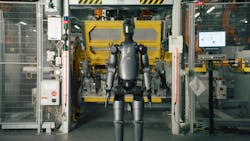
In the manufacturing realm, there are already several initiatives underway involving larger companies. “Figure AI partnering up with BMW is an example that’s well known,” says Hennecke. “I think that will intensify and be rolled out to all kinds of different manufacturers.”’
The Figure 02 robot was deployed last year at an active assembly line at the BMW Group Plant Spartanburg in Greer, S.C. Over 11 months, it loaded more than 90,000 parts, contributing to the production of more than 30,000 BMW X3 vehicles. Figure 02 was retired as of November 2025 and Figure 03 is on the way.
To refine the motion in loading parts and many other tasks, specific hardware in hydraulics, balancing systems, sensors, gears, actuator systems, motors and more are being developed for humanoid models—for motion across a warehouse floor and also motion of the appendages and attachments/hands.
Hennecke explains that “humanoids have a unique form factor, so you can't just use off-the-shelf components. You very much care more about the weight of the components, their size and the energy efficiency. Humanoid robots run on batteries, so all of this matters.”
Igus semi-spherical bearings, he adds, are particularly suited to use in humanoid and other types of robots because they are self-lubricated, durable and lightweight (and have been explored in the Iggy Rob; see below). “Our flexible cables can also be super helpful in a humanoid robot,” says Hennecke, “where cables are constantly subjected to flexing.”
READ MORE: Robotics in 2026: Software-Led Machine Design, Practical AI & Market Demand
Yoshi Umeno, global director of business development, Robotics & Medical at Kollmorgen (owned by Regal Rexnord), points to other challenges. One faced by humanoid OEMs is balancing themselves to preventing falls due to their complex kinematics, he says. Traditional industrial robots have six to seven degrees of freedom while humanoids robots could have 40 or more.
Balancing additional axis of motion in the knee and hips for example, or the wrist, the elbow, the shoulder in the arm, is very difficult. Umeno adds, “human beings have built-in limits for speed and the amount of weight that we can lift, for example, and our joints only go so far, but humanoid robots don’t have this, and a design can be overpowered. In order to meet this challenge, motion control experts have to support the development of humanoid robot actuators that are more compact, but efficient and powerful.”
Still another challenge, says Umeno, is to address the trade-off of durability and strength in axes with dexterity in the hand. Five fingers provide better dexterity for fine-motor tasks and picking up objects, but two fingers provide a stronger grip-and-carry function, and also greater durability, through beefier axes assemblies. He also notes that “humanoids need to be programmed to operate within their mechanical limits right now because, unlike humans, they can’t instinctively adapt to unpredictable environments. Even with machine learning, teleoperation and advanced sensing, their joints, actuators and structures have finite strength, speed and range, so their behavior must be constrained to protect the robot, the surroundings and the people working with it.”
Compactness is also a design requirement, and over the last few decades, Kollmorgen has sold thousands of high torque frameless brushless motor and actuator systems for collaborative (cobot), surgical and humanoid robot applications.
Umeno adds that in the humanoid robot sector, it’s common to have engineering teams with excellent design capabilities but no manufacturing experience, “so we are being asked to make the complete motion solution, customizing actuator joints to incorporate the customer’s needs.”
Humanoid robot design firms are also starting to design their own precision gearing systems, Umeno reports, replacing the traditional harmonic gearing systems that have been common across robotics.
Just in 2026, Kollmorgen has also started up projects to develop braking systems for customers to address safety. Antonio Herrera, industry marketing manager for Regal Rexnord’s Portescap brand, notes that government and industry bodies are currently writing safety standards for robots.
“You have to be able to trust that the robot will carry out the same motion safely, again and again,” Herrera explains. We are working with customers to maximize performance within the space constraints encountered in human-size humanoids, that is, the space available in the palm of the hand, forearms, legs, shoulders, etc., and the scope of applications that we support include legged and wheel-based platforms.
“In wheeled humanoid robots,” he continues, “the space constraints tend to be even tighter than a traditional AMR to take advantage of the human form factor on top of the wheeled base.”
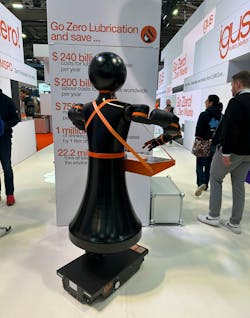
Iggy Rob
Indeed, why not create humanoid robots with wheels—those that go beyond human shape, sensory perceptions, speed, types of human motion and so on? Humanoid robots can have longer “arms” handling greater mass and a multitude of attachments, for example. There are also options like a robot with one main trunk that could do workstation tasks in front and behind it with two sets of attachments and sensors.
But many humanoid robots need not be complex. “We’ve found that a lot of automation tasks are also pretty straightforward, and this is good news for SME manufacturers,” says Hennecke. “A simpler solution is affordable and then it actually makes sense for customers to automate. So that's really what we’ve been focusing on.”
One result of this work is the “Iggy Rob,” which was also developed to incorporate many Igus (plastic) motion components. It’s a wheeled model for straightforward automation applications, tested internally and with potential customers over the past four years in many applications through a “test before you invest” program.
READ MORE: What’s the Difference Between Motion-Control and Robotics Systems?
“It’s meant for firms getting started in automation, who feel uncomfortable putting a large amount of money in it and having to trust that a system works,” says Hennecke. “So, we offer free proof-of-concepts in our lab here, where we can then show a video demonstrating what the system would look like. It’s been resonating a lot.
“We answer all kinds of questions, from speed, what it can physically handle, what tasks it can do, can its camera system detect this or that,” he adds. “Those are some of the common customer tests that we see.”
The Future is Now
Looking forward, it’s Hennecke’s view that “there’s a pretty clear path forward to implementing humanoid robots in manufacturing [with implementation in the service industry, residential use and other sectors coming along at the same time]. “The labor shortage, I don’t see that changing but becoming bigger, so we need robotics.”
Umeno points to the need for humanoid robot motion control systems to perform in a compact space and demonstrate higher responsiveness to sensor input as critical going forward. Ruggedness is also going to become more and more important.
“Traditional motion control products need to provide longer lifespans and in rugged environments where a robot might be subject to repeated impacts, uneven terrain, high levels of electric and sound noise, a range of temperature, precipitation and so on,” he says. “We’ll need innovative actuator systems and also innovation in lightweight, high-strength materials that allow longer arms, higher reach and faster motion without excessive inertia.”
In his view however, future humanoid capability will be driven less by exotic mechanisms and more by mature, scalable motion technologies. “This means electric actuation over hydraulics, enabling precise control, efficiency and safety near people and advanced gearing and transmissions that improve torque density, back-drivability and shock tolerance,” Umeno explains. “We also need integrated sensing (force, torque, thermal) embedded at the joint level. Compliant and springlike joint behavior will begin to approximate human abilities to absorb impact, store energy and accelerate quickly.”
Umeno notes also that the current “humanoid design push” has wide-ranging benefits. “An often-missed point is that the intense focus and investment in humanoids is accelerating robotics and automation overall,” he says. “Humanoids force the industry to solve the hardest problems—high axis count motion, manipulation, safety, energy efficiency, data capture and manufacturability—at the same time.”
Hennecke concludes, “I think there will be a moment when everything starts making sense for humanoids, but before that it will makes no sense, because a humanoid that works 90% of the time is just not good enough. It needs to work 99.99% of the time. I’ll add that safety is a big concern and you can’t just use AI to provide safety. I would encourage everybody to start thinking about that a little bit more.”
About the Author
 Treena Hein
Treena Hein
Treena Hein is an award-winning science and technology writer with over 20 years’ experience.
Voice Your Opinion!
To join the conversation, and become an exclusive member of Machine Design, create an account today!
 Leaders Logo
Leaders relevant to this article: