Robotics Readiness Checklist: 6 Things to Ask Before Implementation
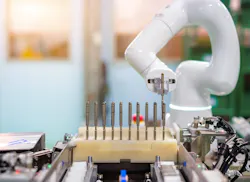
Robotic technology and the plant floor infrastructure needed to support it have come a long way over the past decade. Today, most companies have the three key elements needed to be “robot ready”—air, power and a network. What they often lack is an idea of where to begin, or they implement an unfocused approach that leverages robotics across every operational area with limited success.
To yield value from any robotics investment there is a middle ground, and engineering managers play a critical role in helping to reframe how robotics can be utilized across their unique manufacturing environment. The first step is to recognize that robots are not a 1-to-1 replacement for a job. Instead, they are best suited for specific tasks such as palletizing, packaging, welding, materials handling or parts transfer.
This approach helps to deliver the right robot for the right application and provides the necessary ROI to test and expand as needed. It also helps to streamline the implementation process, providing minimal changes for maximum output by retrofitting and augmenting existing processes rather than replacing them outright and risking disruption.
READ MORE: Q&A: The AI-Robotics Convergence: Global Perspectives for Machine Builders
Determining which tasks are best suited for robotics can be done by asking six key questions:
1. Where do the most repetitive tasks exist on the plant floor?
The best automation opportunities involve repetitive, standardized processes with minimal variability. Often these are the tasks that consume valuable labor hours but don’t necessarily benefit significantly from human judgement and intervention. Basic assembly tasks, part loading, and unloading and pick-and-place operations are good examples.
Robotic implementations leveraged across these specific areas can free up workers to focus on troubleshooting, quality assurance, process optimization and other complex, high-value elements instead of repetitive manual work.
2. Where do ergonomic injuries occur?
Repetitive lifting, awkward reaches, twisting, forceful exertions and other repetitive motions all create risks for ergonomic injuries. According to the U.S. Bureau of Labor Statistics, every year over 270,000 musculoskeletal disorders require workers to take significant time off from work, and the manufacturing sector consistently accounts for many of those injuries.
To understand where robots can alleviate that burden, consider which tasks generate the highest ergonomic risk, including those that require repetitive lifting throughout a shift. This may be an area to consider implementing collaborative robots, or cobots.
These robots are designed to work safely alongside people and often handle heavy lifting, deburring, welding, machine loading and packaging. Instead of performing hundreds or thousands of repetitive motions every shift, employees can supervise these robotics systems while focusing on inspection, quality verification and exception handling.
3. Where and when do your operations slow down?
End-of-line bottlenecks, seasonal labor fluctuations and product changeover requirements are common areas of concern. Rather than redesigning an entire production line, engineers can automate a single bottleneck with robots to increase throughput. Typically, these workflows are highly repeatable, which make them a good option for robots as they operate continuously while maintaining consistent quality.
READ MORE: Beyond the Sticker Shock: The Real Reason Companies Hesitate to Adopt Robotics
A common example is end-of-line palletizing. Many manufacturers discover that their production equipment can operate faster than employees can manually stack, wrap and stage products for shipment.
Rather than redesigning an entire line, organizations often automate that single bottleneck with a palletizing robot or cobot. Robotic palletizing deployments can increase throughput while simultaneously reducing ergonomic strain and allowing workers to be reassigned to higher-value quality and maintenance activities.
Another area to evaluate is product changeovers. High-mix manufacturers may lose significant production time when lines are stopped for setup adjustments between product runs. Robotics and automated handling systems can help standardize those transitions, reducing downtime and creating more predictable production schedules.
4. Where is the highest rate of employee turnover?
The answer to this question applies to the tasks that fall into the “three Ds”—dirty, dull or dangerous. These jobs are critical, and yet can be difficult to fill and even more challenging to maintain.
Automating high-risk or repetitive tasks can reduce workplace risks by removing humans from hazardous scenarios. For example, autonomous inspection robotics equipped with thermal imaging technology can inspect mines, steel facilities or chemical plants for potential issues that would otherwise create big safety risks for employees.
Reducing exposure to hazardous environments not only improves worker safety, morale and retention, but mitigates the headache of needing to backfill positions in an already tight labor market.
5. Where do you need more employees?
Perhaps the greatest potential value of robotics lies in maximizing existing talent. Rather than assigning highly skilled workers to repetitive manual tasks, robotics provide the opportunity to redeploy employees toward the most high-value areas of the manufacturing operation.
This is especially relevant given that manufacturing continues to face a significant workforce challenge. As thousands of skilled laborers approach retirement, maintaining decades of internal knowledge about legacy machines and key operational details is a massive priority. Forward-thinking manufacturers are using automation initiatives as an opportunity to capture and standardize the expertise of veteran employees before they retire.
By documenting best practices, machine settings, inspection criteria and operational workflows during robotic implementation projects, organizations can transform decades of knowledge into repeatable processes that can be more easily transferred to the next generation of workers.
6. How long will it take to see ROI?
Not surprisingly, robot integrations can come with some sticker shock. But it’s important to frame the implementation not in terms of costs, but how quickly it can generate ROI. Organizations can often recoup the costs of a robot implementation in a relatively short timeframe, potentially making the project more enticing.
If the costs of a larger rollout are prohibitive, it may be valuable to start small with pilot projects or small-scale deployments. This allows operators, maintenance teams and engineers to build confidence in the systems, develop technical expertise and showcase the impact that robots can have on your operations.
While labor savings are often the initial justification, the business case should include additional operational benefits such as increased throughput, reduced injury risk, improved quality consistency, lower overtime expenses and the ability to avoid production disruptions caused by workforce shortages. In many cases, these indirect benefits are what ultimately accelerate the payback period and generate long-term value for the organization.
For plant engineers and plant managers, successful robotics implementations are not about simply deploying the newest technology but about identifying the very specific operational challenges where they can create measurable impact. Improving product quality, workforce utilization, safety and process efficiency are key areas for evaluation.
By focusing on specific applications that solve clearly defined problems and tasks and prioritizing those that can deliver meaningful return, manufacturers can benefit from the power of robotics to transform individual operational elements across the plant floor.
More content from Takeover Week: Automation & Robotics.
About the Author
Dan Furrow
Senior Vice President & General Manager - US Industrial, Global Accounts and International Markets, Wesco
Voice Your Opinion!
To join the conversation, and become an exclusive member of Machine Design, create an account today!
 Leaders Logo
Leaders relevant to this article: