Machine Guarding: Coming Out of My Cage and I’m Doing Just Fine
Despite their considerable mass and the speeds at which they operate, industrial robots have an enviable safety track record. According to the International Federation of Robotics (IFR), the increase in robot adoption in European industries between 2011-2019 accounted for an overall reduction in the rates of workplace fatality and injury by approximately 4.3% and 3.2%, respectively, due to shifting hazardous tasks from workers to robots.
Even so, that track record is, in part, due to the tight standards and regulations concerning machine guarding (e.g., OSHA 1910.212, ISO 10218, ANSI/RIA R15.06). While providing protection against harm, these measures inevitably impose a cost—not only in terms of the fencing, light curtains and other safety hardware but also in taking up valuable floor space. Add to that the limitation hard guarding, access restrictions and complex interaction procedures impose on production efficiency.
As a result, industrial robots in many applications are like caged mechanical beasts, segregated from the rest of a manufacturing environment. Therefore, interacting with the machine—to clear a part or service the machinery—entails a lengthy process, says Sensory Robotics Co-founder and COO Mark Gagas.
“We’ve got this amazing 21st Century technology, but it’s stuck behind 20th Century hard guarding fences,” he says. “The obvious limitation is that you’re using up a tremendous amount of floor space to guard the robot. Light curtains and scanners can replace some of the hard guarding, but a lot of them are required to cover a space. At Sensory, we looked at the way traditional safety was being done and said, there’s got to be a better way to do it without trade-offs.”
Software-Defined Machine Guarding
That better way, the Cincinnati-based startup says, is its SR-1 fenceless robotics safety system. In short, the system takes a proximity sensor approach based on a digital twin concept. In place of traditional 2D hard guarding, SR-1 employs between four to eight 3D Time-of-Flight (ToF) cameras encircling a work cell to monitor the volumetric 3D space around the robot.
By emitting infrared light and measuring the time it takes bounce back, the depth sensing ToF video sensors capture a continuously updated virtual representation of the work cell, including walls, floor, pillars, etc. Within the system, these objects and surfaces are configured as “expected” and therefore ignorable mute zones. In addition to static surfaces, other automation equipment such as conveyors or AGV/AMRs can also be designated as mute zones.
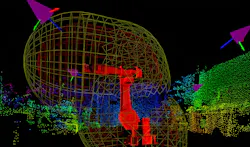
At the center of this virtual environment sits a 3D CAD model of the robot itself. Based on orientation data reported by the robot controller, the SR-1’s edge computers calculate the robot’s kinematics and update the virtual robot to match the path of the physical robot in real time.
With this 3D stage set, the system is then configured to designate one or more virtual 3D safety zones, defined by bubble-shaped regions encompassing the virtual robot arm and end-effector. The innermost volume, closest to the robot, defines the Stop zone, the size of which is based on a speed and separation monitoring calculation. When the ToF cameras perceive a person or other unexpected object (represented in the system as a 3D point cloud) entering the virtual “airspace” of the inner safety zone, a stop command is sent to the system’s safety PLC controller. The robot automatically resumes operation as soon as the person or unexpected object leaves the software defined safety zone.
According to the company, SR-1 detects objects as small as 2 in./50mm in diameter, moving at speeds up to 2m/sec. with a reaction time of 250ms.
A second outer slow zone can also be programmed into the system such that if a person enters this space, the robot will slow. This zone enhances safety without initiating a full downtime event, Gigas says, while also reducing the wear-and-tear imposed by a sudden hard stop. As a result, he says, SR-1 not only reduces space requirements versus traditional hard guarding by 30%, but also shaves minutes off the traditional robot shutdown/restart procedure.
“Instead of going through the process of getting the key, unlocking the gate, getting permission to enter, shutting the operation down, and making a correction at the robot, I can just walk to the robot,” he says. “Our SR-1 system sees me there, the robot stops and I make my correction. When I walk out, the robot resumes operation. That’s a massive time savings when you aggregate the number of cell entries per shift, cells per a manufacturing plant and the number of plants globally.”
In addition to saving time and floor space, Gigas points out that, given its virtual twin inner workings, SR-1 is hardware agnostic, in that it isn’t tied to any specific robot vendor or handful of models. It can also be integrated into an existing robot installation. In fact, it isn’t limited to only robotic arms. The company is currently in the process of adapting its fenceless guarding approach to AGV/AMR with robotic manipulators (i.e., SR-Mobile) and press brakes (i.e.. SR-Press).
The system is also highly adaptive to change or expansion, he says. If a robot cell is reconfigured, for example, changing the guarding configuration can be done relatively quickly in software rather than having to reassemble and re-configure physical fencing, light curtains, scanners, etc. The same goes for expansion, as one SR-1 system can be configured to monitor up to three robotic arms at once, provided there are sufficient additional ToF cameras to monitor the entire space.
Safety Certified
Of course, for plant owners, shop floor personnel and insurance adjusters, how SR-1 works is less important than can it be counted on to work. Fenceless safety systems represent a novel approach while hard fencing is an industry norm. Besides, system integrators need to produce detailed risk assessments they can stand behind and no plant owner wants to face an OSHA violation for being an early adopter.
Given those realities, Gigas says Sensory Robotics spent nearly two years making sure SR-1 checked all the safety certification boxes. For example, SR-1 meets ANSI/RIA R15.06 and ISO 10218, and has been certified PLd Category 3 under the ISO 13849 standard. In May 2026, SR-1 also received cULus Listed certification (UL 1740), making it the first fenceless safety system, Gigas says, to achieve both functional and product safety certification.
“That has unlocked a lot of opportunity because we’ve had a lot of Fortune 50 customers that have tested [SR-1] in their labs,” Gigas says. “I’d get two calls a week from them asking ‘did you get certification yet?’ because once it was approved, they were good to buy.”
To achieve those certifications, SR-1 was built around a series of redundancies, he says. For example, each ToF depth camera’s field of view overlaps with the ones next to it, such that any one point in the monitored work cell is “seen” by at least two cameras. Similarly, the data from each ToF camera is fed to a primary and secondary edge computer. If the sensor data from two or more cameras don’t agree as to what is being perceived, then the system shuts the robot down as a precaution.
RA Drift
No matter how clever the technology or thorough the certification, automation equipment and the way it’s used in production often develop gaps between initial operation assumption and real-life performance. Motors begin to wear, payloads and speeds change and/or pressured operators and maintenance crews employ “out-of-policy” safety system workarounds.
To address this inevitable risk assessment drift, Sensory Robotics provides a subscription add-on to SR-1, called SR-Insight. Based on SR-1 data, the monitoring service logs events that fall outside approved risk thresholds to spot safety issues and help diagnose the root causes of unexpected downtime, Gigas says.
“SR-Insight can tell you if your risk assessment broke because maybe the robot's running faster than it should be, or more people are in the cell than should be, or maybe somebody pushed a new piece of furniture, a conveyor or something else that wasn’t supposed to be there. SR-Insight monitors thresholds in your risk assessment and reports back in real time.”
Although SR-Insight isn’t an mandatory part of SR-1, it may be one of the machine guarding system’s most critical components, since it addresses the ever present tension in manufacturing between keeping workers safe on the one hand and preserving production rates, on the other. One of the challenges of designing tradition machine guarding is foreseeing how personnel might try to defeat safety measures in the name of efficiency.
Physical fencing, therefore, not only protects factory floor personnel from the robot but it's also deters workers from interfering with the robot. Without a physical barrier, then, workers may find it too easy to, intentionally or unintentionally, cause a downtime event within an SR-1 guarded robot cell. In robotic safety, false positives are highly preferable to false negatives, but too many of them could spark adopters to return to historical practices.
While Sensory Robotics’ technology has been safety certified in all the ways that matter to the industrial market, it presents a significant departure from established industry practice. Setting the capabilities of the technology aside and the reliability that UL Listed/PLd certification attest to, there’s still the psychological factor and institutional inertia for the startup to overcome. Building technological trust in manufacturing is notoriously slow to build, often with good reason.
Now that Sensory Robotics has received the certification green light to scale from proof-of-concept to full production, it will be interesting to see if the disruptive new approach to machine guarding takes off or is consigned to the long history of clever concepts that couldn’t quite capture market acceptance.
More content from Takeover Week: Automation & Robotics.
About the Author
 Mike McLeod
Mike McLeod
Senior Editor, Machine Design
Mike McLeod, senior editor of Machine Design, is an award-winning business and technology writer with more than 25 years of experience. He has covered the full spectrum of mechanical engineering, from industrial automation, aerospace and automotive, to CAD/CAE, additive manufacturing, linear motion and fluid power.
Voice Your Opinion!
To join the conversation, and become an exclusive member of Machine Design, create an account today!
 Leaders Logo
Leaders relevant to this article: