The Right Tool for the Job: Practical Advice for Cobots, Physical AI and Robotics Integration
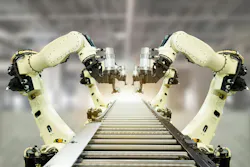
In a recent Machine Design webinar, robotics industry veterans, Ben Perlson, director of consumer industries with ABB Robotics, and Aaron Prather, director of robotics and autonomous systems at ASTM International, addressed the lingering financial and technological barriers to adopting robotics in the U.S. and the strategies industry can employ to address them.
The following is an excerpt of that longer panel discussion in which Perlson and Prather discuss the common pitfalls integrators and end-users can fall into with industrial robotics, ANSI and ISO’s deprecation of the term “cobot” in favor of “collaborative application” in standards specifications and a grounded assessment of the impact of physical AI.
Machine Design: Are there common mistakes the machine builders and end-users make that undermine or unnecessarily stretch out the return on investment of robotics?
Ben Perlson: There are, and to many people’s surprise, very few of those actually have to do with the robot themselves, which are a fixed cost that’s easy to calculate. The key mistakes we see integrators or end customers making is trying to automate on a broken process and not understanding the peripheral integration. For example, the robot is a core part of the cell; it’s only one part. There’s still a lot of added cost or complexity if it’s not properly planned or mitigated around. Things like safety guarding and PLC logic integration can very heavily and quickly impact the overall cost of the project.
In addition, customers we work with are naturally focused on a certain product or process today, but they need to also be planning for what the next month, quarter and year are going to look like. Creating automation solutions that are very rigid oftentimes puts a customer in a very bad or tough position relatively quickly because they don’t have the flexibility to adapt like they were hoping to, just by deploying robots
Aaron Prather: I fully agree. It’s always the things you don’t see. That’s why it’s really key, when you are planning these out, to ask questions, such as how does the robot change the bigger system? Sometimes you have a good idea of where those changes might happen but sometimes something gets missed and now you have to adjust. But, if you do the homework early on, you probably would have seen that. The biggest thing is, you have to be open and honest in the pre-planning stage because you’re about to change one piece and that could impact everything.
MD: In 2025, Ansys and ISO revised their safety standards—in effect, deprecating the term cobot, at least in a regulatory sense. Does this shift from collaborative robot as a product type to collaborative application complicate things or does this mean that many more robots can be collaborative in a sense?
AP: The reason we requested ANSI and ISO do this is that it was just getting really confusing for end-users. Just because you buy a cobot doesn’t mean you’re putting it in a collaborative application. One of the worst things I always hate seeing is a collaborative robot put in a cage because of what it was handling. [The change in the safety standard] is a way of ensuring customers are buying the robot that they need. What we wanted folks to really focus on is their application and what they’re trying to do, then match the robot and all the other tech you need.
Of course, that goes against sales, and that’s where I think we got a bit of pushback, but the whole thing is this was to just make sure folks are getting the right robot for the tasks that they they’re trying to automate. We also we want to build confidence in the market. For example, telling a CEO he paid twice as much for a robot because he put it in an application he didn’t need to, that’s going to hold back future installs pretty quickly. If anything, [the change to the safety standard] was medicine we had to give the industry to make sure the end results were positive.
It does now also give some leeway in how you create a collaborative application going forward. So we actually gave innovation back to the marketplace. We are trying to make it where there’s new pathways for that, because ultimately the question out there now is, is a humanoid a collaborative robot just walking around? I don’t know, but at least we’re getting the conversation going.
BP: Cobots have been an incredible branding tool and also a great tool to get people familiar, excited and comfortable with the idea of robots. We get a tremendous amount of leads and interest in collaborative robots, but after no more than a couple questions or a few minutes of exploring that opportunity, we’ll quickly find that an application is better suited for an industrial robot, due to it’s speed, force, limiting sensors or whatever is required.
I think the key is, and why I was really excited about that new ANSI and ISO standard, is it puts a bit more responsibility on integrators to look at a system holistically and not just as a robot in a vacuum. To quote Aaron, if you give a collaborative robot a butcher’s knife to cut fruits and vegetables, is it still collaborative? Is it still safe? I use that example so often because it so clearly articulates the idea that a robot in a vacuum does not fully encompass all of the safety considerations and requirements that go into creating a safe, efficient and functional cell.
MD: What is your feeling about the state of physical AI applied to robotics, in terms of where the technology is and what its potential is?
BP: Physical AI is a major step forward in allowing us to be more flexible and adaptable in the types of solutions that we deploy and see solutions be successful and have a positive return on investment. But it’s not a silver bullet. The same way that collaborative robots are an application alternative to industrial robots, physical AI also has its applications.
However, that doesn’t rule out the deterministic automation common in assembly lines or pick-and-place—application where there’s a known start and end, and product is presented in a continuous manner. Physical AI, or embodied AI, is really what’s allowing us to automate less-than-perfect environments in a positive way, rather than everything always having to be precisely oriented and placed or the entire process just implodes.
AP: Ben has hit on something in that physical AI follows collaborative robots in a way. The first question anyone should ask is: Do you even need it for your application? Is there enough special need around your use case that having a layer of physical AI in there is really going to clear it up? If you’re simply moving the same part from here to here to here over and over again, just call it a day.
You don’t need [physical AI]. If anything, it’s just going to be part of a thorough analysis of your use case and how you’re going to build your application. If you need it, get it; if you don’t need it, don’t spend the money on it if you’re not going to gain anything. [Physical AI] is going to open up the next layer of robotics use cases, so it is huge. But don’t think it’s going to go back and address things that we’ve already solved.
Editor’s Note: For the complete discussion, check out Machine Design’s webinar, Overcoming the Barriers to Robotics Adoption.
More content from Takeover Week: Automation & Robotics.
About the Author
 Mike McLeod
Mike McLeod
Senior Editor, Machine Design
Mike McLeod, senior editor of Machine Design, is an award-winning business and technology writer with more than 25 years of experience. He has covered the full spectrum of mechanical engineering, from industrial automation, aerospace and automotive, to CAD/CAE, additive manufacturing, linear motion and fluid power.
Voice Your Opinion!
To join the conversation, and become an exclusive member of Machine Design, create an account today!
 Leaders Logo
Leaders relevant to this article: