Wiferion CW1000 Charging System Enables Contactless Charging for AMRs and AGVs
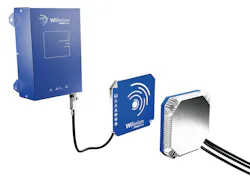
As autonomous mobile robot (AMR) and automated guided vehicle (AGV) deployments continue to grow, reliable energy management has become essential for maintaining uptime and productivity. Wiferion, a PULS brand, addresses this need with the CW1000, a compact 1 kW inductive charging system designed to provide automated, contactless power for mobile robots operating in industrial environments.
The CW1000 delivers up to 1 kW of charging power and supports battery systems from 15 to 60 V with charging currents up to 42 A. Designed for direct battery connection, the system simplifies integration into both new and existing robot fleets. The company reports charging efficiency of up to 93%, which helps reduce energy losses while lowering overall operating costs.
One advantage of the CW1000 is its support for opportunity charging. Instead of sending vehicles to dedicated charging stations, charging pads can be installed at strategic points throughout a facility, allowing robots to recharge during short pauses in operation. This approach minimizes downtime, enables near-continuous operation and can increase vehicle availability by up to 32%. The system's compact footprint and plug-and-play design make deployment straightforward. Charging pads can be installed in high-traffic areas without major infrastructure modifications and relocated as workflows change. A positioning tolerance of ±30 mm and an operating distance of 5 mm to 30 mm reduce alignment requirements. This allows robots to approach charging points from multiple directions.
Intended for around-the-clock operation, the CW1000 requires no routine maintenance and avoids the wear associated with physical charging contacts. Compatibility with multiple battery chemistries allows it to support a broad range of AMR and AGV platforms, including mixed fleets. The system is UL and CSA certified for use in the United States and Canada. Wiferion says the charger can reduce required battery capacity by up to 30%, helping cut battery-swapping requirements, reclaim onboard space and lower total cost of ownership.
The CW1000 offers manufacturers a practical charging solution designed to maximize robot availability while simplifying fleet energy management.
About the Author
 Rehana Begg
Rehana Begg
Editor-in-Chief, Machine Design
As Machine Design’s content lead, Rehana Begg is tasked with elevating the voice of the design and multi-disciplinary engineer in the face of digital transformation and engineering innovation. Begg has more than 24 years of editorial experience and has spent the past decade in the trenches of industrial manufacturing, focusing on new technologies, manufacturing innovation and business. Her B2B career has taken her from corporate boardrooms to plant floors and underground mining stopes, covering everything from automation & IIoT, robotics, mechanical design and additive manufacturing to plant operations, maintenance, reliability and continuous improvement. Begg holds an MBA, a Master of Journalism degree, and a BA (Hons.) in Political Science. She is committed to lifelong learning and feeds her passion for innovation in publishing, transparent science and clear communication by attending relevant conferences and seminars/workshops.
Follow Rehana Begg via the following social media handles:
LinkedIn: @rehanabegg and @MachineDesign
YouTube: @MachineDesign-EBM