Designing with Elastomer Tubing: Fundamentals Engineers Can’t Afford to Overlook

Elastomer materials are found in countless applications around the world. From medical devices, food and beverage delivery components, and sports and leisure items to laboratory testing, industrial pumps and circuits, elastomer materials serve a wide variety of functions that are essential to modern, everyday life.
Few components better illustrate this than tubing. Whether intended for single-use format or as part of an application requiring repeated use throughout service life, tubing is broadly used for fluid transfer in a range of applications.
While it can be easy to view elastomer tubing components as a simple commodity, many specialized and more demanding applications require a higher level of performance and quality—and should be evaluated through every stage of machine design.
In this article, we explore the necessity of firmly establishing the intended functionality of tubing, highlight how material behavior directly affects component function and examine the qualities to seek when sourcing tubing, regardless of industry.
Start with Intent
Tubing selection begins with understanding the application’s requirements. That may sound obvious, but the varying characteristics of elastomer tubing can make a difference in functionality and long-term performance.
Consider the following:
- Does the tubing need to bend or stretch to accommodate its intended function?
- Does it require elasticity, while consistently returning to its initial shape?
- Must it resist tearing and abrading from daily use, or is it intended only for single-use application?
- Will it need to withstand sterilization without degrading its performance?
- Will the tubing come into contact with different chemicals and, if so, will it need to provide the required level of chemical compatibility?
- Does the tubing need to protect against contamination in critical fluid-transfer applications?
- Will it be exposed to high or low temperatures, and can it maintain performance under these conditions?
These are just a sampling of the questions that product designers and engineers should ask in the initial design phase of critical applications. The answers will help guide design specifications when collaborating with tubing suppliers. Operational reliability and end-user safety depend on it.
Material Choice Matters
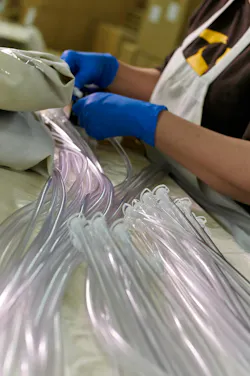
Regardless of the application, tubing should be selected from optimal materials that meet the functional and performance requirements of the device, equipment or process. Among the most common options are polyvinyl chloride, thermoplastic elastomer and natural rubber latex—each of which demonstrates varying characteristics that must match the application.
A quick breakdown is as follows:
Latex. Latex has historically been one of the most reliable workhorses for tubing applications. The material delivers high elasticity, superior flexibility and tear resistance, making it ideal for applications that require high levels of reliability and durability.
Manufacturers can make latex tubing to tight tolerances, making it an ideal material choice for exacting applications such as orthodontia bands, exercise resistance bands, marine spearguns and some medical applications.
Thermoplastic elastomer (TPE). TPE offers several qualities that machine designers can take advantage of. First, it is easy to sterilize and offers excellent cleanliness properties, making it an exceptional choice for the biopharmaceutical, medical, and food and beverage industries.
Additionally, TPE products are naturally latex-free, making them ideal for applications where they may come into human contact, alleviating safety concerns for individuals with latex allergies or sensitivities. TPE also mimics many of natural rubber’s most desirable properties, including flexibility and a soft feel, which can contribute to ergonomic benefits in certain applications.
TPE can also be deployed in applications that may experience harsh operational conditions. For instance, it is far more resistant to heat and chemical exposure than natural rubber, making it a more stable, durable material choice in certain applications.
Finally, TPE material demonstrates excellent elasticity, flexibility and elongation properties, and depending on the compound, TPE products can also offer good tensile strength and tear resistance.
Polyvinyl chloride (PVC). PVC is a lightweight, versatile and durable material that is commonly used for a variety of applications. When an application requires stability, outstanding tear resistance, corrosion performance, weather resistance, chemical compatibility and impact performance, PVC typically represents a strong choice for designers.
PVC tubing features outstanding flexibility and clarity, making it a good candidate for a wide range of medical applications. It also lends itself to solvent bonding for assembly, eliminating the need for mechanical fasteners.
Like TPE, PVC tubing is also suitable for applications where natural latex protein allergies are a concern. However, because flexible PVC relies on the inclusion of plasticizers in its formulation, the material is not suitable for use in the medical space for implants or long-term patient contact.
Customization Capabilities
Once you’ve identified the material options best suited for your application, there are other factors to consider. For instance:
Inner and outer tubing diameter (ID and OD) tolerances can be key to the functionality of your application. The size of the application, required flow and pressure for fluid transfer and other factors may influence the required ID or OD of your tubing.
For example, tight tolerances and precision are critical in medical and laboratory settings. These are factors that should be considered and specified in the design phase; it’s the job of your tubing partner to meet exacting specifications.
Visual appearance can matter as well. Some processes that rely on elastomer tubing may involve periodic visual checks for quality control. The color and clarity of your tubing is critical in such instances. You may also be able to take advantage of an easy branding opportunity: Experienced tubing manufacturers offer custom printing options on their tubing to make your equipment more identifiable. Such distinctions can also help ensure application accuracy and product differentiation.
Sourcing Quality Materials from Reliable Manufacturers
Considering some of the critical applications that elastomeric tubing may be used in—including medical and food and beverage equipment—the stakes are high when it comes to sourcing. Subpar materials can lead to compromised functionality and potential safety issues for end users in a worst-case scenario.
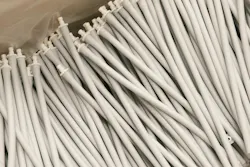
All of this means that quality is one of the most important characteristics to seek out when sourcing tubing, no matter the specific material choice. And high-quality, high-performance tubing isn’t produced by accident—reliable components are the result of sound manufacturing practices, material expertise and collaborative alignment with your expectations.
READ MORE: MedTech Robotics: Motion Plastics Transforming Automation & Cleanroom Design
These are some of the factors to look for when vetting outsourcing partners, but it might be hard to discern which potential suppliers can meet them and which do not. To those ends, tubing producers serving high-stakes markets should generally adhere to certain industry standards that govern specific procedures and expectations. Among them:
- ISO 13485 is the medical device industry’s quality management system standard, and compliance with the standard is preferred for medical tubing applications. It helps ensure medical devices are manufactured with suitable quality controls and is an important validation for component suppliers serving the medical industry.
- The U.S. Food and Drug Administration (FDA) sets standards for food-grade materials as a part of the FDA’s Food Safety Modernization Act (FSMA). These standards help to ensure that tubing (and other components) meets safety requirements for a specific application. When sourcing tubing components, it’s important to be sure the materials of construction appear on the FDA’s list of approved materials for food contact.
Designing for Performance
Elastomeric tubing is a critical element in machine designs across a broad range of industries. Intended use, material choice and quality construction should be machine designers’ guideposts when specifying tubing materials for any application. These considerations can determine whether the system performs reliably throughout its service life or fails prematurely.
About the Author
 Brian Lipowski
 Brian Lipowski
Director, Quality, Regulatory and Technical (QRT) Services, Kent Elastomer Products
Brian Lipowski became director of quality, Quality, Regulatory and Technical (QRT) Services at Kent Elastomer Products in October 2022. He has a track record of proven leadership and works to build the credentials of KEP’s QRT team. Lipowski brings valuable experience from the automotive and medical markets and will continue to expand KEP’s service to clients reacting to regulatory changes that address validation, material requirements and specifications—all critical issues in heavily regulated industries.
Voice Your Opinion!
To join the conversation, and become an exclusive member of Machine Design, create an account today!
 Leaders Logo
Leaders relevant to this article: