Reclaiming Mobility via Technology
When people think of technological advances in the medical field, marvels like 3D-printed skin and bionic legs probably come to mind. But less sci-fi-oriented design concepts also play a significant role in restoring lost mobility.
Take the simple wheelchair. In 1962 Ernesto Blanco was given $5,000 from the National Inventors Council for his wheelchair design, according to NPR.com. Rubber-tipped spokes would extend from the wheel’s rim, allowing the wheelchair to climb stairs. In 1990, Dean Kamen (inventor of the Segway) started working on a multi-wheeled chair that would offer greater mobility with stairs and users to stand. Kamen’s chair debuted in 1999, but was discontinued due to its high cost in 2009.
In 2016, Toyota became interested in the machine’s balancing technology; it is said to re-debut this fall according to NewMobility.com. However, power wheelchairs aren’t always needed; self-propelled devices can help users stay in shape. Unfortunately, a common problem among wheelchair users is that they are inefficient and place physical stress on the user’s hands and arms. The typical propulsion method of using one’s arms to rotate the wheels is unnatural and puts a significant strain on the human body.
A More Efficient Chair
An article from Medical Design earlier this year introduced two new wheelchair designs for increasing efficiency while attempting to keep cost and complexity to a minimum. According to Dr. Claire Flemmer, a professor at the School of Engineering and Advanced Technology at Massey University, “Manual wheelchairs require an inefficient push effort, where the user grips either the wheel or a slightly smaller rim on the outside—called the pushrim—and propels the chair forward by pushing the rim until they are forced let go and repeat the action…This means only about 25% of the action actually contributes to the chair going forward.
“This method causes an imbalanced repetitive strain on the shoulders and wrists that can lead to chronic pain,” she continues. “The longer a person uses the manual wheelchair, the worse it gets.” In attempts to alleviate these pains, engineers have taken to redesign the modern wheelchair with ergonomic features.
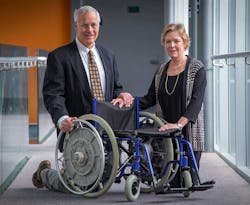
Drs. Roy and Claire Flemmer designed the Ezy-Wheels wheelchair to help reduce the strain on the human body. The chair employs a three-gear system which is driven with a push-and-pull movement, allowing the operator’s hands to never have to leave the pushrim. (Credit: Massey University)
Ezy-Wheels is a new wheelchair design from Flemmer and her husband, Dr. Roy Flemmer. It employs an innovative propulsion method that allows the user’s hands to stay on the pushrim. The new design improves upon stroking efficiency by using 100% of the total arm movement and looks to minimize chronic shoulder and wrist problems, as well as making it easier to travel uphill.
The basic movement of the new chair design requires the user to push and pull on the pushrim. The advanced gear system in the chair allows for this movement and always lets the user keep their hands on the pushrim. The chair employs a three-gear system much like a bicycle—high gears for flat or downhill and low gears for uphill or difficult paths. Additionally, there is a run mode that prevents the chair from rolling backward when on a slope.
Another professor using bicycle like design in wheel chairs is Margit Gföhler from the Institute of Engineering Design and Product Development at TU Wien University. “The motion sequence when using a wheelchair is usually quite unnatural,” explains Gföhler. To change the motion of wheelchairs, the research team developed a biomechanical computer that analyzed various motion sequences of the upper human body.
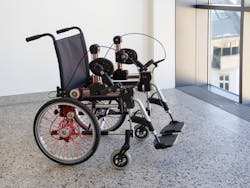
The hand gear wheelchair design from TU Wein University was created after a biomechanical computer model analyzed the human body’s upper movements. The result was a wheelchair design operated via hand gears mounted on the armrests. (Credit: TU Wein University)
The computer determined that the best motion sequence resulted in a mechanical drive system driven by two hand gears. During each revolution, the levers change their length creating an egg-shaped movement in comparison to a circular one. The hand gears are mounted on the wheelchair’s armrests and drive the rear wheels via a toothed belt. This allows for a more compact design with smaller wheels, making it suitable for everyday indoor use.
With these new chair designs coming soon to market, users of wheelchairs will be able to enjoy more efficient systems of maneuverability.
Beyond the Chair
With more attention from organizations like the Paralympics and design engineers, athletes with limited mobility are seeing new opportunities for serious competitive endeavors.
Like every competitive racing athlete, Christopher Young stays acutely attuned to his equipment. But his racing career could come crashing down at any moment if his sled malfunctions. “My life, literally, depends on the machine not breaking,’’ Young said. “There are some places on ski slopes where falling is not an option. If you fell, you would go off the cliff—it’s the end, goodbye.”

Chris Young, one of the world’s most accomplished Paralympic skiers, has been using adaptive skiing equipment manufactured by DynAccess for the past seven years. (Credit: Joe Kusumoto Photography)
After being injured in a plane crash in Alaska in 1982 while serving in the United States Coast Guard, Young was left paralyzed from the knees down and partially paralyzed below the waist. Later, he was introduced to skiing and racing at a Veterans Administration Winter Sports Clinic and is now a five-time member of the U.S. Paralympic team and a multiple Paralympic medalist.
As an adaptive skier who reaches speeds of 70 mph, Young relies on his monoski to keep him competitive and safe. For the past seven years, Young has been using equipment made by DynAccess Ltd., a Pennsylvania business that designs and manufactures outdoor equipment for physically challenged individuals and athletes. Joachim Grenestedt works as the chief engineer and product designer for DynAccess, while his wife, Channy Tokura, runs the business side.
Developing the Monoski
Grenestedt had used his engineering expertise to design land speed racers, boats, and aircraft. He turned to designing monoskis when a former student was injured in an accident and lost the use of his legs. While watching his student, Grenestedt noticed a number of the monoskis were broken. “I believed we could design and manufacture a better sled,’’ he said. Tokura started DynAccess Ltd. in 2011 after receiving a Technology Transfer Grant from the Keystone Innovation Zone.
A monoski consists of a bucket seat and a stiff and strong frame with suspension mounted to a single ski. To make sure monoskis are durable, adjustable, and responsive, DynAccess uses shock absorbers specifically developed for monoski applications. All of the shocks are hand-built by Penske Racing Shocks technicians to order, and they all undergo dyno-testing.
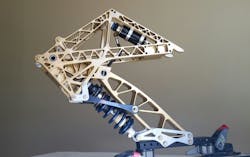
The Hydra 2 monoski is one of four models manufactured by DynAccess, an eight-year-old Pennsylvania company. The monoskis include plastic bearings manufactured by igus that are maintenance-free and corrosion-resistant. (Credit: DynAccess, Ltd.)
Besides the shock absorbers, some other key components on monoskis are flanged bearings. It is important to consider ambient conditions, which for skiing should take into account high compressive strength, low moisture absorption, and temperature. These materials properties can also be found in bearings frequently found in woodworking, aerospace engineering, plastic processing, and beverage technology and iglide T500.
“We tried other components and they worked fine, but the igus products have worked better,’’ Grenestedt said. By finding industrial parts to troubleshoot a recreational product, DynAccess believes it is able to help all skiers.
On the slopes and off, Young’s physical challenges give him the perspective to know when engineering and technical expertise work together to improve his quality of life and athletic performance.
3 Flying High with 3D Printing
Part of design is finding the best solution. Often, simple solutions that minimize moving parts and complexity work well. While 3D scanning and printing can develop advanced prosthetics, it isn’t limited to complex parts. When Italian police officer Mattia Negusanti lost his left arm in a car accident, his focus was not on replacing the complexities of an arm, but accomplishing one objective: flying a plane safely. The solution was a 3D-printed flight control device which eventually let him obtain his pilot license.
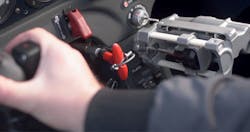
The servo is able to move the throttle linearly. This doesn’t seem complicated, but the user experience is imperative to this design. The speed at which the buttons on the yoke respond to moving the throttle may be a concern. Additionally, having the input from an experienced pilot to the speed the motor and gearing is able to move the throttle could be imperative to changing flying conditions.
“The day I started working again after the accident, I arrived at my new job at the Ministry of Defense and General Filoni, a flight instructor, proposed me to fly with him,” Negusanti recollected. “I said: ‘Comandante, I’ll come along and, if I like it, then we have to find a way to get me to fly a plane myself.’” Despite encountering some initial skepticism, Mattia obtained medical approval to fly and joined the flight school at the Aero Club Fano.
However, operating a plane with one hand can prove difficult. While holding the control wheel or yoke a pilot must also adjust the throttle that is on the dash and operated by hand. After approving the ServoFly device on August 3rd, Mattia passed the VDS flight exam. Today he can fly safely using only one arm.
About the ServoFly
At a glance, the ServoFly looks like it is a metal 3D-printed housing made in multiple parts. This was probably done so it is easier to add other parts into the assembly that can’t be printed or might see wear. This is common in design strategy; just because something can be printed in a single assembly doesn’t mean it should.
When designing for 3D printing remember maintenance, fatigue, and the fact that parts break. If a part in an assembly undergoes wear, it will need to be replaced over time. If that part is integrated into an entire 3D printed mass-part, the whole part will need to be reprinted. Reprinting a metal 3D printed parts can be costly, so it is critical to have a plan for parts to easily be replaced.
The part was the initial idea of designer Paolo Picchi and his cousin Davide. They presented their seemingly crazy project to Valeria Tirelli, CEO of Aidro. Without hesitation she had the company print a metal housing and Leo Cantergiani founder of TecnoElettra Impianti srl, a company leader in wiring and electronic systems for Formula 1 and Moto GP, created the electrical part of the actuator that carries all the main controls on a joystick.
The 3D printed device is unique and has been customized to meet Mattia’s disability, but it is also a “plug & fly” piece of equipment, that is easy to install on the cockpit of the plane. The ServoFly is attached to the bar without requiring any modification to the aircraft, which therefore did not have to undergo further revisions and certification processes.
If you design bearings, shocks, 3D printers, or other parts, remember—you might not know where your work might end up and who it might help. Engineers often don’t see how their designs help people. Often, it’s indirectly through a bridge, road, or something even further behind the scenes. Overall, good engineering will help extend human abilities, even if they aren’t as visible or direct as these stories. If you have an interesting design story of our own, feel free to tell us about it. E-mail [email protected], and in the subject line put Engineering Stories.

About the Author
Jeff Kerns
Technology Editor
Voice Your Opinion!
To join the conversation, and become an exclusive member of Machine Design, create an account today!
 Leaders Logo
Leaders relevant to this article: