The New Autonomous Mobile Robots Move Beyond Hydraulics with Electric Lift and QDD Motors
Key Highlights:
- AMRs are now utilizing AI and advanced sensors to perform complex motions, including obstacle detection and omnidirectional movement, enabling safer and more efficient operations.
- Design innovations include ultra-compact, electric-driven systems like Filics and Toyota's Walk Me, which balance stability and agility without hydraulics.
- The rapid development of AI reinforcement learning has compressed years of hardware testing into weeks, accelerating the deployment of intelligent, adaptable robots.
Enjoying Machine Design’s Motion Control content? Be sure to check out the rest of our Takeover Week coverage here.
There’s an AMR design revolution happening right now, with exciting developments emerging every month. New designs, components and the use of AI in design is enabling the new AMRs (autonomous mobile robots) to carry out unprecedented types of motion.
As ABB Robotics President Marc Segura has stated, “we’re in a new era of robotics innovation. Robots that can do more things, in more places, and do it faster, safer and smarter directly open the door to greater productivity and eliminate the need to invest in specialist skills or infrastructure.”
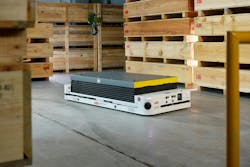
Segura was in part referring to the lifting and transport of pallets in manufacturing plants, construction sites and warehouses, for decades the domain of forklifts that require specialist skills for operation. Over the past decade or so, it’s true that more compact and maneuverable versions of forklifts have emerged, along with autonomous models (AMRs by any definition) such as the OTTO Lifter, Vecna AFL and the FoxBot ATL. These AMR forklifts, however, have now gone compact, to the extreme.
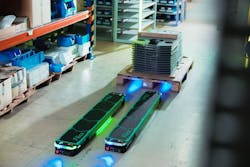
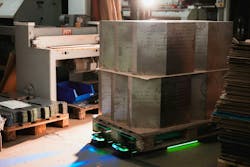
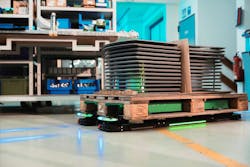
One example is the ABB Flexley Mover P604, which has 3D visual simultaneous localization and mapping navigation. Another is the Filics, a set of two synchronous robotic skids that can lift and transport pallets of up to 800 kg at up to 1.2 m/s using laser navigation (including obstacle detection) and an omnidirectional drive.
Based in Germany, Filics is exploring the European market, with plans to go international in a few selected European markets by the end of this year, according to Marketing Lead Florin Wahl.
Lifting Pallets and More
Rather than using hydraulics, the small-but-mighty Filics lifting system is electric, and described as “rather simple,” by the engineering team at Filics.
“The challenge was the extreme limits in terms of space,” Wahl says. “Each robot skid has two lifting modules that need to share its space with the driving modules, battery, electronics and sensors. Since we only lift high enough in order to look ‘under’ the pallet (for the laser scanners, localization and safety), it is just 90 mm.”
Filics is unveiling design updates at the international logistics show, LogiMAT 2026, in March. The new version is even lower, more compact and the lifting modules are more robust. In addition, a new arrangement of the laser scanners increases the field of view, enabling more reliable localization and higher speed of motion.
Electric Actuation
Rather than pallets, the Toyota Walk Me transports people (with more possibilities potentially in its future).
Its motion system is unique, enabling it to keep balanced and steady on slopes, uneven terrain and up and down stairs. Like a tall crab on a rocky beach outcrop, the Walk Me has a four-legged motion system with each leg independently adjusting in real time in a variety of directions and heights to ensure level, balanced, controlled motion of the entire unit.
Sensors and LiDAR systems provide obstacle and terrain detection—even the edges of a rug or another difference in terrain change, such as pavement to gravel. No major motion is initiated if the seat weight sensors detect the user is not centered.
READ MORE: AI Takes Center Stage at Hannover Messe 2026 Preview
To control the unit, users can either manually steer using controls on the sides of the seat or use verbal commands such as “washroom” or “faster.” When storage or transport of the unit is required, the legs fold down within about 30 sec.
Like the Filics, the Walk Me motion system has no hydraulics. Instead, the legs rely on electric actuation via compact Quasi-Direct Drive motors.
Takuya Watabe, assistant manager at Toyota Motor Corporation’s Advanced Design Development Department (ADDD) in Japan, says that “while we cannot disclose direct benchmarking data against conventional [hydraulic] systems or the proprietary mechanics of our posture control architecture at this time, our ongoing R&D remains heavily focused on the precise, coordinated control of these four legs to deliver unprecedented ride smoothness and mobility versatility.”
AI Speeds Timeline
The development of Walk Me was completed in only 10 months. That is astonishing—involving the integration of an onboard AI system making real-time adjustments of the innovative four-legged motion system, with the AI also processing data from sensors/LiDAR about its surroundings and also responding to user commands, all to continuously maintain stability and conform to ongoing operational commands.
Watabe explains that the traditional timeline for such a feat would traditionally span at least three years of hardware and control system engineering.
“The catalyst for this rapid development was the concurrent engineering of our hardware and AI reinforcement learning models,” he notes. “By applying reinforcement learning to the most computationally-demanding aspects of locomotion—specifically dynamic postural stabilization and real-time adaptation to unknown terrain—we compressed what would normally take years of physical trial-and-error data collection into a matter of weeks.”
READ MORE: More Design and Automation Highlights from MD&M West 2026
However, they also had other goals for the use of advanced AI in the design, beyond achieving mere mechanical stability. “From a design philosophy standpoint, we engineered the mobility device to exhibit ‘emotive kinematics’—moving with intention,” Watabe says. This gives the Walk Me a feeling of being a partner in movement, to both users of the unit and observers.
“For example, the precise way the device lowers its center of gravity to welcome a user, or the kinematics of its compact fold-for-storage, is rooted in Omotenashi (traditional Japanese hospitality), reminiscent of a ryokan hostess respectfully bowing to greet guests,” Watabe explains. “Maintaining dynamic stability while executing gestures that feel warm and empathetic, rather than cold and mechanical, was a primary focus for this concept model.”
Inside the Four Legs
From a motion/hardware perspective, the Walk Me legs are continually adjusting many times a minute and very quickly in some cases, all to ensure the unit remains level and stable.
Another ADD assistant manager, Takashi Nishimura, explains that the system also maximizes spatial degrees of freedom. “The rotationally symmetric four-leg chassis autonomously balances and enables omnidirectional movement, including pure lateral translation (strafing) in confined spaces like kitchens,” he says.
Active articulation of the legs also allows for Walk Me to offer dynamic seat height adjustments. This not only facilitates smooth boarding (taking your seat on the unit) but also enables the seated user to be elevated to eye level with people who are standing in the vicinity, “actively fostering equitable communication and removing psychological barriers,” says Nishimura.
READ MORE: A3’s Insights from the Congressional Robotics Caucus
The hardware in the legs is also covered in an innovative manner, explains ADDD Specialist Misako Kawata. “To mask the mechanical joints inherent in legged locomotion, we engineered a custom 3D-knitted textile shell,” he reports. “This fabric stretches organically to accommodate complex leg kinematics. Coupled with our AI-driven locomotion control, it transforms a high-tech machine into an approachable, tactile product akin to modern furniture.”
Kawata adds that “we envision this exterior fabric as interchangeable, allowing users to personalize the device to match their daily style.”
When asked about sensor architecture, LiDAR integration and the potential roadmap for cloud-based topologies like “fleet learning” of Walk Me units, Watabe says these remain proprietary areas of active R&D. He can say that he and his team members “are continually optimizing our edge and cloud data-processing pipelines to ensure consistently safe, highly personalized user experiences.”
Liquid Motion
In looking at AMR motion developments, one would be remiss not to pause at one development that seems lifted straight from the realm of science fiction (think back to the shapeshifting T-1000 in “Terminator 2: Judgement Day”).
About a year ago, a team of scientists in South Korea announced the creation of a new type of robotic motion using a liquid-particle composite with a coating of superhydrophobic particles (named a particle-armored liquid robot). The behavior pushes the boundaries of how engineers imagine robot mobility and adaptability.
The work addresses the challenge of emulating biological forms and functions with robots, the team explains, with “the enhanced deformability and structural stability of our [technology] enabling a range of versatile robotic functions, such as navigating through complex environments, engulfing and transporting cargoes, merging and adapting to various environments.”
These technologies hint at a future where robots can be more adaptive, reconfiguring as conditions command.
About the Author
 Treena Hein
Treena Hein
Treena Hein is an award-winning science and technology writer with over 20 years’ experience.
Voice Your Opinion!
To join the conversation, and become an exclusive member of Machine Design, create an account today!
 Leaders Logo
Leaders relevant to this article: