Bearings in Compact Rotational Design Scenarios
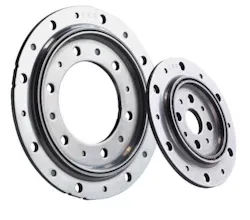
In the design of high-precision machines, correct bearing decisions are crucial. A complete understanding of how bearings differ in stability, rigidity, load capacity and more is needed in order to achieve desired levels of efficiency and reliability.
Both crossed roller bearings and four-point contact ball bearings provide high levels of rotational precision in compact design envelopes and display durability in a wide range of environments. They are therefore found in many of the same applications and sectors. Engineers routinely choose between them in the design of high-performance machinery in machining, vertical grinding and more in aerospace, robotics, CNC equipment and beyond.
To assist in selection, here’s a close look at both bearing types.
Crossed Roller Bearings Basics
Crossed roller bearings feature cylindrical rollers arranged in a perpendicular (criss-cross) manner. This enables them to handle loads in multiple directions, which provides high levels of rotational precision and stability.
They are also particularly suited to situations where space is constrained. As explained by Schaeffler Group USA Inc., “these bearings can support axial forces from both directions as well as radial forces, tilting moment loads and any combination of loads by means of a single bearing position. As a result, designs involving two bearing positions can be reduced to a single bearing position.”
READ MORE: Why Crossed Roller Bearings Dominate Precision Robotics and Automation
Expressed another way, the two sets of races and rollers in a crossed roller bearing, brought together at right angles (with alternate rollers facing opposite directions), “allows two half-rows of rollers to fit into the space of one,” notes Timken. The stability of a two-row bearing is provided in a single-row bearing.
This makes crossed roller bearings “uniquely suited to many pivot and pedestal applications where space is limited or the lowest possible center of gravity of a rotating mass is required.” Timken lists examples such as the table bearing of machine tools, and in vertical boring and grinding machines.
Crossed roller bearings come in extremely small (“super slim”) sizes, as small as 5.5 mm high and 5 mm wide, as well as larger sizes. Some companies also offer high-rigidity designs, achieved with the integration of the inner and outer rings into one structure.
There are also split outer ring and split inner ring formats available, as well as customized crossed roller bearings. In the realm of customization, HIWIN suggests that choosing different surface treatments can help address specific environmental requirements.
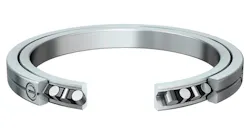
Four-Point Contact Roller Ball Bearings
Four-point contact ball bearings are single-row angular bearings that have four contact points with the raceway. Having multiple points of contact minimizes deflection and movement, enabling high precision.
While the raceways of these bearings support axial loads in both directions, for a given axial load only a limited radial load can also be supported in this bearing type.
However, according to CHG, one of the primary advantages of four-point contact ball bearings is their ability to handle complex loads. “In many industrial applications, machinery is subjected to a combination of radial, axial and moment loads. Four-point contact bearings, with their unique design, excel in managing these scenarios, providing stability and reliability in demanding environments.”
READ MORE: Humanoid Robots: Enhancing Accuracy with Custom Crossed Roller Bearings
According to SKF, four-point contact ball bearings offer a high load-carrying capacity because they incorporate a large number of balls. The outer ring with ball and cage assembly can be mounted separately from the two inner ring halves (the inner ring is split), providing easier installation and removal.
Regarding compactness, SNK Ltd notes that “a single four-point contact bearing usually makes a second bearing unnecessary, which offers a variety of benefits including space, weight and cost savings. It is easier to build, more detailed and requires less upkeep.”
Similarities Summary
So far, we have noted that crossed roller bearings and four-point contact ball bearings share several similarities. They are both very high precision.
Inherently, the rollers roller bearings provide line contact with the raceway. Roller bearings have point contact, which allows them to carry higher loads and achieve greater stiffness under similar constraints—in general.
However, precision performance depends more on bearing design, preload and manufacturing tolerances than on contact geometry alone. Four-point contact ball bearings, as mentioned, have four points of contact with the raceway and a large number of balls, which also enables them to deliver accurate and stable positioning under large loads.
Both bearing types are well-suited to compact applications and harsh environments.
Differences: An Overview
1. Load
Four-point contact ball bearings only support a limited radial load, whereas crossed rollers provide high axial and radial loads. However, four-point contact ball bearings can handle complex axial, radial and moment loads in many instances.
2. Rigidity
Related to load, owing to their unique design, crossed roller bearings provide more rigidity than four-point contact ball bearings because the rollers create line contact rather than point contact. “This helps reduce elastic deflection and improves positioning accuracy under load,” explains the Technical Team at Bearingmaker.com, a precision bearing manufacturer specializing in crossed roller bearings, custom bearings and motion system components for industrial OEM and automation applications worldwide.
3. Friction and Lubrication
Four-point contact ball bearings have less friction (less surface contact) than crossed roller bearings. Due to larger contact area between rollers and raceways, crossed roller bearings therefore often require careful lubrication management, especially in precision or continuous-duty applications, notes the Technical Team at Bearingmaker.com.
4. Preload Sensitivity
Care must also be taken with mounting accuracy with crossed roller bearings to minimize friction and wear. These bearings are typically more sensitive to preload settings, notes the Bearingmaker.com Team, but while proper preload can improve stiffness and running precision, excessive preload may increase torque, heat generation and wear.
Applications
Crossed roller bearings are commonly found in the precision manufacturing and machining industries. Specifically, these bearings provide precision motion control in CNC, grinding and milling machines where smooth and controlled motion is required. CHG Bearing notes on its website that “their ability to handle both radial and axial loads makes them ideal for multi-axis machining centers, where complex movements and forces are common.”
READ MORE: A Gallery of Common Bearings
However, four-point contact bearings are also used in machining and in CNC machines, where spindle assemblies require rigidity and low friction.
Looking at broad sectors, crossed roller bearings and four-point contact ball bearings are both used in robotics, aerospace, defence and vehicle design.
Overall Selection Guidance
Selecting between crossed roller bearings and four-point contact ball bearings requires thorough analysis of engineering priorities. This includes application requirements, speed, rigidity, load direction, available space and service life expectations.
Overall, Bearingmaker.com advises that “crossed roller bearings are often chosen when stiffness and precision are critical. Four-point contact ball bearings are often selected where higher speed, bidirectional axial load support and simplified system integration are priorities.”
About the Author
 Treena Hein
Treena Hein
Treena Hein is an award-winning science and technology writer with over 20 years’ experience.
Voice Your Opinion!
To join the conversation, and become an exclusive member of Machine Design, create an account today!
 Leaders Logo
Leaders relevant to this article: