Why Crossed Roller Bearings Dominate Precision Robotics and Automation
In the accompanying video interview, Machine Design Editor-in-Chief Rehana Begg engages Doug Martin, a veteran SKF mechanical engineer, to unpack crossed roller bearings’ unique design advantages.
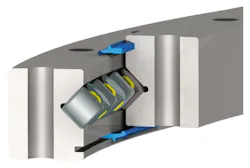
Martin highlighted the unique design of crossed roller bearings, comparing them with conventional rolling element bearings, where rollers or balls align in a single direction, each sharing uniform load efforts. In contrast, crossed roller bearings are 90-deg. angles to each other, said Martin, a mechanical engineer in the bearings industry since 1987.
“One roller has a certain job in one direction, and the other roller has a job in the other direction,” said Martin. “And that gives it one of its unique properties—a single row bearing that is able to do a multitude of tasks all at the same time.” This unique configuration enables a compact, nearly square design, with roller width roughly matching the outer diameter and four races in the running channel (versus two in standard bearings).
READ MORE: Bearing Selection for Linear Motion Applications
The rollers’ interaction with the four races (unlike the points of contact in four-point ball bearings) delivers unique properties. “You’re able to get very good accuracy both in the running accuracy of the bearing itself, but also in its ability to resist tipping moments,” Martin said. “And this is where its special attributes make it a choice for designers who need something that runs very, very accurately, but also something that’s very stiff.”
These unique attributes position crossed roller bearings as a premium choice over standard or four-point contact options, particularly in high-stakes applications where rigid performance is demanded.
Crossed Roller Bearings in Robotics
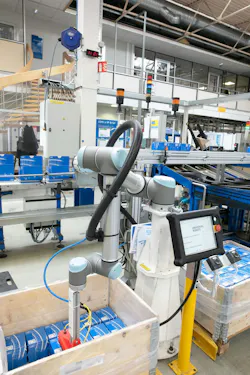
Crossed roller bearings find application in industries where precise positioning and multi-directional load handling are critical. These include robotics, semiconductor and medical imaging applications.
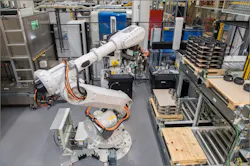
For example, when a moving robot arm needs to place an object in an exact spot, the crossed roller bearing delivers the precision and resistance to moment tipping required to perform the task very effectively. In robotics, preload eliminates elasticity for short-stroke, high-acceleration moves, which ensures repeatability by minimizing deflection and rotation-to-rotation variance—much like preloaded spindles in machine tools, as Martin explained.
Crossed roller bearings are also seeing growing demand in the semiconductor industry. Driven by AI-fueled semiconductor needs, their thin cross-section and low mass make them attractive for efficient, space-constrained automation.
In medical imaging equipment, crossed roller bearings support large-diameter structures that can accommodate a patient’s body. The large bearing supports precisely positioned cameras and sensors for high-resolution imaging.
Trade-offs and Material Impacts
Crossed roller bearings come with a few practical trade-offs that engineers must consider. Roller bearings run warmer than ball bearings, Martin noted. As a result, lube degradation is accelerated and makes selecting the right lubricant for the heat generated is essential. Heavier rollers also demand more torque from the motor than lighter balls to get things moving. While not a deal-breaker, it is a factor in the powertrain design, Martin said.
In terms of materials, ceramic balls offer an edge through weight reduction, while ceramic rollers prove more challenging and expensive to manufacture due to their non-uniform cylindrical geometry.
Crossed Cylindrical vs. Four-Point Contact
A comparison of crossed cylindrical roller slewing bearings versus four-point contact ball options further serve to highlight key distinctions.
“With a cross roller bearing, it’s quite simple,” said Martin. “You’ve got a single row of cylindrical rollers, and they’re alternated at 90-deg. angles to each other. A four-point contact slewing ring, on the other hand, is typically a single row of balls with a raceway that’s ground with two different curvatures—one curvature for load in one direction and the other curvature for load in the opposite direction.”
The disadvantage of the ball bearing is that you just can’t get it to the same stiffness and accuracy. “There’s more elasticity, because the ball is in contact at more of a point, and the point load is higher for a ball than it is for a roller,” Martin explained. “So as the load goes up, you’ve got more force trying to stretch things—so to speak—and you see more deflection.”
READ MORE: How Technology Is Rewriting Backlash and Gearbox Performance
Balls, on the other hand, ease the burden of lubrication through point contact, rolling over the lubricant less and potentially extending lube life. That advantage fades, however, under higher point loads that speed up fatigue.
With a cross-roller bearing, you’re spreading the load over a larger contact area, so you increase stiffness and, generally, fatigue life. The trade-off is that more rolling contact means more lubricant shear and degradation from extended rolling contact.
But in large slewing rings, which typically operate at low speeds with minimal heat buildup, this trade-off lessens, said Martin. “In both cases—ball or roller—you rely on grease additives to protect the surfaces when you don’t have complete film separation,” he said.
“You also have to remember these slewing bearings are typically induction hardened,” continued Martin. “So, placement of the induction hardening tools during the final work matters. Because the roller contact patch is longer, you may need room for a second pass on the second raceway.
“That can influence geometry and where, exactly, you end up carrying that roller contact,” he added. “So that’s another difference I’d be thinking about between cross-roller bearings and four-point contact ball bearings.”
Unique Offerings
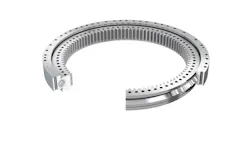
SKF addresses longevity challenges like cage creep and lubrication with custom features, such as strategically placed lube inlets tailored to an application’s rotation arc. Martin cited a large-diameter slewing bearing case where limited oscillation (for instance, 15 to 90 degrees back-and-forth) demands multiple inlet points for even grease distribution, unlike full 360-deg. rotations that circulate lube from a single spot.
This targeted approach ensures reliability by delivering lubricant precisely where it is needed across the ring, he said.
About the Author
 Rehana Begg
Rehana Begg
Editor-in-Chief, Machine Design
As Machine Design’s content lead, Rehana Begg is tasked with elevating the voice of the design and multi-disciplinary engineer in the face of digital transformation and engineering innovation. Begg has more than 24 years of editorial experience and has spent the past decade in the trenches of industrial manufacturing, focusing on new technologies, manufacturing innovation and business. Her B2B career has taken her from corporate boardrooms to plant floors and underground mining stopes, covering everything from automation & IIoT, robotics, mechanical design and additive manufacturing to plant operations, maintenance, reliability and continuous improvement. Begg holds an MBA, a Master of Journalism degree, and a BA (Hons.) in Political Science. She is committed to lifelong learning and feeds her passion for innovation in publishing, transparent science and clear communication by attending relevant conferences and seminars/workshops.
Follow Rehana Begg via the following social media handles:
LinkedIn: @rehanabegg and @MachineDesign
YouTube: @MachineDesign-EBM