Pluggable Terminal Blocks: Simple and Secure
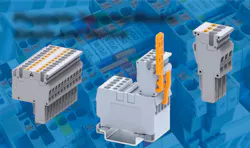
Pluggable terminal blocks are designed to facilitate both push-in wire connections and pluggable connections, combining design flexibility with easy installation. A truly hybrid technology, these connectors reduce wiring time and effort, ensure accurate field wiring and establish secure connections.
Why Use a Pluggable Terminal Block?
Industrial operations must continually change to adapt to present and future needs. Building and deploying vital equipment demands a robust connected infrastructure capable of reliably delivering various power and control signals to advanced and modular systems while enabling operational flexibility. To get these systems up and running quickly, cable connections must be fast, easy and secure.
READ MORE: Uninterrupted Supply: The Principals Behind 40 Years at Altech’s Helm
For applications with frequent connections and disconnections, the connection method must be simple enough to help operators and technicians keep downtime to a minimum. Pluggable terminal blocks offer a hybrid approach to satisfy these requirements, making them well-suited for a wide range of industrial applications.
Traditional interconnection methods are typically prone to connection errors caused by vibrations from nearby machinery, configuration issues or poor manual assembly. These errors can increase system downtime, risk operator safety, raise maintenance costs and even cause a total plant shutdown. Pluggable terminal blocks that use spring clamp contacts are designed to provide secure, vibration-resistant wire connections while allowing for easier disconnection and reconnection through plug-in interfaces.
Reduce Wiring Time and Effort
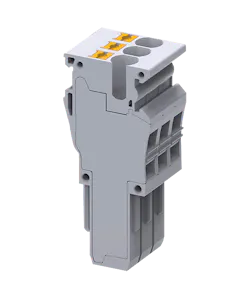
Designed with time savings in mind, Altech terminal blocks are typically configured with spring clamp connections on one side and plug connections on the other, enabling instant connections that also eliminate the need for tools and time- and labor-intensive screw tightening.
The plugs come in single blocks and can be stacked to easily build harnesses. For complex circuits, technicians and installers can save considerable time and effort by simply inserting lugged wires into the push-in plugs. The units also provide built-in jumpering features and allow external jumpering to minimize wiring time and effort.
Ensure Secure Connections and Accurate Field Wiring
The specially engineered spring contacts engage with the base of the terminal to create a reliable wire-to-wire connection without tools. Integrated locking pins keep the connection in place without worry of loosening—even during severe vibrations. An optional strain relief plate allows users to secure connected cables with a cable tie for added reliability and peace of mind.
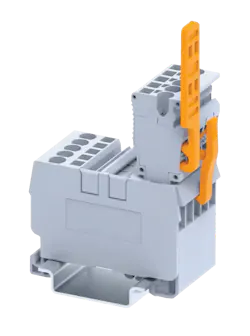
Other versions include DIN rail options for installation in either panel or harness-based systems. Installers can simply snap the base onto the DIN rail and insert a plug into the plug side for an easy and secure hard-wired connection. The plug disconnects just as easily, freeing technicians from the time and effort of removing several wires.
In addition, free-floating male and female terminals make it easy to extend harnesses without any mounting hassles. Also, coding pins and breakaway stubs insert directly into the base assemblies to eliminate mating errors. Additional features include compact sizes, multiple color options and a long service life.
How Are Pluggable Terminal Blocks Configured?
Because engineers must address many different machines and applications, each with their own requirements, an ideal terminal block family must be equally diverse. For example, Altech pluggable terminal block configurations range from one contact on one side and one plug on the other, to two contacts on one side and two plugs on the other. There is also a one-contact and four-plug version.
READ MORE: DC UPS System, Enclosure and Switches Join Together
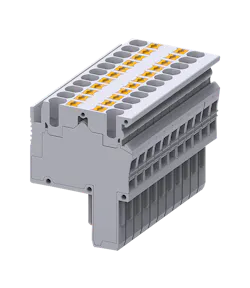
In addition, multiple plugs can be stacked together to create a wire harness. Stacks of up to 15 poles are available pre-snapped, or designers may choose single, stackable poles. To create an identical stack, the stubs on the plug can be broken and polarized with the base terminal without risking wiring errors. Double-level pluggable units with options for internal shorts, four-plug connections or ground connections are well-suited for high-density applications.
For further customization, these terminal blocks can be outfitted with accessories such as DIN rails, a DIN mounting foot, snap-on end clamps for DIN rails, a partition plate for electrical isolation, a terminal mounting and actuation tool, warning labels, and terminal and group markers.
An Effective Combination of Ease, Flexibility and Security
Terminal blocks are commonly used in factory testing applications that require frequent wiring changes, as well as in on-site installations and sub-assembly interconnections where wiring accuracy, reliability and ease of integration are important. Other suitable applications include switchgear, railways, machine building, marine, HVAC, elevators or most any application that involves frequent connections and reconnections.
About the Author
Markus Kraess
Product Manager, Altech Corp.
Voice Your Opinion!
To join the conversation, and become an exclusive member of Machine Design, create an account today!
 Leaders Logo
Leaders relevant to this article: