The Coming Shift: Why Industry 5.0 Will Be Driven by AI in Mechanical
The Industrial Paradigm Shift
The conversation around industrial progress has officially outgrown the cloud-heavy promises of Industry 4.0. For the past decade, our industry has been obsessed with the Internet of Things, aggregating massive data lakes and achieving baseline machine interconnectivity. But on the factory and fulfillment floor, a glaring bottleneck has emerged. Software intelligence is accelerating exponentially, while our physical hardware foundations are still treated as static, rigid blocks of steel and aluminum.
True innovation cannot occur in a computational vacuum. The next major leap in robotics and automated infrastructure relies on embedding artificial intelligence directly into the deterministic physics of mechanical engineering. As engineers, we must stop thinking of code and carbon steel as two separate worlds.
Redefining Industry 5.0: Beyond the Policy Framework
The European Commission’s original Industry 5.0 vision centers on three pillars: human-centricity, sustainability and resilience. These are important organizational goals. But from the perspective of the engineers who actually design and deploy physical automation systems, the enabling mechanism beneath all three pillars is the same: mechanical hardware that can think.
A resilient system requires hardware that predicts its own failure before it fails. A sustainable system requires machinery that extends its own operational lifespan instead of being replaced on arbitrary schedules. A human-centric system requires physical infrastructure intelligent enough to adapt its behavior without demanding constant human intervention. The policy framework describes the “what.” This article addresses the “how”—and the how lives squarely in the fusion of AI with mechanical engineering.
To understand why this fusion is overdue, we must first examine where today’s hardware control architectures fall short.
The Limits of Reactive Control in High-Throughput Environments
In high-speed, high-volume material handling environments, the primary challenge is not raw structural mass. It is managing complex, multi-axis kinematic chains under continuous, aggressive, around-the-clock duty cycles. Traditional control architectures rely almost exclusively on standard Proportional-Integral-Derivative (PID) loops. These loops operate on a fundamentally reactive basis: They read an error from an encoder and apply a correction only after the physical deviation has already occurred.
At the velocities required by modern global supply chains, reactive correction is a liability. Non-linear variables such as localized thermal expansion in mechanical joints, high-velocity orientation drift in end-effectors and structural mechanical compliance create compounding errors. When these microscopic deviations propagate through a long kinematic chain, they produce positional inaccuracies, accelerated component wear and unexpected system shutdowns.
According to the International Society of Automation, unplanned downtime in manufacturing costs an estimated $50 billion annually across North American industry alone. To protect these capital investments, we must transition from reactive correction to predictive mitigation. That transition begins at the design stage.
AI in Design and Development: Front-Loading Intelligence
Before a single motor turns on the factory floor, AI is already reshaping how mechanical systems are conceived and validated. The traditional design workflow of CAD modeling, static FEA, prototype fabrication, physical testing and iteration is giving way to a fundamentally different methodology where AI participates at every stage of the mechanical development cycle.
Generative kinematic synthesis uses constrained optimization algorithms to explore mechanism topologies that human designers would never consider. Given a set of motion requirements, payload constraints and duty cycle specifications, AI-driven synthesis tools can evaluate thousands of candidate linkage configurations in hours, filtering simultaneously for manufacturability, fatigue life and dynamic stability. This is not generative design in the aesthetic sense used by architects. This is computationally exhaustive kinematic enumeration bounded by the laws of physics.
Digital twin validation allows engineers to subject a mechanical design to millions of simulated duty cycles before committing to physical prototyping. Physics-informed simulations model not just nominal behavior but degradation trajectories, predicting where a mechanism will wear, how compliance will evolve over time and which joints will accumulate backlash first. This front-loads failure analysis into the design phase rather than discovering it 18 months into production.
AI-assisted tolerance stack-up replaces worst-case manual analysis with Monte Carlo-driven probabilistic assessment. Instead of over-engineering every interface to survive a statistical impossibility, designers allocate tolerances intelligently, reducing material cost and manufacturing complexity while maintaining statistical reliability targets across the full production run.
The result is mechanical systems that arrive on the factory floor already optimized for their entire operational lifecycle, not just their Day 1 performance envelope. But design-phase intelligence is only half the equation. What happens when the physical world begins to deviate from the model?
Physics-Informed Neural Networks: AI with a Mechanical Compass
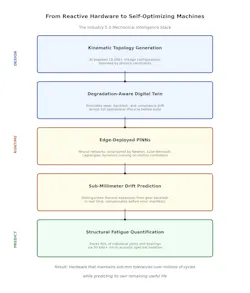
To bridge the gap between design intent and operational reality, top-tier mechatronic design is turning to Physics-Informed Neural Networks (PINNs). Unlike standard data-driven black-box models that look purely for statistical patterns in raw sensor data, PINNs are pre-trained to operate within the strict boundaries of classical mechanics. The underlying mathematical loss functions of these neural networks are directly constrained by foundational physics principles including Newton’s laws of motion, Euler-Bernoulli beam theory and Lagrangian dynamics.
By deploying these specialized networks directly at the edge alongside the machine’s motion controllers, engineers instantiate a real-time, high-fidelity mechanical digital twin. When a micro-deviation occurs, the system does not merely recognize an error spike. It calculates the underlying physical root cause, distinguishing, for example, between thermal expansion in a linear rail and backlash accumulation in a gear train, even when both produce similar encoder readings.
This unlocks deterministic synchronization. By predicting kinematic drift milliseconds before it physically manifests, the system can dynamically modulate motor torque profiles or proactively adjust path trajectories. High-throughput machinery maintains sub-millimeter alignment tolerances over millions of continuous duty cycles. Unpredictable physical degradation becomes a completely modeled, mathematically stabilized variable.
Transitioning from Scheduled to Predictive Maintenance
The integration of physics-informed AI into mechanical infrastructure unlocks the ultimate goal of industrial asset management: edge-driven predictive maintenance. For decades, our sector has been bound to scheduled maintenance, an inefficient model where critical components are replaced based on arbitrary calendar timelines or run-hour metrics, completely independent of their actual structural integrity. This routinely results in the premature disposal of perfectly viable components or, conversely, catastrophic in-cycle failures that halt entire distribution networks.
When embedded neural networks continuously audit the delta between the baseline physical design model and real-world mechanical feedback, they calculate sub-visual structural fatigue in real time. The algorithm tracks the exact degradation curve of individual assets, establishing accurate Remaining Useful Life (RUL) projections.
Instead of waiting for a component to cross a failure threshold, the system flags micro-anomalies such as localized backlash accumulation in a gearbox or microscopic structural degradation in a support mount, weeks before they become operationally relevant.
This empowers engineering teams to execute targeted maintenance exclusively during planned operational windows. For a single high-throughput fulfillment facility running 20+ hours per day, the difference between predictive and scheduled maintenance can represent six figures in annual savings per production line.
Harmonic Noise and High-Frequency Vibrational Analysis
One of the most demanding engineering challenges when deploying AI onto a heavy industrial floor is isolating true mechanical wear from background environmental noise. A live distribution center is a chaotic acoustic environment. Low-frequency floor vibrations, structural building resonance and neighboring machinery interference combine into a dense noise floor. Standard diagnostic algorithms frequently fail to separate a degrading bearing signature from this environmental static.
To achieve field-ready reliability, advanced mechatronic systems utilize high-frequency Frequency Domain Analysis coupled with localized AI filters. The process begins by capturing the precise acoustic and vibrational fingerprint of a mechanically sound machine across its full operational envelope. The edge AI learns to map and reject standard environmental harmonics, focusing computational bandwidth strictly on the high-frequency micro-acoustic emissions that signal structural degradation.
For instance, microscopic pitting of a high-speed ball bearing generates a distinct ultra-high-frequency stress wave long before it manifests as detectable heat or visible misalignment. A conventional accelerometer-based monitoring system would miss this entirely at typical sampling rates. AI-driven spectral decomposition, operating at sampling frequencies above 50 kHz, captures these precursor events with high confidence. This is what separates reliable, large-scale automation deployments from systems that surprise their operators with unscheduled failures.
Economic Impact: The Value of Absolute Precision
When analyzed at scale, the economic implications of embedding AI into mechanical hardware are substantial. According to McKinsey, predictive maintenance alone can reduce machine downtime by 30% to 50% and extend machine life by 20% to 40% across industrial operations. Within global logistics and high-throughput fulfillment, a single hour of unscheduled downtime across a distribution network equates to millions of dollars in lost throughput and fractured supply chain commitments.
When mechanical engineers design hardware that natively utilize predictive stabilization and automated diagnostics, they are no longer solving localized physics problems. They are actively insulating critical national infrastructure from cascading supply chain vulnerabilities. Extending the operational lifecycle of multi-million-dollar automation systems while simultaneously extracting higher velocities from existing physical kinematics redefines the return-on-investment calculation for industrial capital expenditure.
The compounding effect is significant: AI-optimized mechanical systems simultaneously reduce capital replacement frequency, lower maintenance labor costs, increase throughput per unit of floor space and improve product quality by maintaining tighter positional tolerances over longer operational windows.
The Evolution of the Mechanical Discipline
As we scale physical hardware to meet unprecedented global demands, the definition of the mechanical engineering discipline continues to evolve. The static structural designer, shaping link arms, bearings and frames as passive components, is being replaced by the mechatronic systems architect who designs hardware, intelligence and degradation models as a single unified system.
Industry 5.0 will not be defined merely by the speed of the software we write. It will be defined by the computational intelligence we embed into the very structure of our mechanical designs: hardware that learns, predicts and adapts within the rigid, unyielding laws of classical physics.
Editor’s Note: This article is part of Machine Design’s summer reading series exploring global design engineering trends redefining how products are conceived and scaled.
In This Series:
- From Data to Decisions: The Race to Make Industrial AI Operational
- The Coming Shift: Why Industry 5.0 Will Be Driven by AI in Mechanical
- Will AI Replace Programmers? What Elon Musk’s Prediction Means for Mechanical Engineers
- Q&A: The AI-Robotics Convergence: Global Perspectives for Machine Builders
- The Robots Are Getting Real: Lessons from Hannover Messe’s Industrial AI Reality
- How Augmented Reality is Changing the Way We Design Machines
About the Author
 Santosh Yadav
 Santosh Yadav
Hardware Development Engineer, Amazon Robotics
Santosh Yadav is a Hardware Development Engineer at Amazon Robotics and an IEEE Senior Member. He holds multiple US patents on deterministic kinematic synchronization and publishes monthly in Machine Design on mechanism-centric approaches to industrial automation.
Voice Your Opinion!
To join the conversation, and become an exclusive member of Machine Design, create an account today!
 Leaders Logo
Leaders relevant to this article: