Making Sense of Additive Manufacturing with Conrad Smith: A Practical Glossary
At large trade shows such as IMTS 2026, it is entirely possible to pick a track and learn as much as possible in a day. I had set aside an afternoon for an additive manufacturing crash course. The mission was to understand how the technology has evolved since its early use in prototyping and where it is gaining traction in aerospace and defense.
Imagine my luck when Conrad Smith, Global Director of Aerospace, Defense and Drones (A&D), Stratasys, offered to take me on a tour of the company’s booth. I happily accepted. The tour covered a lot of ground: Aircraft components, drone structures, composite tooling, qualified materials, production applications and software all made an appearance, along with enough additive manufacturing terminology.
By the end of the conversation, I had a much clearer picture of where additive manufacturing fits in aerospace production and a growing list of terms worth understanding. Consider what follows The Field Guide to Additive Manufacturing According to Conrad Smith. Watch the accompanying video and check off the terms as they come up. Together, they offer a practical introduction to the materials, processes and engineering concepts that surfaced during our discussion. No evangelizing, just a useful lesson in how the technology is being applied.
The Field Guide to Additive Manufacturing According to Conrad Smith
STOP 1: From the Factory Floor to Flight
Application: Flight-qualified aircraft components and space hardware.
Smith’s tour begins with a compelling case for industrial AM: actual parts installed in aircraft and spacecraft. His examples include components on Boom Supersonic’s aircraft, parts on the Airbus A350 and a component used in NASA’s Artemis mission.
The terminology reflects the demands of putting AM parts into service, from material selection and performance to qualification and the conditions parts must withstand under operating conditions.
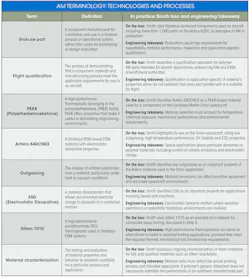
STOP 2: Building Lighter, More Capable Drones
Application: Drone structures, lightweight components and complex geometries.
The drone examples illustrate how AM can influence both component design and material selection. Smith discusses a printed drone structure, a winglet made with Nylon 12 Carbon Fiber and components designed to reduce weight while maintaining structural requirements.
These applications introduce several key concepts, including powder-bed fusion, topology optimization, fiber reinforcement and the design flexibility offered by additive processes.
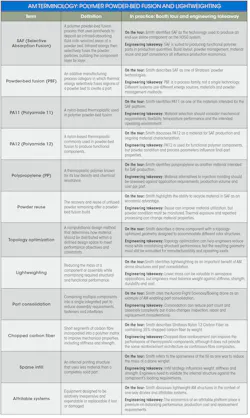
STOP 3: Tooling up for Aerospace Production
Application: Composite layup molds, drill guides, jigs and fixtures.
The focus here shifts to the tools used in manufacturing. Printed jigs, fixtures and molds can help manufacturers position, align and assemble components, illustrating how AM applications extend well beyond the finished part.
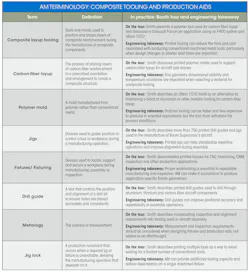
STOP 4: Bringing Additive into the Machine Shop
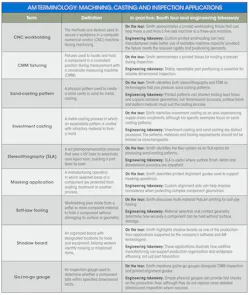
Applications: CNC workholding, CMM inspection, sand casting and production-floor aids.
Smith makes a point of connecting AM with traditional manufacturing. His examples include printed fixtures for CNC machining, inspection aids and patterns for sand casting.
Many manufacturing engineers will recognize these terms. What changes with AM is the approach to producing the tools and patterns, including the design options, lead times and manufacturing constraints.
STOP 5: The Digital Thread: Software, Design and Production
Application: Automating fixture design, managing print operations and supporting production workflows.
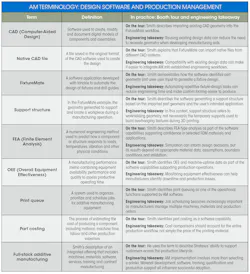
Smith’s final stop is the software side of the AM ecosystem. His discussion of FixtureMate, GrabCAD Print Pro, CAD files and FEA illustrates how digital tools can help connect design information to the manufacturing floor.
A Few More Terms from the Booth Tour
Smith also touched on silicone and several other specialized applications beyond the five main stops. The terms below add further context to the range of uses for additive manufacturing.
DLP (Digital Light Processing)
A vat photopolymerization process that uses a digital projector to cure photosensitive resin. Unlike SLA, which scans a laser across the build area, DLP can cure an entire layer at once.
On the tour: Smith identifies Stratasys’ Origin DLP platform as the technology used for its silicone application.
True Silicone
Smith’s description of a silicone elastomer developed with Shin-Etsu for the Origin DLP platform.
On the tour: He identifies potential applications including blow molds, gaskets and seals.
Shore A Hardness
A scale used to measure the indentation hardness of flexible materials such as elastomers.
On the tour: Smith describes the silicone material as 25A Shore hardness, indicating a relatively soft material.
FST (Flame, Smoke and Toxicity)
A group of fire-safety performance characteristics used to evaluate materials for applications such as aerospace interiors.
On the tour: Smith says the silicone meets FST requirements.
PolyJet
A material-jetting process that deposits droplets of liquid photopolymer and cures them using UV light.
On the tour: Smith discusses PolyJet for multi-material soft-jaw tooling and other production-floor applications.
Total Cost of Ownership (TCO)
The total cost of acquiring, operating and maintaining equipment or a production system over its useful life.
On the tour: Smith uses the term when discussing the economics of SAF and material reuse.
Foreign Object Debris (FOD)
Objects or materials that could damage aircraft, equipment or systems if inadvertently introduced during manufacturing or operation.
On the tour: Smith describes incorporating metal inserts into printed drill guides to avoid introducing foreign object debris during use.
Putting the Terminology to Work
Smith’s overview of the Stratasys booth illustrates the range of technologies, materials and applications that fall under additive manufacturing. Manufacturing a flight component, producing a lightweight drone structure, making a composite layup tool or improving a shop-floor operation each calls for different processes, materials and design considerations.
This field guide gives engineers a reference point for assessing AM processes, weighing their capabilities and limitations. As additive manufacturing advances, new processes, materials and applications will bring additional terminology and engineering considerations into the picture.
Reference Guide: Interview Insights and Technical Reviews
- Conrad Smith, Global Director of Aerospace, Defense and Drones (A&D), Stratasys, video interview conducted at IMTS 2026.
- A Review on Recent Advancements in Additive Manufacturing Techniques (2024): Classification of AM processes according to ASTM standards.
- Additive Manufacturing: A Comprehensive Review (2024): Overview of technologies, materials, applications and production workflows.
- A Review of Topology Optimization for Additive Manufacturing: Status and Challenges (2021): Topology optimization, structural design and lightweighting.
- Additively Manufactured Cure Tools for Composites Manufacture (2023): Additive manufacturing of composite tooling.
- Re-use of Polyamide-12 in Powder Bed Fusion and Its Effect on Process-Relevant Powder Characteristics and Final Part Properties (2024): Powder reuse and material degradation.
- Part Consolidation for Additive Manufacturing: A Multilayered Topology Optimization Approach (2021): Part consolidation and design optimization.
Editor’s note: AI tools were used to assist with formatting and organizing the tables. The content, technical interpretation and editorial judgment remain the editor’s intellectual work.
More content from IMTS 2026.
Have a question, comment or idea? Get in touch with the Machine Design editors at [email protected].
About the Author
 Rehana Begg
Editor-in-Chief, Machine Design
As Machine Design’s content lead, Rehana Begg is tasked with elevating the voice of the design and multi-disciplinary engineer in the face of digital transformation and engineering innovation. Begg has more than 24 years of editorial experience and has spent the past decade in the trenches of industrial manufacturing, focusing on new technologies, manufacturing innovation and business. Her B2B career has taken her from corporate boardrooms to plant floors and underground mining stopes, covering everything from automation & IIoT, robotics, mechanical design and additive manufacturing to plant operations, maintenance, reliability and continuous improvement. Begg holds an MBA, a Master of Journalism degree, and a BA (Hons.) in Political Science. She is committed to lifelong learning and feeds her passion for innovation in publishing, transparent science and clear communication by attending relevant conferences and seminars/workshops.
Follow Rehana Begg via the following social media handles:
LinkedIn: @rehanabegg and @MachineDesign
YouTube: @MachineDesign-EBM
Related
 3D-printed jet engine model

Voice Your Opinion!
To join the conversation, and become an exclusive member of Machine Design, create an account today!
 Leaders Logo
Leaders relevant to this article: