R&D Spotlight: What Does the Future of Industrial Collaboration Look Like?
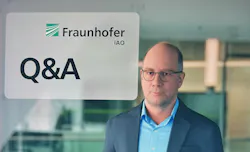
Your virtual agent, an AI-supported digital teammate, is now joining your team.
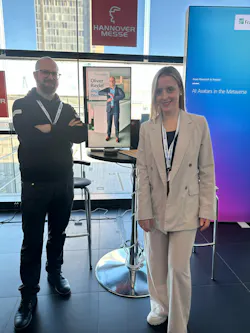
At a media preview (Feb. 25, 2026), research scientists from the Fraunhofer Institute for Industrial Engineering IAO demonstrated one of the primary technologies they intend to bring to Hannover Messe 2026.
Dan Blank, a spokesperson for Interaction Design and Technologies at the Fraunhofer Institute for Industrial Engineering IAO, introduced a special highlight—a photorealistic, voice-enabled AI avatar of Univ.-Prof. Dr.-Ing. Oliver Riedel, the institute’s director.
READ MORE: AI Takes Center Stage at Hannover Messe 2026 Preview
The spotty Wi-Fi connection was the only hiccup when it was Machine Design’s turn to interact with “Oliver,” the avatar modeled on Dr. Riedel’s likeness and expertise.
Still, that didn’t stop it from answering a question with pinpoint accuracy.
Machine Design: “What’s the difference between a digital twin and a digital thread?”
Oliver: “I would distinguish two key aspects here. Firstly, the digital twin is a natural representation of a physical object or system. Let’s say, a machine that mirrors its behavior and state in real time. The second point is that the digital thread connects data flows across the entire lifecycle, from design to production to operation. In other words, the digital twin shows the current state. The digital thread traces the entire journey.”
Capturing Expertise for Posterity
Avatars open up new avenues of providing companies with qualitative expertise at any given time. The avatars can be used in teams for communication and translation, providing a more empathetic interface than traditional chatbots, said Blank.
Oliver is one of several avatars developed using AI-based speech analysis and gaming technologies. Another is modeled on the likeness of Joseph von Fraunhofer, the institute’s namesake.
READ MORE: A Short Introduction to Digital Twins
For Riedel, seeing an avatar in his own likeness came as a surprise. “This was all a top-secret project, so, he didn't know about this when we made it,” Blank recalled. Naturally, Riedel put Oliver to the test by asking it questions based on his own work. The digital twin responded correctly, even citing published research. “He was really happy,” Blank said.
Riedel, an expert in the fields of cybernetics and civil and military security research, has held distinguished roles throughout his career, including leading the Institute for Control Engineering of Machine Tools and Manufacturing Units (ISW) at the University of Stuttgart and as Chair for Production IT and board member at the Fraunhofer Institute for Industrial Engineering and Organization (IAO).
What’s the Benefit?
The Institute's work on avatars is viewed as a significant step towards creating more empathetic and engaging interfaces for information, Blank said.The Fraunhofer Institute is exploring the use of avatars in various applications, including education, museums and historical projects, to create deeper connections and experiences.
READ MORE: Video Insights: Pioneering Digital Twins
The institute will present these as well as Added Value Avatars (AVA) at this year’s show. The AVA avatars are digital twins of actual people who answer questions in real time through a combination of a large language model and a local knowledge system, explained Blank.
Blank said visitors to the Fraunhofer exhibit (Hall 11, Booth D33) at Hannover Messe 2026 (April 20-24, 2026) will have an immersive experience with several technologies designed to bring the industrial metaverse to life. It will include immersive visualizations, photorealistic AI avatars and digital twins.
About the Author
 Rehana Begg
Rehana Begg
Editor-in-Chief, Machine Design
As Machine Design’s content lead, Rehana Begg is tasked with elevating the voice of the design and multi-disciplinary engineer in the face of digital transformation and engineering innovation. Begg has more than 24 years of editorial experience and has spent the past decade in the trenches of industrial manufacturing, focusing on new technologies, manufacturing innovation and business. Her B2B career has taken her from corporate boardrooms to plant floors and underground mining stopes, covering everything from automation & IIoT, robotics, mechanical design and additive manufacturing to plant operations, maintenance, reliability and continuous improvement. Begg holds an MBA, a Master of Journalism degree, and a BA (Hons.) in Political Science. She is committed to lifelong learning and feeds her passion for innovation in publishing, transparent science and clear communication by attending relevant conferences and seminars/workshops.
Follow Rehana Begg via the following social media handles:
LinkedIn: @rehanabegg and @MachineDesign
YouTube: @MachineDesign-EBM
Voice Your Opinion!
To join the conversation, and become an exclusive member of Machine Design, create an account today!
 Leaders Logo
Leaders relevant to this article: