Factory Tour: Siemens Electronics Factory in Erlangen, Germany
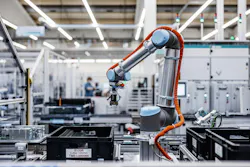
Machine Design visited Siemens Electronics Factory in Erlangen, Germany to see how emerging technologies are being validated in a live production environment. The facility operates as a working testbed, offering a practical view of how physical AI, digital planning and next-generation automation are used.
Demonstrations during the factory tour focused on a core challenge for manufacturers as they navigate solutions for high-variance, low-volume production. Siemens’s approach integrates industrial AI, digital twins and advanced robotics with the ambition of enabling more adaptive systems, especially scenarios where robots must safely operate alongside active machinery. The emphasis is on orchestrated, data-driven systems that respond dynamically to variability.
The Erlangen factory was designated as a Digital Lighthouse Factory by the World Economic Forum (WEF) in 2024. The site introduces visitors—Siemens customers are infrastructure and industry applying digitalization and automation—to the ways Siemens uses its own operations as a testbed for technologies such as physical AI and digital planning.
READ MORE: Are Humanoid Robots Ready for Industry? Hannover Messe Thinks So (Maybe)
According to Siemens, the use of AI, digital twins and robotics has boosted productivity at the site by 69% and reduced energy consumption by 42%. These numbers reflect internal testing but also echo a shift in the way engineering works; performance gains are increasingly achieved through system-level optimization as opposed to incremental hardware tweaks.
A recurring theme during the visit was Siemens’ “customer zero” philosophy. Site Manager and Global Head of Manufacturing Motion Control Stephan Schlauß explained that Siemens employs its own automation and digitalization technologies internally before releasing to the market. In so doing, Siemens can uncover integration and operational challenges while closing the gap between design and real-world use.
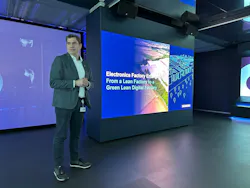
Motion Control Anchors System Performance
As Schlauss frames it, motion control is the layer that links software-defined intent to the physical environment and remains at the center of Siemens’ digital deployment strategy. Any industrial or infrastructure system involving motion depends on a tightly coupled stack of drives, motors and control system. Therefore, optimizing that stack is especially critical as AI-driven decision-making increasingly affects real-time machine behavior.
Deployments at the Erlangen site are purposefully designed for replication rather than one-off pilots, said Schlauss. Successful approaches are then standardized to be rolled out across Siemens’ global manufacturing network and adapted to different sites and business models, and other Siemens’ “lighthouse” facilities benchmarked against global best practices recognized by the World Economic Forum’s Global Lighthouse Network.
Siemens hardware and software are built on an industrial-grade AI stack designed to streamline deployment, reduce change-management complexity and enable rapid training. AI is embedded throughout the production process. Machine learning speeds up product testing and reduces rework.
On the factory floor, human operators use AI-guided tools and work alongside fully automated assembly lines. AI-enabled robots handle pick-and-place tasks across a wide range of components and materials, while continuous monitoring keeps performance stable and output reliable.
Editor's Note: The factory tour took place as part of a Siemens-sponsored press event.
Stephan Schlauss Shares Three Defining Insights
- Virtual commissioning enables safe robot deployment. To prevent collisions, conventional automation systems place robots at arm’s length from active machines. Siemens takes the tack of testing robots via virtual commissioni.ng before transitioning them to physical operation. Schlauss said this approach sidesteps costly real-world crash testing during validation.
- Intelligent automation drives capital efficiency. A compelling demo featured robots working inside a cell housing a conveyor belt. Since manual stoppages are avoided with robots entering and exiting during operation, the automated setup costs less upfront than sticking with manual labor methods. At the Erlangen factory setup, robotic systems can easily adapt to production switches without needing to retool or make major changes, which keeps operations efficient and costs down, said Schlauss.
- 3. A “do it smart” philosophy guides implementation. Siemens employs a “customer zero” approach. This means perfecting motion control to the point where it can profitably manage evolving production needs. Once proven, they roll out solutions across “lighthouse” plants. This approach complements the software-driven robot intelligence (prioritizing software brains over hardware), such as the adaptable brains powering the Humanoid HMND 01 logistics robot at the Erlangen factory.
About the Author
 Rehana Begg
Rehana Begg
Editor-in-Chief, Machine Design
As Machine Design’s content lead, Rehana Begg is tasked with elevating the voice of the design and multi-disciplinary engineer in the face of digital transformation and engineering innovation. Begg has more than 24 years of editorial experience and has spent the past decade in the trenches of industrial manufacturing, focusing on new technologies, manufacturing innovation and business. Her B2B career has taken her from corporate boardrooms to plant floors and underground mining stopes, covering everything from automation & IIoT, robotics, mechanical design and additive manufacturing to plant operations, maintenance, reliability and continuous improvement. Begg holds an MBA, a Master of Journalism degree, and a BA (Hons.) in Political Science. She is committed to lifelong learning and feeds her passion for innovation in publishing, transparent science and clear communication by attending relevant conferences and seminars/workshops.
Follow Rehana Begg via the following social media handles:
LinkedIn: @rehanabegg and @MachineDesign
YouTube: @MachineDesign-EBM
Voice Your Opinion!
To join the conversation, and become an exclusive member of Machine Design, create an account today!
 Leaders Logo
Leaders relevant to this article: