Case Study: How Modular Conveyor Systems Improve End-of-Line Packaging Performance
This article was featured in Machine Design’s Automation & Robotics Takeover Week (July 13-17, 2026).
Froneri, a joint venture between the British company group R&R Ice Cream and the Swiss Nestlé Group, operates more than 30 plants worldwide, two of which are in Italy. At its plant in Terni, Froneri mainly produces packaged ice cream for the private label of retail chains. In Ferentino, the company produces ice cream for the foreign market and for its own brands such as Nuii.
In Ferentino’s end-of-line packaging process, individually wrapped frozen ice cream products are transported to a cartoning machine, where they are sealed, weighed and inspected before advancing to palletizing. A VarioFlow plus chain conveyor system from Bosch Rexroth was configured with a modular design to accommodate the facility’s layout constraints and throughput requirements.
READ MORE: From Components to Systems: Motion Engineering for Automation, Robotics and AI
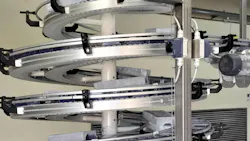
“The VarioFlow plus chain conveyor system transports the products coming from the metal detectors and scales to the shrink packing machine,” explained Alfredo De Falco, Group Project Manager at Froneri. “Chain conveyors placed on the floor and mounted on the ceiling transport the cartons further for palletization, depending on the format. The height differences are overcome using spiral conveyors with minimal space requirements.”
To improve line resilience during production interruptions, Froneri incorporated spiral conveyors using Bosch Rexroth’s VarioFlow plus conveyor components, according to Claudio Morabito, Factory Automation End Users Sales FMCG at Bosch Rexroth.
“The use of spiral conveyors in conjunction with the chain conveyor system offers several advantages here,” Motabito explained. “In the case of a machine standstill, the products in the infeed can be easily accumulated and temporarily stored in the spiral conveyor. The quantity of products that can be buffered on the spiral conveyors corresponds to a third of the total quantity of products on the conveyors in the infeed at the time of the machine downtime.”
READ MORE: Conveyor Trends: Safer, Stronger, Sleeker
“This is an essential aspect,” De Falco emphasized, noting that the ability to reduce the transport speed of the spiral conveyor during a machine stoppage means that products can accumulate within the conveyor. During planned downtime of the shrink-wrapping machine, much of the incoming product can be buffered on the conveyor belts, providing 1-3 minutes to resolve the interruption without immediately affecting upstream production.
During accumulation, the conveyor chain moves beneath stationary products, making it important to prevent damage to packaging, including printed graphics and labels. De Falco said the low-wear characteristics of the VarioFlow plus conveyor chain help minimize the risk of marking or damaging packaged products, making durability an important consideration in the system’s selection.
“The spiral conveyor has two lanes,” said Morabito. “This means that it has two separate spiral conveyor lines. Compared to a single-lane spiral conveyor of the same size, this almost doubles the transport capacity. This will save valuable space in the production area.”
A second reason is the possibility of vertical transport. The transport system enables simple and reliable operation on different transport levels. In the Ferentino plant, for example, the conveyor is operated 2.4 meters above the hall floor. This means that not only people, but also vehicles for transporting pallets and other materials can pass under the conveyor system.
READ MORE: The Hidden Powers of Conveyors
A third reason, according to De Falco: “VarioFlow plus allows a wide range of conveyor speeds.” This property allows it to be adapted to different format types, he said.
Reflecting on the system’s performance in production, De Falco highlights flexibility and reliability as key factors in the conveyor system’s long-term operation.
“The system offers maximum flexibility and can be easily adapted to a wide range of layout requirements,” he said. “In addition, it has proven to be robust and reliable in the long term, which is extremely important for us. At no time were there significant downtimes in production caused by malfunctions.”
About the Author
 Krupa Ravichandraan
Krupa Ravichandraan
Sales Product Manager – VarioFlow, Bosch Rexroth
Voice Your Opinion!
To join the conversation, and become an exclusive member of Machine Design, create an account today!
 Leaders Logo
Leaders relevant to this article: