From Components to Systems: Motion Engineering for Automation, Robotics and AI
For more Automate 2026 coverage, be sure to visit our Tradeshow Takeover event hub.
AI may be making robots smarter, but the next challenge is orchestration. As robotics and automation systems move into more complex environments, motion, controls, software and sensing must work together seamlessly at scale.
It is a complexity that stems partly from the industry’s growing push toward automating higher-mix, lower-volume production, where flexibility and throughput carry equal weight. In this transition, engineering teams are forced to think across mechanical design, electronics, controls and electronics software from the outset, according to Kyle Thompson, Global Robotic Automation Manager, Regal Rexnord, Linear Motion Division.
“That pushes suppliers like us to deliver systems that don’t live in isolation but are designed to integrate into a broader control ecosystem,” he said. “As those systems mature, the motion platforms around them need to be smarter at synchronizing with robot controls, more configurable and better able to support collaborative safety expectations without complex tuning.”
For motion suppliers that means embedding connectivity, configurability and interoperability directly into hardware and control architectures. These advancements are happening alongside vision-enabled robotics and edge intelligence from companies such as Teradyne Robotics, which are expanding the operational envelope of collaborative and mobile systems, while industrial computing platforms from providers such as Teguar are pushing more processing power closer to the machine. At the same time, precision motion specialists such as maxon are advancing high-efficiency motors and compact actuation systems that support increasingly space- and energy-constrained designs.
As Thompson puts it, “motion solutions must be easier to deploy, easier to connect and more capable of working as part of a multi-axis, multi-vendor automation system.”
The implication for product developers is to ensure that motion systems function as part of an increasingly tightly coupled automation stack, where hardware performance, software orchestration and system interoperability are designed together from the outset. For Thompson, that systems-oriented approach is becoming more important. “We expect that systems-ready mindset to matter more each year,” he said.
The products and technologies in this roundup address many of the challenges behind that approach. Across motion systems, embedded computing, robotics platforms and precision actuation, companies—such as Regal Rexnord, Teradyne Robotics, Teguar, maxon, Beckhoff Automation, Weidmüller and Schneider Electric—are reflecting how motion engineering is helping to shape the next iteration of automation.
1. Integrated Automation in Action
Regal Rexnord will showcase applications that bring together technologies from its Industrial Powertrain Solutions, Power Efficiency Solutions and Automation & Motion Control businesses. Booth spotlights include a series of application-focused demonstrations designed to showcase the company’s integrated approach to automation.
Highlights include a Smart Factory demo featuring seventh-axis systems, motors, linear units, couplings, gearing and software; an Adaptive Packaging application combining seventh-axis gantry systems, conveying technologies and predictive maintenance capabilities; an Autonomous Workflow exhibit integrating software, motors, brakes, gearing and linear motion technologies; and a Next-Generation Motion display highlighting advances in seventh-axis systems, linear units, motors and braking solutions.
Together, the demonstrations illustrate how the company is bringing motion, power transmission, controls and software technologies together to address increasingly complex automation challenges.
Three products to check out at their booth (North Building–Booth 17030):
(i) Collaborative Seventh-Axis Motion
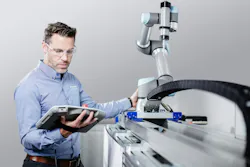
Thomson, a Regal Rexnord brand, will showcase its Movotrak Cobot Transfer Unit (CTU), which the company describes as the industry’s first collaborative seventh-axis system for cobots. Designed as a plug-and-play solution, the CTU incorporates collision-detection capabilities and extends a cobot’s horizontal working range by up to 10 m. This will enable robots to serve multiple workstations and applications from a single installation.
(ii) Single Source Motion Integration
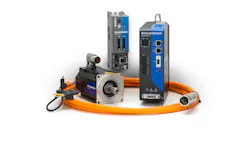
Kollmorgen is expanding its Essentials Motion System portfolio with the addition of the PCMM2G Essentials controller and a high-voltage drive rated up to 4 kW. The expanded platform gives OEMs more options to balance performance, scalability and cost while streamlining machine design through a fully integrated motion system sourced from a single supplier.
(iii) Brake with Built-in Position Sensing
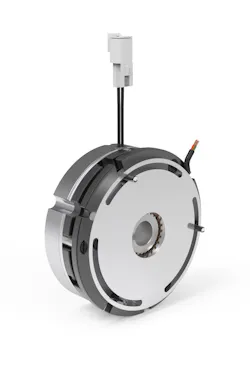
Warner Electric’s Integrated Position Brake (IPB) combines a spring-applied, electrically released brake with a built-in absolute position sensor that eliminates the need for a separate encoder. The design adds just 9 mm to drivetrain length while reducing component count and simplifying integration, offering OEMs a more compact solution for space-constrained motion applications.
2. Compact Motion Solutions for Next-Generation Logistics Automation
Demand for high-performance motion systems is rising alongside logistics automation, which market forecasts expect to expand rapidly through 2033 as automated guided vehicles (AGVs), autonomous mobile robots (AMRs) and intelligent warehouse systems gain traction.
What should engineers take away from this data? The growth has a ripple effect that puts a premium on compact, efficient and highly configurable drive systems. As AGVs and AMRs become central to modern logistics, engineers are being pushed to deliver precise, reliable motion in tighter spaces. They are also charged with meeting demands for design flexibility, faster development and scalability as requirements evolve.
Manufacturers such as maxon are responding with brushless DC (BLDC) motors and modular drive systems designed for continuous operation in automated guided vehicles (AGVs) and autonomous mobile robots (AMRs). These platforms can be configured with different motors, gearheads, encoders, brakes, electronics and environmental protection ratings to meet a wide range of application requirements. The modular approach provides a more adaptable way to meet the performance, efficiency and reliability demands of automated material-handling applications.
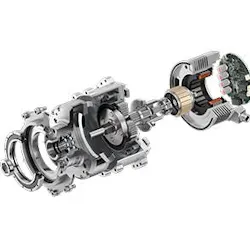
Take also as an example maxon’s joint variants, which pair high-efficiency planetary gear systems with frameless, torque-dense EC motors and dual-encoder architectures. For untethered medical and robotic applications, the emphasis is on efficiency, runtime and durability, including the ability to withstand repeated sterilization cycles under autoclave conditions,
At Automate, attendees can view maxon’s High-Efficiency Joint (HEJ) platform—specifically the HEJ 90—a compact, high-dynamics actuator that integrates motor, transmission, electronics and sensors for robotics applications including AGVs, AMRs, quadrupeds and bipeds. The HEJ 90 delivers 50 Nm of peak torque and speeds up to 28 rad/sec while weighing just over 1 kg, delivering high torque density for mobile manipulation tasks. It includes integrated EtherCAT controllers, impedance control and precise torque measurement without a separate sensor. The solution reduces costs and failure points while maintaining a robust, fully encapsulated design for continuous operation.
South Building—Booth 231
3. Physical AI Enhances Automation
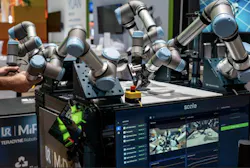
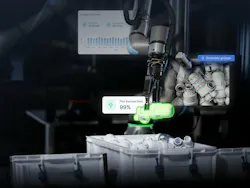
Developing robots that can operate reliably in messy, unpredictable environments remains one of industrial automation’s central challenges. Teradyne Robotics is working on this by combining Universal Robots (UR) collaborative robots and Mobile Industrial Robots (MiR) autonomous mobile robots with AI-driven vision, learning and control systems.
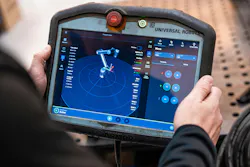
With live demonstrations scheduled hourly, the company will present applications designed to learn from human demonstrations, adapt to changing conditions and handle objects whose position or orientation may not be known in advance. These capabilities are supported by PolyScope X, Universal Robots’ next-generation software platform, which is positioned as an AI-ready framework for more autonomous robotic behavior.
PolyScope X incorporates modern web technologies, containerized applications and native ROS 2 support, allowing developers and engineers to work within familiar software environments. It also introduces Logic Programs—continuously running, multi-threaded processes that operate alongside the main robot program. This type of background logic can coordinate multiple work-cell components and support data exchange. In some cases, it can reduce reliance on external PLCs, while running independently of safeguard stops, program pauses and robot power state.
Taken together, the demonstrations are intended to illustrate how the field of industrial robotics is evolving toward moving from strictly predefined programming toward systems that can perceive, interpret and respond to more variable real-world conditions. This is often referred to as physical AI.
The booth features a range of physical AI applications built around UR robots and MiR autonomous mobile robots that highlight how ecosystem partners are tackling unstructured industrial tasks. Demonstrations include force-sensitive polishing through learned motion with AICA; adaptive palletizing, mobile material handling and coordinated flow between a UR20, MiR600 and AI-enabled pallet jack from beRobox (PALTZ) and MiR Mobility; and a mobile cobot material transfer system using MiR250 and ROEQ.
Additional use cases feature Maple Advanced Robotics Inc.’s CAD-free spot sanding system powered by a UR8L, Trener Robotics’ Acteris platform enabling conversational deployment of machine tending on a UR7e, and Vention’s Rapid Operator AI bin-picking solution using a UR12e and 3D vision for unstructured part handling.
South Building—Booth 1250
4. Industrial PCs for AI
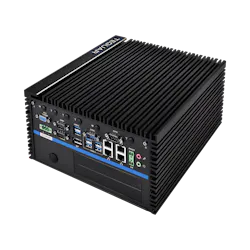
Visit Teguar to see how industrial PCs are being asked to handle everything from AI inference to machine connectivity in ever smaller footprints. The provider of advanced industrial and medical computer solutions will debut its Regiment Series of fanless industrial edge box PCs, spanning high-performance AI systems, compact edge AI platforms and lightweight IoT gateways.
The lineup includes the Intel Core-powered Regis for machine vision and edge AI workloads (Regis TB-7393), the Core Ultra-based Optio with an integrated NPU for on-device AI processing (Optio TB-7293), and the compact Scout gateway for secure data aggregation and thin-client deployments (Scout TB-6293).
These systems are designed for harsh environments and combine wider operating temperature ranges, flexible I/O and expansion options and support for applications ranging from collaborative robotics and vision systems to industrial networking and centralized computing architectures.
North Building—Booth 32022
5. Uptime-Driven Network Design
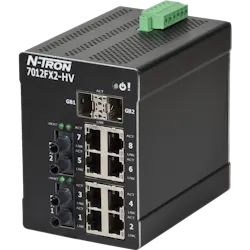
Industrial networks are becoming faster, more distributed and increasingly critical to uptime. That calls for updated infrastructure. The latest demands are emerging around deterministic performance, rapid recovery and simplified lifecycle management at the edge. For example, the N-Tron NT7000 Series from HMS Networks is a next-generation industrial Ethernet switch platform is designed deterministic performance and lifecycle simplicity in demanding industrial environments.
Key technical differentiators include ultra-fast startup with traffic forwarding in under 7 seconds, rapid N-Ring redundancy recovery of about 20 ms, and hardware-based IEEE 1588 PTP support for sub-microsecond time synchronization—targeting motion control, robotics and other time-sensitive applications where timing variability is critical.
Beyond performance, the platform emphasizes deployment and maintenance efficiency through tools such as N-View 3 for network discovery and monitoring, micro-SD-based configuration backup and restore for rapid replacement, and integrated support for EtherNet/IP environments via CIP messaging AOI and faceplates. A modular hardware design supports copper and fiber configurations for scalable industrial architectures.
Ruggedized for real-world deployment, the switches carry certifications including UL, ATEX, IECEx, ODVA, marine and railway standards, and are designed for shock, vibration, surge protection and wide temperature ranges in DIN-rail-mounted metal enclosures.
South Building — Booth 3076
About the Author
 Rehana Begg
Rehana Begg
Editor-in-Chief, Machine Design
As Machine Design’s content lead, Rehana Begg is tasked with elevating the voice of the design and multi-disciplinary engineer in the face of digital transformation and engineering innovation. Begg has more than 24 years of editorial experience and has spent the past decade in the trenches of industrial manufacturing, focusing on new technologies, manufacturing innovation and business. Her B2B career has taken her from corporate boardrooms to plant floors and underground mining stopes, covering everything from automation & IIoT, robotics, mechanical design and additive manufacturing to plant operations, maintenance, reliability and continuous improvement. Begg holds an MBA, a Master of Journalism degree, and a BA (Hons.) in Political Science. She is committed to lifelong learning and feeds her passion for innovation in publishing, transparent science and clear communication by attending relevant conferences and seminars/workshops.
Follow Rehana Begg via the following social media handles:
LinkedIn: @rehanabegg and @MachineDesign
YouTube: @MachineDesign-EBM