The AI Trainer, the Generalist and the Cable Inserter Walk into a Booth
This article was featured in Machine Design’s Automation & Robotics Takeover Week (July 13-17, 2026).
Teradyne Robotics used its Automate booth to show how physical AI is moving from experimental applications into deployable manufacturing workflows, with demonstrations focused on robot training, autonomous assembly and AI-enabled electronics production.
Rather than leaning on forward-looking concepts, Will Healy III, Director of Product and Industry Marketing, Teradyne Robotics, positioned the booth tour around applications that were relevant to today’s production environments. “These are real things that real people can deploy in real factories,” said Healy.
The AI Trainer
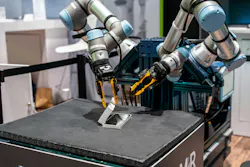
The tour started at Universal Robots’ AI Trainer, developed in collaboration with Scale AI. The demonstration used a pair of collaborative robots that operators guided through assembly tasks while the system captured high-frequency force, motion and positional data. Those datasets are used to train vision-language-action (VLA) models, enabling robots to reproduce the tasks autonomously without traditional programming.
READ MORE: A New Agent in Town: Inside the Industrial AI Workforce
“The software from Scale AI is collecting thousands of data points from the robots every second and putting that all into a database to build an AI model,” Healy explained. “As you build that training data, you can build a model to actually have the robots do the tasks [independently].”
The Generalist
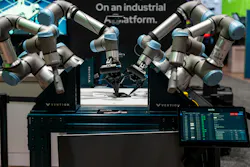
This approach was further illustrated in a second demo developed with robotics and AI startup Generalist, where two UR12e cobots performed an assembly operation using a model trained via imitation learning. The application reflects hundreds of hours of operator-guided input, replacing traditional teach-pendant programming with data-driven model training. If the robot makes a mistake, it iterates until the task is completed, noted Healy.
The Cable Inserter
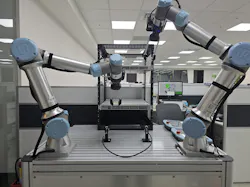
A third demonstration, developed with Cambrian, a developer of AI-powered 3D vision systems, highlighted AI-driven automation in data center infrastructure manufacturing. Two UR7e cobots, guided by Cambrian’s vision system, assembled high-density server racks by routing and inserting copper cabling. This operation is typically performed manually due to the complexity of handling deformable materials.
Wires exhibit what is known as “memory,” meaning they retain their shape and flex unpredictably, creating variability that conventional automation often struggles to accommodate, Healy explained. The vision system identifies connector orientation and dynamically adjusts robot trajectories in real time prior to insertion.
READ MORE: 5 Things Engineers Need to Know About FactoryTalk Orchestration Software
The data center use case also played into Teradyne Robotics’ position that many applications often associated with future humanoid systems, such as flexible assembly and labor-intensive tasks, can already be addressed using collaborative robots paired with AI models.
“There’s a lot of discussion around humanoids solving labor and flexibility challenges,” Healy said. “Whether you want to apply a humanoid in the future or want to apply a humanoid today, you can start with a with AI Trainer...and then go to a dual-arm assembly application like this.”
Building Autonomy
For Healy, building more capable autonomous systems starts with applying collaborative robots, AI vision and imitation learning in current production environments. If the AI Trainer is the starting point, applications such as the ones from Generalist and Cambrian represent the next logical progression in an automation strategy, demonstrating how manufacturers can begin deploying physical AI while laying the groundwork for increasingly autonomous systems.
The Digital Twin Walks in: Vention Brings Virtual Work Cells to Life
Before the cobot ever turns on, Vention’s digital twin platform enables engineers to design, simulate and validate robotic work cells.
While Teradyne Robotics’ booth at Automate 2026 emphasized how robots learn and perform tasks, the company also highlighted the engineering tools needed to design those systems before deployment. Through its collaboration with Vention, Universal Robots (a Teradyne company) showcased how MachineBuilder, simulation and digital twins can help engineers configure, validate and optimize robotic work cells using preconfigured templates and virtual commissioning tools.
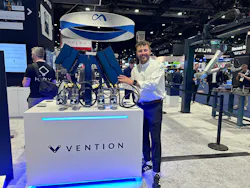
At the Vention booth, the platform was paired with its Rapid Operator AI deep bin-picking application running on a UR12e cobot, illustrating how digital engineering and physical AI are converging to accelerate automation deployment.
Faster Development, More Complex Automation
Complementing the physical AI demonstrations, Vention showcased its Manufacturing Automation Platform, which brings design, simulation, deployment and operations together within a single workflow. During a booth overview, Vention’s Baptiste Bonturi highlighted a practical reality for engineers: as automation systems become more intelligent, the tools used to design and deploy them must evolve as well.
Across six live demonstrations, the company highlighted applications ranging from Rapid Operator AI deep bin-picking with a UR12e cobot and AI-driven FANUC machine tending to modular motion, welding and factory infrastructure solutions.
About the Author

Rehana Begg
Editor-in-Chief, Machine Design
As Machine Design’s content lead, Rehana Begg is tasked with elevating the voice of the design and multi-disciplinary engineer in the face of digital transformation and engineering innovation. Begg has more than 24 years of editorial experience and has spent the past decade in the trenches of industrial manufacturing, focusing on new technologies, manufacturing innovation and business. Her B2B career has taken her from corporate boardrooms to plant floors and underground mining stopes, covering everything from automation & IIoT, robotics, mechanical design and additive manufacturing to plant operations, maintenance, reliability and continuous improvement. Begg holds an MBA, a Master of Journalism degree, and a BA (Hons.) in Political Science. She is committed to lifelong learning and feeds her passion for innovation in publishing, transparent science and clear communication by attending relevant conferences and seminars/workshops.
Follow Rehana Begg via the following social media handles:
LinkedIn: @rehanabegg and @MachineDesign
YouTube: @MachineDesign-EBM
Voice Your Opinion!
To join the conversation, and become an exclusive member of Machine Design, create an account today!

Leaders relevant to this article: