A New Agent in Town: Inside the Industrial AI Workforce
This article was featured in Machine Design’s Automation & Robotics Takeover Week (July 13-17, 2026).
The data exists. The problem is accessing it when it matters most.
Manufacturers have spent years collecting machine and operational data, yet much of that information remains trapped within disconnected systems, forcing engineers, operators and reliability teams to navigate fragmented sources before they can act. Augury’s newly introduced Industrial AI Workforce aims to close that gap with AI agents designed around specific manufacturing roles and workflows.
Machine Design has followed Augury’s evolution from predictive machine health toward broader manufacturing intelligence. Earlier coverage explored Augury’s use of AI and ultrasound for predictive maintenance and its role in advancing connected manufacturing operations. Their latest offering represents the next step in that evolution, shifting from identifying equipment problems to helping industrial teams determine what actions to take next.
READ MORE: Sonair Hits Robotics Milestone with First Certified 3D Ultrasonic Safety Sensor
Watch the video: At AVEVA World in Milan, Machine Design sat down with Augury CEO Elan Greenberg and Chief Product and Technology Officer Anoop Mohan to discuss how the company's Industrial AI Workforce uses AI agents to connect siloed manufacturing data, preserve institutional knowledge and support faster operational decision-making.
Problem Statement: Turning Siloed Data into Actionable Insight
Augury is addressing a familiar challenge across manufacturing: despite years of investment in sensors, automation systems and enterprise software, valuable operational data often remains fragmented across disconnected platforms. The company’s Industrial AI Workforce is designed to help reliability, maintenance and operations teams access and interpret that information more efficiently, with the goal of accelerating decision-making and improving plant performance.
“If we can help with that solution, that’s going to allow them to become more efficient and execute their functions better than ever, increase the yield at their sites, reduce their unplanned downtime and all sorts of great operational metrics that we’re excited to partner with them on,” Greenberg said.

Connecting Machine Data with Operational Context
Augury has historically focused on machine health monitoring through sensors, gateways, cloud connectivity and machine learning models. But as Mohan explained, supporting industrial workflows requires looking beyond machine data alone. “Everything from a sensor that goes on top of a machine that manages the vibration… to a gateway that gets the sensor data and goes all the way to the cloud,” he said, describing the company’s existing technology stack.
Today, engineers also need access to operational data from across the plant. “They’re just not looking at the sensor data now,” Mohan said. “They’ll need to look at data coming from operational systems, historians, CMMS, ERP data and so forth.”
To connect these sources, Augury introduced what it calls an industrial context graph layer, which is a data layer designed to provide context across different systems. Mohan described the architecture as three connected elements: machine data from Augury’s sensors and analytics, operational data from plant systems and a reasoning layer that allows AI agents to interpret information in context.
READ MORE: From Data to Decisions: The Race to Make Industrial AI Operational
“We need the machine data that comes from us,” he said. “We need the operational data that comes from AVEVA Connect. That’s why it’s a marriage of 1 + 1 equals 3. When you bring these two data, you need a reasoning layer.”
At AVEVA World in Milan, Greenberg said the Industrial AI Workforce was introduced alongside integrations with AVEVA Connect and Google Cloud. The integrations enable the platform to ingest operational data through AVEVA Connect while using Google Cloud’s foundation models to support AI reasoning.
By adding sensing capabilities to existing assets, Augury can transform decades-old machines into connected systems that provide operational insights through cloud-based platforms. “You can take a piece of equipment that is 50, 80, 100 years old, in some instances, and have that engaging with an agent to provide the best possible insights to the end user,” Greenberg said.
AI Agents Built for Reliability
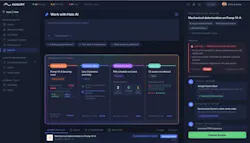
Augury’s premise is that engineers don’t need more dashboards. They need faster ways to interpret data and act on it within the context of their daily workflows. Mohan used the example of a reliability engineer investigating a machine fault, where determining the root cause, assessing its severity and deciding on corrective action often requires navigating multiple systems.
“That process of being able to diagnose, do a root cause analysis and then be able to open a work order—that’s typically what we call a workflow—takes weeks, if not more, these days,” Mohan said. The company's response is to develop role-specific AI agents that understand these workflows and help reliability engineers move more quickly from fault detection to maintenance decisions.
AI Agents Built for Operations
While the first AI agent targets reliability workflows, Augury has also developed agents for operations. Mohan described a use case involving operators and process engineers managing production performance.
Operators may monitor numerous dashboards tracking process parameters, yield, throughput and product quality. When performance begins to decline, they must identify which variables are responsible and determine what action to take. “They’re looking at 10 different dashboards at any point in time of various different process parameters, trying to make sense of: Is my yield dropping? Is my throughput dropping? Is my product quality changing?” Mohan said.
READ MORE: Will AI Replace Programmers? What Elon Musk's Prediction Means for Mechanical Engineers
The operations agent is intended to identify those changes, determine contributing factors and provide recommendations. “It automatically detects when the yield is going to go down,” Mohan said. “It identifies what parameters are causing the yield to go down. It recommends to them. It pops up on the HMI screen. They can go take this action.”
For Mohan, the objective is to tailor AI agents around the way people already work, rather than asking them to adapt to another software platform. “Understand every user, understand their workflows, give an agent that caters to them that understands the 8 a.m., understands the 2 p.m., understands the 5 p.m.,” he said.
Addressing the Industrial Workforce Transition
Beyond improving productivity, Augury sees AI agents as one way to help manufacturers address the reality that experienced workers are retiring, while recruiting the next generation of maintenance, operations and reliability professionals is becoming increasingly difficult.
Greenberg noted that many longtime manufacturing professionals with decades of site-specific knowledge are approaching retirement, while companies are finding it increasingly difficult to fill roles in maintenance, operations, process engineering and reliability. “They’re the subject matter experts [on] how to perform those functions,” he said.
The Industrial AI Workforce is intended to help bridge that knowledge gap by enabling leaner teams to access operational insights and continue meeting production and reliability objectives. “By leaning on the Industrial AI Workforce, you have the opportunity to do more with a leaner team in place,” Greenberg said.
While predictive maintenance remains Augury's foundation, the company’s latest announcement signals a renewed ambition that leans on AI agents to help engineers, operators and maintenance teams interpret industrial data in the context of their daily work.
Rather than replacing existing software, the AI agents are intended to sit across manufacturing systems, turning fragmented operational information into recommendations that support informed decisions.
About the Author
 Rehana Begg
Rehana Begg
Editor-in-Chief, Machine Design
As Machine Design’s content lead, Rehana Begg is tasked with elevating the voice of the design and multi-disciplinary engineer in the face of digital transformation and engineering innovation. Begg has more than 24 years of editorial experience and has spent the past decade in the trenches of industrial manufacturing, focusing on new technologies, manufacturing innovation and business. Her B2B career has taken her from corporate boardrooms to plant floors and underground mining stopes, covering everything from automation & IIoT, robotics, mechanical design and additive manufacturing to plant operations, maintenance, reliability and continuous improvement. Begg holds an MBA, a Master of Journalism degree, and a BA (Hons.) in Political Science. She is committed to lifelong learning and feeds her passion for innovation in publishing, transparent science and clear communication by attending relevant conferences and seminars/workshops.
Follow Rehana Begg via the following social media handles:
LinkedIn: @rehanabegg and @MachineDesign
YouTube: @MachineDesign-EBM