What Engineering Design Reviews Commonly Miss Before Automated Equipment Reaches FAT
What You'll Learn:
- Why recurring FAT problems often originate in incomplete multidisciplinary design reviews.
- Which operating, recovery, interface, changeover and maintainability questions should be resolved before FAT.
- How early FAT criteria and user journey reviews can move defect discovery to a more flexible stage of design.

FAT Problems are Often Design Review Problems
Factory acceptance testing (FAT) should verify that an automated machine meets agreed requirements before shipment. Yet many FAT sessions become design workshops conducted under schedule pressure. Reviewers discover inaccessible sensors, unclear recovery behavior, incomplete interfaces, weak diagnostics or changeover concepts that were never fully evaluated. These are not primarily testing failures. They are design review issues that surfaced late.
Traditional design reviews are often organized by discipline. Mechanical reviews examine frames and mechanisms, electrical reviews examine panels, and schematics and controls reviews examine sequences. That structure is necessary, but it can miss the operating experience created by the interaction of those disciplines. A more effective review asks how the machine will be installed, connected, started, operated, cleaned, changed over, faulted, recovered, maintained and modified.
1. The Physical Envelope is More Than the Machine Footprint
A layout may show that the machine fits in the assigned space while overlooking the space needed to use and service it. Review the operating envelope, maintenance envelope, removal paths for major components, door swings, guard access, material replenishment, cleaning access, lifting points, cable routes and the location of temporary service equipment.
Ask whether a technician can replace a motor, sensor, belt, cylinder, valve or drive without removing unrelated equipment. Confirm that adjustment points can be reached safely and that routine work does not require improvised platforms or awkward body positions. Also check whether carts, ladders, lifting devices and replacement components can physically reach the service location. A machine that fits geometrically can still fail operationally if its service envelope was never designed.
2. Interface Control Should be a Design Deliverable
Automated equipment rarely operates alone. It exchanges product, utilities, signals, data, safety conditions and operating expectations with other systems. These interfaces should be captured in an interface control document rather than dispersed across drawings, meeting notes and email threads.
The review should identify responsibility for mechanical transitions, elevations, accumulation, utilities, network addresses, data tags, time synchronization, upstream and downstream signals, safety boundaries, reject transfer and line-control ownership. Each interface needs an owner, an acceptance condition and a defined test method. If an interface cannot be simulated before FAT, the team should agree on what evidence will be available at FAT, what remains for site acceptance testing and who owns the residual risk.
3. Fault Recovery Deserves the Same Attention as the Normal Cycle
Design teams naturally focus on the sequence that produces output. Operators and technicians spend much of their time dealing with the conditions that interrupt that sequence. Reviews should therefore examine failure and recovery as explicit operating modes rather than as exceptions to be addressed during commissioning.
Challenge loss of product, loss of material, blocked discharge, sensor disagreement, actuator timeout, communication failure, emergency stop, guard opening, power interruption and manual movement. Determine what the machine retains, what it forgets, what must be inspected and what actions are required before restart. Good recovery logic protects product identity, machine position and operator understanding. It also avoids the common pattern in which clearing one fault creates another.
4. Diagnostics Should Explain the Condition, Not Only Name the Device
An alarm that identifies a “sensor fault” may be technically correct but operationally weak. The human-machine interface should help the user understand what the machine expected, what it observed, what condition is preventing operation and what safe checks are appropriate.
During design review, evaluate alarm text, prioritization, first-out capture, event history, permissive displays, device status and access to relevant drawings or procedures. Confirm that diagnostic data survive long enough to support troubleshooting and that timestamps are consistent across connected equipment. Maintenance and operations personnel should review diagnostics before FAT, when changes remain relatively inexpensive and can still be tested systematically.
5. Changeover Needs a Complete Operating Concept
Changeover performance depends on more than quick-release hardware. The design must coordinate physical parts, recipe selection, adjustable positions, label or code data, inspection limits, line clearance and verification that the correct setup has been installed.
Review the range of product and package variants, the storage and identification of change parts, error-proofing features, adjustment scales, recipe access and the process for introducing a new format. Conduct a representative changeover during FAT rather than testing only the base product. Record the tools, decisions, manual inputs and verification steps required. What appears simple in CAD may be confusing on the shop floor, especially when multiple machines must be changed in a controlled sequence.
6. Maintainability and Lifecycle Support Should be Testable
Maintainability is often expressed as a general requirement rather than a set of observable design features. Convert it into questions that can be reviewed and demonstrated. Are wear components visible? Are lubrication points accessible and identified? Are diagnostic connectors reachable? Are backup files organized? Are replacement devices standard or uniquely configured? Can the machine be restored after a failed controller, drive or HMI?
The review should also address spare input/output capacity, network capacity, panel space, software licenses, source-code ownership, password administration, cybersecurity expectations and obsolescence risk. Confirm what documentation, software backups, bill-of-material information and vendor support contacts will be delivered. These decisions determine whether the machine can be supported, restored and modified over its operating life.
7. FAT Criteria Should be Written While the Design is Still Flexible
FAT protocols are strongest when they are drafted early and used as a design-review tool. Each requirement should have a test method, needed material, expected result, responsible witness and rule for handling exceptions. Early drafting reveals requirements that are ambiguous, contradictory or impossible to test.
The review should distinguish demonstration from endurance testing, nominal production from boundary conditions and OEM responsibility from site-dependent verification. It should identify which software, drawing, recipe and parameter revisions will be frozen for FAT. Open items should be classified by their effect on safety, function, shipment, installation and startup rather than collected in one undifferentiated punch list. A test cannot provide confidence when the configuration under test or the acceptance decision is unclear.
A Better Review Format
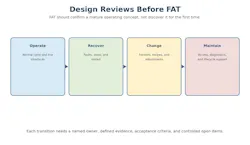
A multidisciplinary review can be organized around six user journeys: installing the machine, starting it, running it, changing it over, recovering it from failure and maintaining it. Walk each journey using the latest layout, control narrative, schematics, HMI screens, maintenance information, interface documents and FAT protocol. Include the people who will operate and support the equipment, not just the people who designed it.
For each journey, identify assumptions, decisions, evidence, owners and unresolved exceptions. Assign actions with due dates and verify closure at the next design gate. This approach does not replace discipline-specific review; it connects those reviews around the complete operating experience.
The objective is not to predict every possible field problem. It is to move discovery earlier, when the design is flexible and correction is less disruptive. FAT should confirm a mature operating concept—not become the first time the complete machine is evaluated through the eyes of the people who must live with it.
About the Author
 Muhammad Rafay Ikram
Muhammad Rafay Ikram
Muhammad Rafay Ikram is an industrial automation engineering professional, independent researcher and inventor with two U.S. patent applications pending. He has more than 14 years of experience in controls, commissioning, robotics-enabled material handling, packaging automation, reliability and capital-project delivery. His work focuses on practical methods for integrating equipment, people and operating systems in complex manufacturing environments.
Voice Your Opinion!
To join the conversation, and become an exclusive member of Machine Design, create an account today!
 Leaders Logo
Leaders relevant to this article: