Design Brief: Overcoming Machine Vision’s Low-Light Barrier
If machine vision systems had only one job, it would be to turn difficult image data into reliable inspection decisions. But motion blur, low light and high dynamic range can still make that harder than it should.
The Problem: Machine Vision Struggles in Real-World Conditions
Machine vision systems break down when speed and lighting become unpredictable. That's because conventional image sensors cannot simultaneously capture fast motion, low-light scenes and high dynamic range. When lighting changes, important details can disappear in both bright and dark areas, making it harder for AI vision systems to detect defects accurately. This forces engineers to make tradeoffs between blur, noise and exposure.
Under these conditions, engineers compromise by slowing the line, adding more lighting, deploying multiple cameras or accepting less reliable detection. The result is a dependency on a system that can become overly complex and that may not guarantee image quality.
One Emerging Solution: Photon-Level Image Processing
Ubicept, an MIT spinout based in Madison, Wis., is taking a different approach by improving image quality before computer vision algorithms ever analyze the scene. "High-speed imaging is very useful, but typical high-speed cameras don't work in low light or with high dynamic range," said Ubicept Cofounder and CTO Tristan Swedish.
Rather than relying solely on improvements in traditional cameras, Ubicept combines advanced sensor technology with computational processing to extract more useful information from captured light. The company uses single-photon avalanche diode (SPAD) sensors with proprietary software to process photon-level data. Unlike conventional cameras that measure overall light intensity during an exposure, SPAD sensors detect individual photons, generating richer image data—but also creating large amounts of information that must be processed efficiently.
READ MORE: The Eyes of Automation: Machine Vision’s Role in AI-Powered Automation
To address this challenge, Ubicept developed FLARE (Flexible Light Acquisition and Representation Engine), which manages photon-level data while reducing bandwidth and compute requirements. The platform also uses Ubicept Photon Fusion (UPF) algorithms to process and enhance image data, helping machine vision systems maintain performance in difficult conditions such as low light, fast motion and high dynamic range scenes.
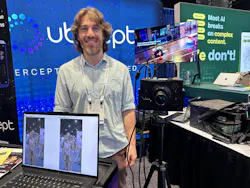
At a booth demonstration at Automate 2026, Swedish showed a SPAD camera capturing images at 1,000 frames per second while observing a rapidly spinning target in low light. Without Ubicept's processing, motion blur prevented a QR code detection algorithm from identifying the target. Once real-time processing was enabled, the system consistently detected the QR code despite the high rotational speed. "We're able to undo that motion blur in real time and feed that into computer vision," Swedish explained.
What the Technology Addresses
According to Ubicept, photon-level processing can improve performance in situations including:
- High-speed inspection with minimal motion blur
- Low-light imaging without excessive noise
- Scenes containing both very bright and very dark regions
- Inspection systems synchronized with LEDs or lasers
- 3D sensing applications requiring precise timing
Why it Matters for Design Engineers
For automation designers, better imaging means better machine performance. As AI-driven inspection systems become faster and more widespread, poor image quality can reduce accuracy, slow production and limit overall effectiveness.
READ MORE: What Industries can Benefit from Machine Vision?
Photon-level imaging offers one way to reduce reliance on additional lighting, multiple camera types or slower conveyor speeds. By capturing clearer images at the point of acquisition, the technology can help machine vision systems operate more reliably across a wider range of production conditions.
Ubicept's capabilities target applications such as surface inspection, defect detection, robotic guidance, infrastructure inspection and autonomous vehicles. “This could be useful for perception applications in automotive autonomous vehicles, but also infrastructure inspection and industrial inspection applications in automation scenarios,” said Swedish.
About the Author
 Rehana Begg
Rehana Begg
Editor-in-Chief, Machine Design
As Machine Design’s content lead, Rehana Begg is tasked with elevating the voice of the design and multi-disciplinary engineer in the face of digital transformation and engineering innovation. Begg has more than 24 years of editorial experience and has spent the past decade in the trenches of industrial manufacturing, focusing on new technologies, manufacturing innovation and business. Her B2B career has taken her from corporate boardrooms to plant floors and underground mining stopes, covering everything from automation & IIoT, robotics, mechanical design and additive manufacturing to plant operations, maintenance, reliability and continuous improvement. Begg holds an MBA, a Master of Journalism degree, and a BA (Hons.) in Political Science. She is committed to lifelong learning and feeds her passion for innovation in publishing, transparent science and clear communication by attending relevant conferences and seminars/workshops.
Follow Rehana Begg via the following social media handles:
LinkedIn: @rehanabegg and @MachineDesign
YouTube: @MachineDesign-EBM
Voice Your Opinion!
To join the conversation, and become an exclusive member of Machine Design, create an account today!
 Leaders Logo
Leaders relevant to this article: