Power and Control Components Address Evolving Data Center Infrastructure Challenges

As data centers grow rapidly to support artificial intelligence (AI), Internet of Things (IoT), cryptocurrency and 5G technologies, they place ever-increasing workloads on their power and control systems.
To meet these requirements, data center operators must address complex infrastructure challenges, including ensuring continuous power for energy-intensive high-density rack systems and deploying advanced cooling systems. Not only must power and control components deliver reliability, efficiency and redundancy, they also should be modular and scalable to allow for future growth.
This overview looks at essential power and control systems and components critical to reliable data center operations in a rapidly evolving industry, including energy monitoring, connectivity and circuit protection products. You’ll learn about the trends that are driving these latest-generation products and their notable features, using offerings from Altech Corporation as representative examples.
Terminal Blocks
To keep up with the latest innovations, facilities must constantly add racks, switches, routers and sensors that require extensive cooling systems as well as control panels and power distribution units to manage it all.
Terminal blocks offer safe, scalable means of organizing and routing the multitude of field wiring connections. Their benefits include easy connections and disconnections and implementers can add new circuits without the burden of rewiring existing circuitry. This modularity and serviceability mean faster equipment installations and less downtime for maintenance and troubleshooting.
Marshaling terminal blocks are particularly attractive for data centers, providing an intermediate connection point between field-wired devices and the control panel for optimal wire organization and easy changes. They combine the reliability of DIN rail mounting with the ease of push-in connections in a compact size. In fact, one such terminal block measures 9 mm wide and 120 mm long. Additionally, ultra-slim terminal blocks are ideal for achieving high connection density in space-constrained cabinets. Altech offers these and other vibration-resistant terminal blocks available in screw-clamp, spring-clamp, push-in and pluggable styles, rated up to 600V for control panels, cooling and data transmission applications.
Busbars and Power Distribution Systems
With expansive amounts of equipment in data centers, facility managers need various means of distributing the power to the different circuits. In a large facility, integrators will deploy both busbars and power distribution blocks for effective end-to-end power routing.
Busbars often provide a simpler, more efficient way to distribute high currents than routing traditional point-to-point cables from circuit breakers and disconnects to rack-level components. They also provide inherent space savings and reconfiguration flexibility when rack layouts change.
READ MORE: Q&A: Safety First—The Role of Disconnect Switches in Industrial Applications
There are also UL 489 busbars that can interface with miniature circuit breakers such as those that protect critical cooling equipment in confined spaces. One such UL 489 busbar can jumper up to 57 poles. Another space-saving option, flexible busbars, can be bent to simplify routing or adapt to tight spaces during retrofitting.
When distributing mains power from a single feed to multiple racks and servers, power distribution blocks are commonly used to divide and route current throughout the system. Available designs include DIN rail-mounted units with features such as color-coded phase identification, finger-safe protection and voltage ratings up to 1,000 V AC/DC. Some configurations also combine a high-current screw-clamp input with spring-clamp outputs to help simplify wiring in space-constrained installations.
UL 489 Miniature Molded Case Circuit Breakers
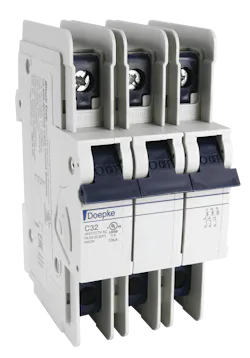
UL 489 miniature circuit breakers offer effective protection against overcurrents and are particularly important at the back end of the facility where the cooling fans, blowers and pump systems are powered and controlled. Molded case construction helps keep the footprint small, offers good insulating properties and can contain arcing between phases that may otherwise create a fire hazard.
One molded-case UL 489 family from Altech is available in AC versions rated to 32A at 480V/277V AC and 63A to 240V AC with one to three poles, and a DC version rated up to 63A at 125 and 250V, with two poles. Short circuit interrupt capacity is up to 10 kA. They snap directly on to standard DIN rails so systems get up and running quickly, and they feature specially designed screw doors for easy accessibility. The UL 489 miniature circuit breakers are part of a complete UL-rated family that also includes UL 508 and UL 1077 units.
Disconnect Switches
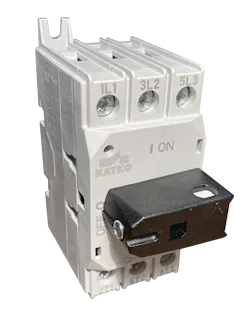
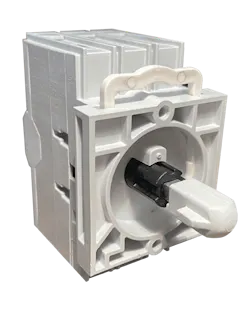
Because data centers no longer rely exclusively on AC power, dual-rated AC/DC disconnect switches are an attractive choice for de-energizing a problematic circuit or component without disrupting the rest of the power infrastructure. And with data centers distributing power at 480V AC and panel systems increasingly operating at 48V DC, demand is growing for dual-rated disconnect switches built for high-power circuits.
Other features to look for include durable, shock-resistant construction, silver contacts for excellent conductivity, a compact size for space-constrained panels and easy installation.
Motor disconnects rated for 600 V AC and 60 V DC are available in a variety of mounting configurations to accommodate different installation requirements. Altech's offerings include DIN rail-mounted and base-mounted designs for extended-handle applications, along with through-door models that fit standard 22.5-mm pushbutton openings and use rear-facing terminals to simplify wiring. The portfolio also includes high-power, dual-rated disconnects designed to reduce the number of required components.
Energy Monitoring Relays
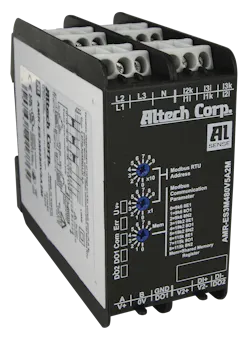
Data center managers are under constant pressure to optimize energy consumption while keeping operating costs under control. Energy monitoring relays can provide the real-time data needed to manage their extensive energy infrastructure. Altech’s Alsense energy monitoring portfolio, for example, includes voltage, current, frequency and phase monitoring units. These devices typically monitor input signals and compare them to a predetermined value, alerting personnel to act on power abnormalities or potential circuit overloads.
With comprehensive energy monitoring, implementers can protect important hardware and prevent downtime, plan circuit capacities and harness information for audits, just to name just a few benefits. The Alsense relays can interface with any logging platform, PLC, HMI or SCADA system and communicate via Modbus RTU/RS485 protocols.
DC UPS/Ultracapacitor Technology
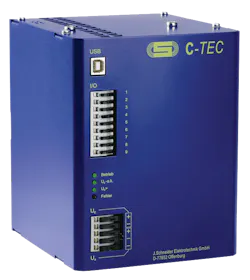
Because data centers operate continuously, backup power systems are often used to help maintain control and monitoring functions during power interruptions. Altech’s CBI DC-UPS combines a power supply, battery charger, backup module and battery management functions in a single unit, while also supporting diagnostic monitoring and communications capabilities.
READ MORE: Uninterrupted Supply: The Principals Behind 40 Years at Altech’s Helm
The unit can be configured for a range of applications, from smaller backup installations to 48 V control panels. When a power event occurs, status information can be communicated through LED indicators, alarms or remote notifications. The unit's Ethernet interface supports protocols including Modbus, TCP/IP, SNMPv3 and HTTPS, and it can record operational data for reporting and analysis.
For operators that prefer an effective alternative to battery-based systems, Altech’s ultracapacitor-based CAPTEC UPS provides straightforward, short-term power continuity.
20A, 30A and 60A Pin and Sleeve Connectors
Pin and sleeve plugs and sockets are increasingly replacing NEMA-type connectors throughout the data center. But as AI, IoT and other technologies proliferate, pin and sleeve connectors must accommodate higher amperages and safely deliver the power to dense rack systems. For effective IEC 60309-compliant connections in high-power rack systems, look for rugged and secure construction plus features that prevent mismating.
Altech’s IEC 60309 Series II 20A, 30A and 60A pin and sleeve devices provide these attributes. The full lineup includes IP67-rated plugs with a patented strain relief and conductive brass pins, sockets that feature a secure cable nut gland and tool-free mounting, along with easily identifiable screw terminals.
D- and X-Coded Sensor Cable Connectors
As AI and cloud computing drive sharply higher data rates and denser rack configurations, managing the growing volume of cabling has become critical. Cables must meet higher bandwidth demands while ensuring secure, reliable connections. X- and D-coded connectors are increasingly essential in data centers to meet these needs.
D-coded connectors have a four-pin, M12 design, supporting fast Ethernet. They are backward-compatible with a wide range of existing field devices and sensors. X-coded connectors come in an eight-pin M12 arrangement and handle up to 10 Gbps.
Rugged and compact, both connectors work with CAT 6e cables. Their circular thread and screw-lock design ensures secure connections in dense racks and cooling systems where accidental disconnects may otherwise occur. X- and D-coded connectors also feature IP67-rated protection and ruggedized housings for reliability in less-than-ideal conditions.
Industrial Enclosures
Enclosures are available for a wide range of applications, including housing control components, DIN rail terminal blocks, circuit breakers, switches, meters, printed circuit boards, instruments and sensors. Manufacturers offer numerous enclosure designs to accommodate different device types, environmental conditions and installation requirements.
Selecting an enclosure typically involves matching the enclosure’s characteristics with the intended application and operating environment. Common selection criteria include:
- Construction. Enclosure materials vary in strength, impact resistance and environmental durability, with non-metallic options commonly used in industrial and electrical applications.
- Fire safety. Material selection may also be influenced by fire-safety requirements. Options such as flame-retardant polystyrene, ABS and glass-filled polycarbonate are available with ratings that meet standards including UL 94 and VDE 0471.
- Ingress protection. Depending on the enclosure design and installed fittings, ingress protection ratings can reach IP67 (NEMA 4/4X) for applications exposed to dust, moisture or washdown conditions.
- Mounting requirements. Enclosures are available in configurations designed for panel, frame and surface mounting.
- Additional considerations. Other factors may include visibility of internal components through transparent covers, enclosure weight and the need for modifications or customization.
Choose an Ideal Component Partner
Component selection is one part of a broader data center design process that also includes evaluating vendor support, integration requirements and the availability of application-specific solutions. Addressing these factors early can help streamline deployment and support reliable operation over the life of the system.
Have a question, comment or idea? Get in touch with the Machine Design editors at [email protected].
About the Author
Klaus Tum
Product Director, Altech Corp.
Voice Your Opinion!
To join the conversation, and become an exclusive member of Machine Design, create an account today!
 Leaders Logo
Leaders relevant to this article: