OPEN MIND Joins FANUC Initiative to Integrate 5-Axis CAM and CNC Technology
OPEN MIND Technologies has joined FANUC’s 5-Axis Integrated Technology Initiative as a founding member, a collaboration aimed at improving the efficiency, accuracy and repeatability of complex 5-axis machining by aligning CAD/CAM software, postprocessors, CNC controls and machine tools.
The initiative brings together FANUC, machine tool builders and CAD/CAM technology companies to establish best practices for code structure, data standards and postprocessor integration. The objective is to give manufacturers greater assurance that a CAM-generated program will behave as intended on the target machine, while supporting high-performance machining and surface finishes.
This initiative reflects the growing CAM software demands of design and manufacturing engineers. Rather than simply generating a toolpath, CAM systems are being asked to manage more of the manufacturing workflow—from design data and model-based tolerances through simulation, machine control, probing and part verification.
Alan Levine, Managing Director of OPEN MIND Technologies USA, said engineers are asking CAM software to handle more of the manufacturing workflow, from incorporating design data and model-based tolerances into toolpath generation to interfacing with machine controls and probing systems used to verify the part.

“Many years ago we were asked to make a good tool path, and we do that and we still do that today,” Levine said in an interview at IMTS 2026. “They’re looking for more of an entire workflow.”
“Beyond the toolpath, we make the part, we interface with machine controls and we do a lot of probing processes to confirm the quality of the part or to confirm the alignment of the part on the machine,” Levine said, “so that we’re increasing the chances through one data structure that the part will be made properly.”
Proving the Machining Process Before It Reaches the Machine
OPEN MIND’s hyperMILL CAD/CAM software is known for its 5-axis machining capabilities and what the company calls Virtual Machining, which simulates the machining environment before production. The approach is particularly relevant as 5-axis operations become more complex. Toolpath calculations must account for more than part geometry; machine configuration, tool orientation, collisions, rotary-axis motion and control behavior can all affect whether a program can be executed safely and efficiently.
Levine said simulation has increasingly moved closer to the actual machining process and NC code. “In the simulation end of the software, we’re able to see the entire machine environment and the toolpaths are checked again so that when we get to the machine, everything is proven,” he said.
That validation can occur earlier in the programming process as well. A machine may have an asymmetric head or an offset spindle, for example, creating constraints that are not apparent from the part geometry alone. “We can check this even earlier at the time of the toolpath generation and make sure that we’re not calculating something that will fail later on,” Levine said. “So we can stop the toolpath or trim a toolpath using our virtual machine integrated with the machine simulation at the toolpath calculation time.”
The distinction matters because OPEN MIND is using virtual machine information during toolpath calculation, rather than limiting simulation to a check after the NC program has been generated.
FANUC Initiative Targets the Machine-CAM Interface
OPEN MIND’s participation in the FANUC initiative is intended to strengthen that connection between CAM programming and machine execution.
At IMTS in Chicago, Levine said the program is designed to help manufacturers identify combinations of technologies that have been proven to work together. OPEN MIND demonstrated its compliance with FANUC’s recommended practices by producing the standardized 5-axis evaluation part used in the program.
“What this is aiming to do is to give customers the ability to find matching technologies that are proven and, in this case, essentially certified by FANUC,” Levine said. “So when they try to bring different technologies into their manufacturing environment, everything has a higher assurance.”
READ MORE: Siemens Targets Faster CNC Ramp-Up with “Meet at the Machine” Initiative
The sample component used in the program incorporates a range of machining features, including surfacing, 5-axis motion and pocketing patterns. Levine said the individual features correspond to different machine-control commands that must be supported correctly by the CAM and CNC combination. “This gives the end-user a confidence that their process will work smoothly,” he said.
The emphasis on matching technologies addresses a challenge in 5-axis manufacturing, where a theoretically valid CAM strategy still has to work with a specific machine configuration, tool assembly, postprocessor and CNC control.
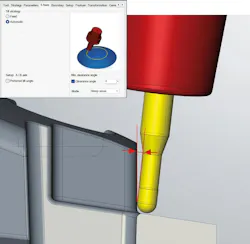
hyperMILL 2026 Expands 5-Axis Toolpath and Collision Control
OPEN MIND has expanded hyperMILL 2026 with new tools for 5-axis toolpath generation, simulation and finishing. In 5-axis machining, three linear axes and two rotary axes can be coordinated simultaneously, allowing the cutter to approach complex surfaces from different angles. That flexibility also makes tool orientation and collision avoidance more challenging, because the tool, holder and machine components must remain within safe limits throughout the cut.
The software’s updated rest-machining strategies improve detection of material left behind by earlier operations and generate smoother toolpaths for removing it. A new Minimum Clearance Angle setting helps maintain a defined gap between the tool shank and the workpiece, while 5-axis Automatic Mode can determine tool orientations and combine indexed and simultaneous movements. The goal is to keep the cutter in an effective cutting position while avoiding the tool, holder or machine head contacting the part—one of the key challenges in 5-axis programming.
hyperMILL also expands virtual machining and tool-definition capabilities. Programmers can model tools such as right-angle heads and simulate the complete machining environment to identify collisions before the program reaches the machine. This is particularly useful for complex parts, where a collision may result not only from the cutter but from the holder or machine geometry.
READ MORE: Physical AI Needs a Paper Trail: Engineering Evidence at the Actuation Boundary
Other updates target difficult finishing and deburring operations. A redesigned 5-axis strategy supports more complex impeller and blisk geometries (integrated rotor disks with curved, closely spaced blades commonly used in aerospace engines), while new brushing and deburring functions automate toolpath sequencing for features such as cross holes and internal threads.
A new 2D Hale Machining strategy is designed for surfaces that require a scratch-free finish. It keeps the tool edge aligned with the contour while machining without active spindle rotation and is currently available for Siemens-controlled machines.
For manufacturers running complex 5-axis parts, the combination of CAM programming, machine simulation and CNC-specific practices is aimed at reducing the gap between what is calculated in software and what happens on the machine.
OPEN MIND solutions are used across industries including aerospace, automotive, medical technology, tool and mold making, energy and precision engineering, where machining performance and process reliability are critical.
OPEN MIND Technologies USA marked its 30th anniversary in North America in 2026. The subsidiary supports manufacturers in the United States, Canada and Mexico with OPEN MIND’s hyperMILL CAD/CAM platform.
Click here for more IMTS 2026 coverage.
Have a question, comment or idea? Get in touch with the Machine Design editors at [email protected].
About the Author
 Rehana Begg
Editor-in-Chief, Machine Design
As Machine Design’s content lead, Rehana Begg is tasked with elevating the voice of the design and multi-disciplinary engineer in the face of digital transformation and engineering innovation. Begg has more than 24 years of editorial experience and has spent the past decade in the trenches of industrial manufacturing, focusing on new technologies, manufacturing innovation and business. Her B2B career has taken her from corporate boardrooms to plant floors and underground mining stopes, covering everything from automation & IIoT, robotics, mechanical design and additive manufacturing to plant operations, maintenance, reliability and continuous improvement. Begg holds an MBA, a Master of Journalism degree, and a BA (Hons.) in Political Science. She is committed to lifelong learning and feeds her passion for innovation in publishing, transparent science and clear communication by attending relevant conferences and seminars/workshops.
Follow Rehana Begg via the following social media handles:
LinkedIn: @rehanabegg and @MachineDesign
YouTube: @MachineDesign-EBM