Exploring the Electronics Aboard AC75 and AC40 Foiling Yachts
Key Highlights
- Modern AC75 yachts use integrated electronics to support monitoring, control, performance, and safety-related functions.
- For the 2027 AC75, batteries replace cyclors as the source of hydraulic power, making energy allocation a key part of race strategy.
- Teams analyse onboard data to refine foil positioning, hydraulic response, and energy management.
- Dual sourcing, component traceability, and life cycle monitoring help protect critical systems from supply disruptions.
- MSD protection, ESD-safe handling, and authenticity checks help ensure component reliability under extreme loads.
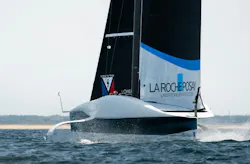
Source: ©Nicolas Touze/La Roche-Posay Racing Team
Modern America’s Cup racing yachts are high-speed embedded systems platforms that use onboard sensors, telemetry, control loops, power conversion, and cockpit interfaces to help crews manage stability, drag, hydraulic response, and foil position. The competition features two classes of foiling yachts: the 12-metre AC40, used for preliminary regattas and the Women’s and Youth America’s Cup, and the 23-metre AC75, the team-specific design that contests the match.[1]
Mouser has joined La Roche-Posay Racing Team as an Official Supporter for the team’s campaign in the 38th Louis Vuitton America’s Cup. The partnership gives the French challenger access to performance-critical electronic components, supporting the onboard systems that keep the team’s foiling race yachts stable, fast, and reliable.
This blog looks at why electronics have become central to America’s Cup performance, how the team’s AC75 boat copes with the demands of the marine environment, and what component availability and traceability mean for a campaign built on rapid, data-driven improvement.
Why Electronics Are Central to America’s Cup Performance
Modern America’s Cup boats are tightly integrated, embedded platforms whose electronics—including telemetry, sensor fusion, and networked electronics architectures—support performance, control, monitoring, and safety-related functions. Mark Patrick, Technical Content Director at Mouser EMEA, describes today’s AC75s as “effectively flying embedded systems platforms,” where the deciding factor is how quickly a team can turn that data into performance improvements. For the 2027 AC75, batteries replace the cyclor teams—crew members pedaling stationary bikes—that previously supplied hydraulic power. A new onboard data crew member monitors how the limited stored energy is allocated among trimming, mast rotation, and foil-cant functions, making power monitoring and control part of the race strategy. Engineers analyse the data both during and after testing sessions to refine foil positioning, hydraulic response, and energy management, continuously updating the digital models that guide development.
That speed of iteration puts real pressure on component reliability, system integration, and supply chain support. For critical systems, such as flight control, power conversion, and telemetry, teams typically apply dual sourcing to ensure supply continuity, along with full component traceability and life cycle monitoring to safeguard design decisions. Quality controls, including moisture-sensitive device (MSD) protection, electrostatic discharge (ESD)-safe storage and assembly practices, and authenticity verification, help ensure components perform reliably under extreme load.