Start With the Finish: Designing Better Abrasive Processes for Modern Metal Fabrication
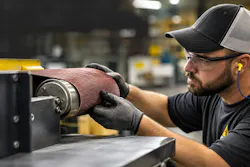
Abrasive selection can seem deceptively simple. Pick a disc, choose a grit, remove the weld and move on. In practice, a grinding or finishing process can go wrong long before the mistake becomes obvious. An operator may stay in one spot a little too long and create a shallow divot that becomes a lot more visible once they reach the painting or polishing stage. Or a grit sequence may skip too far ahead, leaving deep scratches underneath a finer surface, while an overly aggressive disc can remove the weld quickly but also leave gouges that create more work later.
These challenges are playing out as metal fabrication shops adapt to an aging workforce, difficulty recruiting skilled tradespeople and growing pressure to improve production efficiency. More manufacturers are investing in CNC-controlled laser cutting, robotic welding and automated grinding and finishing equipment. Adoption varies from one facility to another, but the direction is clear: Manufacturers want more consistent results, predictable cycle times and less reliance on labor-intensive manual processes. That doesn’t make skilled operators any less important; it does change the work they do, with greater emphasis on equipment setup, programming, process control and quality.
For grinding and finishing, that shift puts more emphasis on controlling the process than relying on an individual operator’s technique. The required surface finish needs to guide decisions much earlier in production, including the choice of abrasives, grinding pressure and sanding sequence. Removing too much material or using an overly aggressive process at an earlier stage can create problems that are difficult to correct during final finishing.
Working Backward from the Finished Surface
The most important question in an abrasive process is, what does the part need to look like when the work is finished? That endpoint should influence nearly every decision that comes before it. A bridge component whose weld only needs to be removed can tolerate a very different grinding process than a stainless-steel appliance, cookware surface or architectural component where aesthetics and surface safety are paramount. In one case, speed may matter most. In the other, every scratch created during material removal eventually must disappear.
Whether the goal is a mirror finish, a brushed appearance or simply a smooth surface ready for coating, the previous abrasive steps have to support that result. A poor choice early in the sequence tends to reappear later, particularly once paint, polish or another finish makes surface irregularities more visible. Material type and part geometry then refine the process further.
Grinding a broad, flat plate allows relatively consistent contact between the abrasive and the workpiece while on a contour, a rigid abrasive may contact only part of the surface at once or dig into high points instead of following the shape evenly. Stainless steel adds another variable because excessive heat can discolor the material, while applications requiring a specific visible finish, such as a brushed, polished, or mirror-like surface, place greater importance on controlling the scratch pattern. Because of these variances, the abrasive process should be designed around the actual part, rather than chosen from material type alone.
Every Grit Has a Job
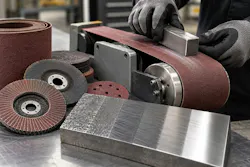
Once the finish is defined, grit progression becomes one of the most important parts of the process. Removing or jumping steps is a common temptation. If an operator can jump directly from a coarse abrasive to something much finer, the process appears faster on paper. The problem is that the finer abrasive still has to remove the scratch pattern created by the coarse one. If the jump is too large, it may spend far longer doing work it was not designed to do or never completely remove those scratches at all.
A better progression gives each grit a specific job. A coarse abrasive handles initial material removal. The next step removes the scratches left behind. Subsequent abrasives continue refining the surface until it reaches the required finish. Depending on the application, that might become a three-, four- or five-step process rather than an arbitrary sequence of whatever products happen to be available.
Technique matters just as much as sequence. Spending too long in one location can overwork the metal and create a small depression that may be nearly impossible to see during grinding, but will become apparent during finishing. Heat can create a different problem. On stainless steel and other alloys, excessive grinding can produce blue heat discoloration, which then has to be removed before the finishing process can continue.
Scratch direction can also reveal whether a grit has actually finished its job. If every sanding step moves in the same direction, a finer abrasive can pass over deeper scratches without fully erasing them. Changing direction between stages makes the previous scratch pattern easier to identify, giving the operator a visual cue that the surface is ready for the next grit. The goal is not to move through abrasives quickly, but to leave each stage only after it has prepared the surface for the next one.
Match Aggression to the Work
Grit tells only part of the story. The construction and backing of the abrasive determine how that grit actually meets the metal. Stiffer products generally transfer more force into the workpiece, producing a more aggressive cut. That can be valuable when a heavy weld needs to disappear quickly. The tradeoff is that stiffness reduces the abrasive’s ability to follow contours and can increase the likelihood of gouging.
Traditional bonded grinding discs sit near the aggressive end of that spectrum. On structural steel where appearance is not important, that can be exactly what the process needs, especially when speed is a main consideration. A surface intended for a refined or decorative finish requires a different balance.
Fiber discs can remove material aggressively while lying relatively flat against the workpiece, which can produce a smoother surface than a traditional bonded wheel. Flap discs are more flexible still and generally leave a finer finish, although they do not remove material as quickly. For a flat part with a weld that needs both removal and refinement, a practical sequence would begin with a fiber disc and move to a flap disc as the priority shifts from stock removal to surface quality.
The same principle applies across cloth, paper, fiberglass and other backing systems: Greater stiffness usually increases aggression while reducing conformity. That tradeoff is becoming even more relevant as automated welding improves consistency. A robotically produced weld may require far less cleanup than a large, irregular manual weld. If less material has to be removed, there may be no reason to begin with the most aggressive abrasive available. Better upstream consistency can allow the finishing process to start closer to the final surface.
Make the Process Measurable
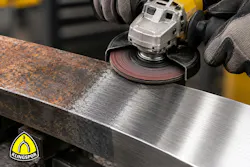
Abrasive efficiency is often discussed in terms of purchase price, but the disc itself is only one part of the cost. Misapplication can make an inexpensive abrasive expensive. Whereas a product that costs slightly more per unit may last considerably longer, cut faster, require fewer changeovers or reduce downstream finishing. Those gains can also limit back-end costs associated with longer manufacturing times, equipment downtime, labor and additional handling or finishing operations. Looking only at unit price misses those considerations.
Waste can also result from how abrasives are used and replaced. Operators may discard sanding discs that still have useful life because they no longer feel as sharp as when new or because loading has reduced their cutting performance. Understanding how abrasive wear and loading affect cutting action can help operators determine when a disc needs replacing, rather than relying on feel alone.
A defined process also makes it easier to train operators who may not have years of hands-on experience. Documenting the sequence and the conditions that affect the result helps reduce variation between operators and shifts. Automation can further improve repeatability by controlling variables such as pressure, cycle time, abrasive wear and material removal. Testing also helps establish process standards by showing how different abrasives perform under comparable conditions.
One method, used by abrasives manufacturer Klingspor, is to evaluate abrasive performance by weighing cutoff wheels before and after testing, run them for a set period and measure how much material they remove. Similar methods can be used to assess how far and how deeply a diamond blade cuts before it needs replacing. These measurements give manufacturers a basis for comparing abrasive wear, cutting output and operating cost rather than relying on subjective impressions of product life.
This data can then inform purchasing and production planning. If a facility knows approximately how much material an abrasive can process, it can estimate consumption more accurately, tighten consumables budgets and compare alternative workflows based on the cost of completing the part rather than the price printed on the box. That same focus on measurable, application-specific results shapes how Klingspor works with its customers. The company begins by identifying the material, defining the desired outcome and finished appearance and then working backward to determine the abrasive sequence and how each product should be used.
Build a Process That Can Evolve
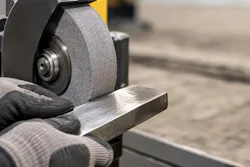
Abrasive technology itself will continue to evolve, just as processes do. Ceramic and shaped grains are receiving significant development attention, while improvements in resins and backing materials continue to change how abrasives cut and wear. Diamond blades have expanded rapidly in applications once dominated by conventional bonded products and film backings have become increasingly common in fine finishing and automotive work.
The materials being fabricated are changing at the same time. New alloys may be designed for corrosion resistance, weight reduction or entirely new operating environments, and every material change raises a practical manufacturing question: How should it be cut, ground, sanded and finished at production scale?
As more fabrication processes become automated, consistency in grinding and finishing will matter even more. That starts with knowing what surface finish the part requires, selecting the right abrasive and checking whether the process delivers the intended result. The goal is to get the finish right without spending unnecessary time, material or abrasive life to achieve it.
About the Author
Matt LeMay
Product Specialist, Klingspor Abrasives Inc.



Voice Your Opinion!
To join the conversation, and become an exclusive member of Machine Design, create an account today!
 Leaders Logo
Leaders relevant to this article: