Sonair Hits Robotics Milestone with First Certified 3D Ultrasonic Safety Sensor
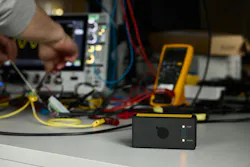
Sonair has cleared a milestone that could reshape how robots safely operate around people.
The Norwegian company’s ADAR One has become the world’s first 3D ultrasonic sensor to receive independent SIL 2 and PLd safety certification for human-robot collaboration. The certification marks a significant step for both Sonair and the broader robotics industry, where ensuring safe interaction between humans and machines remains one of the biggest barriers to wider deployment.
Unlike traditional 2D safety sensors, 3D ultrasonic technology provides real-time spatial awareness, allowing robots to better understand and respond to their surroundings. With independent certification now in place, Sonair argues that the technology moves from a promising concept to a commercially viable safety solution.
The certification comes as robotics capabilities accelerate on the back of the AI boom, while safety infrastructure has struggled to keep pace. Widely used 2D laser scanners define safety perimeters on a single plane, leaving blind spots above and below that limit how robots perceive people and obstacles in real-world environments.
The certification’s implications reach well beyond Sonair itself. For developers of humanoid robots, it provides a certified 3D perception system that can serve as a safety backstop to camera- and AI-based approaches. Systems integrators, meanwhile, can incorporate the technology into autonomous mobile robots, automated guided vehicles and collaborative robot applications without pursuing special exemptions, potentially lowering barriers to deploying robots in environments where people and machines work side by side.
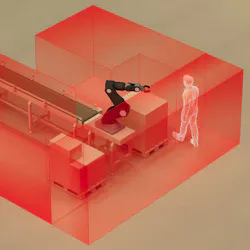
Sonair’s ADAR One (short for Acoustic Detection and Ranging) is designed to address that gap, delivering 180 deg. × 180 deg. 3D spatial awareness for autonomous mobile robots and industrial automation systems. The company says it can detect people and obstacles at all heights, eliminating the blind spots inherent in 2D safety architectures, while its compact form factor allows it to be embedded across robot designs, including humanoids.
“The bottleneck to safe human-robot coexistence isn’t intelligence or speed,” said Knut Sandven, Chief Executive Officer, Sonair. “It’s safe perception, knowing reliably under any condition, that a human is nearby. This milestone certification is the first time a 3D sensor has been independently verified to meet that bar using sound instead of light—a new sensing modality that complements cameras where they fall short.”
The certification was conducted by exida Ireland, an ANSI-accredited functional safety certification body and a notified body under the EU Machinery Directive. The assessment evaluated ADAR against IEC 61508 and ISO 13849, two widely used standards governing electronic safety systems and safety-related control systems. The result is a SIL 2 and PLd rating, with a probability of dangerous failure below one in a million operating hours.
Sonair also says ADAR is the first safety-certified embedded system built in the programming language Rust, whose memory-safety features are designed to eliminate certain classes of software failures.
Machine Design recently connected with Sandven about Sonair’s implications for the future of robot safety, and whether independently certified 3D sensing could help accelerate the adoption of autonomous systems across industry.
Machine Design: What technical and validation hurdles had to be overcome to reach this milestone, and how does Sonair expect it to influence the way robot safety systems are designed going forward?

Knut Sandven: Sound is fundamentally deterministic. That means it obeys the laws of physics and makes it possible to calculate performance in various conditions. It travels at a known speed, reflects in predictable ways, and an echo either comes back within a defined window or it doesn’t. That’s exactly the property you want in a safety function: behavior you can bound and prove. The hard part was engineering a sensor that guarantees a worst-case detection and response time even if something should fail.
Certification doesn’t care about average performance; it cares about the worst case. What’s new is that this kind of certified safety is now available in 3D. That should change how the whole industry thinks about virtual safety barriers. Instead of drawing them on a flat plane, you can define them through a real volume around the machine. And once the protected space is something you can trust in three dimensions, you can finally start taking down the physical fences rather than working around them.
MD: The standards referenced in your press release are International Standards that typically complement rather than replace U.S. and Canadian regulatory and certification requirements. What does it actually mean for marketing the product in the U.S.?
KS: Functional safety speaks a common language. North American machine safety is built on the same ISO/IEC backbone, so a sensor certified to the international functional-safety standards gives a U.S. integrator and their safety assessor the documented basis they need to put it to work. The final deployment sign-off still rests with the integrator and the local authority, but we hand them a certified building block.
READ MORE: The Eyes of Automation: Machine Vision’s Role in AI-Powered Automation
MD: Environmental conditions can degrade the performance of cameras, LiDAR and other optical sensing technologies. In what safety-critical scenarios does certified 3D ultrasonic sensing provide a measurable advantage? How should engineers think about sensor redundancy and fusion when designing collaborative work cells?
KS: Ultrasound doesn’t depend on light, so it performs exactly where optics struggle. Dust, glare, darkness and matte or transparent surfaces that cameras and LiDAR may misread. But the bigger point, once a robot works close to people, is that you have to see the whole person, not a slice of them.
For example, a worker crouches to pick something up beside a moving AMR, and a 2D plane at leg height never sees the head and torso now low in the robot’s path, or an operator reaches into a cobot cell and their arm extends well above the single scan line. If the robot is meant to operate near people, full-body 3D detection shouldn’t be only a nice-to-have.
On redundancy and fusion, my advice is to think in layers, not in one fused brain. Keep the certified, deterministic safety channel independent from the probabilistic perception and fusion stack, so an edge case or failure in the AI can’t compromise the safety function. Real redundancy comes from diversity, not from stacking more of the same sensor.
MD: How does certified real-time 3D spatial awareness enable more flexible human-robot collaboration without compromising compliance with standards such as ISO 13849 and IEC 61508?
KS: Because the safety function has a known, rated performance and a bounded response time, you can calculate safe separation and speed precisely. Add the third dimension and you’re accounting for the whole working volume rather than a single plane. That’s what creates the headroom: You can reduce separation distances, raise speeds and reshape or remove zones while staying firmly inside the determinism those standards demand.
About the Author
 Rehana Begg
Rehana Begg
Editor-in-Chief, Machine Design
As Machine Design’s content lead, Rehana Begg is tasked with elevating the voice of the design and multi-disciplinary engineer in the face of digital transformation and engineering innovation. Begg has more than 24 years of editorial experience and has spent the past decade in the trenches of industrial manufacturing, focusing on new technologies, manufacturing innovation and business. Her B2B career has taken her from corporate boardrooms to plant floors and underground mining stopes, covering everything from automation & IIoT, robotics, mechanical design and additive manufacturing to plant operations, maintenance, reliability and continuous improvement. Begg holds an MBA, a Master of Journalism degree, and a BA (Hons.) in Political Science. She is committed to lifelong learning and feeds her passion for innovation in publishing, transparent science and clear communication by attending relevant conferences and seminars/workshops.
Follow Rehana Begg via the following social media handles:
LinkedIn: @rehanabegg and @MachineDesign
YouTube: @MachineDesign-EBM
Voice Your Opinion!
To join the conversation, and become an exclusive member of Machine Design, create an account today!
 Leaders Logo
Leaders relevant to this article: