CAD to Robot: Inbolt and RoboDK Tackle Different Stages of the Automation Workflow
Getting a robot from a digital model to a functioning production line can be a time-consuming process. While simulation and offline programming tools have streamlined much of the CAD-to-robot workflow, ensuring that a trajectory developed in software performs reliably on the factory-floor often requires additional commissioning and manual adjustment.
Inbolt is aiming to address that gap with its new Robot Programming capability. According to Albane Dersy, COO and co-founder of the company, the system connects CAD-derived robot paths with runtime vision, helping robots adapt to real-world variations that are difficult to capture in simulation alone.
READ MORE: Design Brief: Using AI to Build Reusable CAD Tools
The challenge typically arises during commissioning. Engineers build digital twins and validate robotic motions in software, yet even slight differences between the simulated environment and the physical cell can affect performance. A robot mounted just a few millimeters from its intended position, for example, may require further tuning before production can begin.
“The problem is that the reality is never like the simulation software,” Dersy said during a demonstration at Automate 2026 in Chicago. “When you design your cell in a simulation software, it is roughly never going to match the reality.”
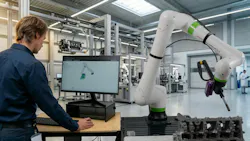
To address that disconnect, Inbolt’s Robot Programming capability starts with a CAD model of the part and automatically generates the robot trajectory. The company’s focus extends beyond offline programming. Once the system is deployed, Inbolt’s vision technology locates the physical part and adjusts the robot’s motion so it can execute the intended path despite variations in the production environment.
Dersy said the approach is designed to eliminate the iterative trajectory touchups that often follow virtual commissioning. The missing link, she argued, has long been the connection between the 3D model and what actually exists on the factory floor.
That connection is provided by the Inbolt Vision Model. According to Dersy, the model learns a part’s 3D geometry at the edge in roughly 30 sec. to 5 min. During operation, it uses that information to identify the part’s location and guide the robot along the CAD-programmed trajectory. “We now have this end-to-end layer, from the programming to the reality that Vision enables by being the missing bridge that was missing all along,” she said.
The Robot Programming capability is currently available for FANUC, Universal Robots and Yaskawa systems, with support for additional robot brands planned.
Closing the Simulation-to-Reality Gap
Inbolt’s solution arrives as robotics software vendors continue to pursue faster paths from CAD models to robot deployment. Among them is RoboDK, an offline programming and simulation platform that can import CAD files, generate toolpaths and robot motions, perform collision checks and produce programs for a wide variety of robot brands.
Its recently introduced RoboDK CAM, for example, is designed to move directly from CAD models to production-ready robotic machining while reducing manual programming effort. The company claims RoboDK CAM can cut robotic machining deployment time by up to 40%.
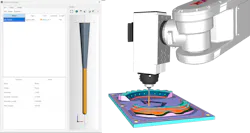
“Basically, it removes the need to have CAM software,” said Jonathan Lambert, Product Manager, RoboDK. “You can do everything you need for machining directly on RoboDK and then export it directly to your robot.”
Both start with CAD, but they address different parts of the robot deployment process. RoboDK focuses on programming, simulating and validating the robot before deployment. Inbolt picks up where simulation falls short, using vision at runtime to adapt the CAD-based trajectory to the actual conditions on the factory floor.
One turns CAD into robot programs. The other makes sure those programs work in the real world.
More content from Takeover Week: Automation & Robotics.
About the Author
 Rehana Begg
Rehana Begg
Editor-in-Chief, Machine Design
As Machine Design’s content lead, Rehana Begg is tasked with elevating the voice of the design and multi-disciplinary engineer in the face of digital transformation and engineering innovation. Begg has more than 24 years of editorial experience and has spent the past decade in the trenches of industrial manufacturing, focusing on new technologies, manufacturing innovation and business. Her B2B career has taken her from corporate boardrooms to plant floors and underground mining stopes, covering everything from automation & IIoT, robotics, mechanical design and additive manufacturing to plant operations, maintenance, reliability and continuous improvement. Begg holds an MBA, a Master of Journalism degree, and a BA (Hons.) in Political Science. She is committed to lifelong learning and feeds her passion for innovation in publishing, transparent science and clear communication by attending relevant conferences and seminars/workshops.
Follow Rehana Begg via the following social media handles:
LinkedIn: @rehanabegg and @MachineDesign
YouTube: @MachineDesign-EBM