The Case for Open Drip‑Proof Motors in Today’s Grimy and Gritty Industries
Key Highlights:
- Open drip-proof motors utilize ambient airflow for cooling, enabling higher power density and more compact installations compared to traditional enclosed designs.
- ABB’s latest ODP models incorporate internal filtration and modular design to provide environmental protection without sacrificing airflow or cooling efficiency.
- These motors are ideal for indoor, outdoor and humid environments, especially in applications requiring high torque, continuous operation and low maintenance.

For decades, the open drip‑proof (ODP) motor has been a dependable industrial workhorse across the United States. Its straightforward design, which allows ambient air to flow freely through the motor frame, made it an efficient and cost‑effective option for indoor applications where the environment was relatively clean and dry. Yet in recent years, as end-users prioritized totally enclosed fan‑cooled (TEFC) configurations to mitigate dust, moisture and debris, some assumed the ODP design had reached its limits.
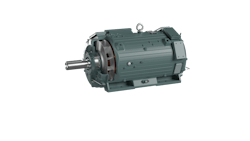
That perception is changing rapidly. The latest generation of designs, including ABB’s new IEC low voltage ODP5000 and ODP580 motors, demonstrates that open ventilation can coexist with high energy efficiency, robust protection and flexibility in a broad range of applications. Many high‑demand sectors, particularly those using pumps and compressors, will find that the modern ODP motor delivers superior cooling, power density and reliability.
How ODP Design Works
At its core, the ODP concept is simple: Air moves through openings in the motor frame and passes directly over the windings, carrying heat away before it can accumulate. This approach allows the motor to run cooler than most totally enclosed alternatives, since heat transfer occurs over a large surface area, rather than depending on an external fan to pull air across the exterior of the enclosure.
READ MORE: Precision Motion Engineering Hits its Stride
That cooling efficiency translates directly into higher power density. Because the motor’s internal temperature rise is lower, engineers can specify more power output within a given frame size, which results in a better horsepower‑to‑dollar ratio and a more compact installation footprint. These advantages matter in crowded equipment rooms, fabrication facilities or retrofits.
The design of ABB’s IEC ODP motors applies these principles. Airflow modeling was used to optimize the internal passage geometry so every cubic foot of air contributes to cooling efficiency. Materials were selected for thermal performance and corrosion resistance, ensuring that the open housing is resilient under demanding operating conditions.
Performance in Today’s Industrial Environment
The range for ABB’s newest ODP family extends from 400 to 1,250 horsepower, in IEC frame sizes 280–355 and NEMA 5010, 5012 and 588. The motors are optimized for 460V/60Hz operation—the most common U.S. industrial standard—and are compliant with the Department of Energy’s Integral Horsepower (IHP) efficiency regulations, as well as the European Union’s EcoDesign standards.
With IE3 efficiency ratings (equivalent to NEMA Premium Efficient levels), these motors are engineered for both raw output and sustainable operation. Enhanced cooling performance directly supports longer equipment lifetime by reducing the wear caused by heat generation. In facilities where motors run continuously, that can equate to substantial savings by delaying the need for replacement.
The motors are available from U.S. stock, pre‑engineered for rapid shipment. Local availability addresses one of the biggest challenges for industrial operations, which is the need to replace or upgrade critical assets without extended downtime. For system designers or maintenance teams bound by standard North American dimensions, the new ODP motors slot neatly into existing installations.
The Modern Approach to Protection
One of the traditional tradeoffs with ODP motors has been exposure to the surrounding environment. While airflow provides excellent cooling, it also opens the potential for dust and moisture ingress. ABB approached this limitation with innovative internal geometry, rather than by fully enclosing the motor housing.
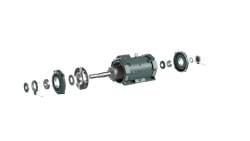
With the new ODP designs, ABB continues its use of the modular “lego brick” system. In this case, a series of right‑angle paths from the standard ODP design can be supplemented with integrated filters positioned to interrupt and trap airborne particulates without restricting air throughput.
READ MORE: Axial Flux Motors Are Reshaping Movement, Manufacturing & Power Generation
This configuration is available through a simple variant code and creates what is known as a Weather Protected Type II (WPII) option, or IP44 equivalent, allowing use in environments with moderate exposure such as outdoor or humid industrial spaces. The solution delivers the best of both worlds: It maintains open‑air cooling while achieving a higher level of environmental resilience.
Another benefit of ABB’s design philosophy is reduced reliance on auxiliary cooling systems. In many high‑horsepower applications, traditional enclosed motors require additional fans or heat exchangers to manage temperature rise. By contrast, a properly configured ODP motor self‑regulates through its own airflow, lowering both energy consumption and system complexity.
Applications That Benefit Most
ODP motors are particularly well‑suited to applications that operate indoors or below deck, where temperature and humidity can be controlled and where the mechanical load profile demands high torque and continuous operation. Example applications include:
- Compressor rooms, where constant airflow and a reduced buildup of heat improve overall efficiency.
- Ammonia compressors in the food and beverage industry, where efficient cooling is vital for temperature‑sensitive processes.
- Container cranes, hoists and trolley or boom cranes, where high torque and long operating cycles require robustness and power density from the motor.
- Marine environments, where cool operation and low levels of required maintenance are favored.
Efficiency and Sustainability in Focus
The Department of Energy’s IHP standards and the growing adoption of the EU’s EcoDesign principles have established IE3 (NEMA Premium) performance as the baseline for responsible operation. However, the discussion around sustainability now extends beyond simple nameplate efficiency. Users are also evaluating the energy required to cool, maintain and replace equipment over a plant’s lifetime.
READ MORE: Are Outdated Motors Draining Your Fluid Lab’s Potential?
ABB’s ODP motors address these broader sustainability goals. By reducing operating temperatures and extending bearing life, material use and costs for replacement parts decrease, along with the need for disposal. These factors make ODP motors a practical means to advance corporate sustainability metrics without sacrificing performance.
In economic terms, those same features enhance the return on capital investments. Higher efficiency cuts electricity consumption, while durable construction minimizes unscheduled downtime. This is a critical advantage for processes where every hour of lost productivity carries real cost.
Reevaluating the Role of ODP Technology
Historically, the ODP motor was perceived as a basic product for benign conditions. That view no longer holds. Modern open designs that combine open ventilation with enhanced filtration represent a distinct engineering approach that is optimized for today’s manufacturing and energy priorities.
The design’s value proposition of compact size, high power density and energy efficiency aligns directly with the needs of modern U.S. industry: where productivity pressures and sustainability goals are converging.
About the Author
 Robert Boyce
Robert Boyce
U.S. Division Manager, IEC Low‑Voltage Motors, ABB
Voice Your Opinion!
To join the conversation, and become an exclusive member of Machine Design, create an account today!
 Leaders Logo
Leaders relevant to this article: