How Technology Is Rewriting Backlash and Gearbox Performance
Key Highlights
- Modern machining and design advancements have made tight backlash control and high efficiency achievable in gear systems.
- Proper system integration, including load and control considerations, is essential to prevent performance issues and ensure reliability.
- Understanding thermal limits, duty cycles and service factors is crucial for maintaining gear integrity and operational efficiency.

Enjoying Machine Design’s Motion Control content? Be sure to check out the rest of our Takeover Week coverage here.
From the moment Mark Perkins entered the shop floor as a quality assurance technician nearly two decades ago, the environment became his engineering classroom. Early on, tracing gear components, from raw blanks to finished tooth profiles, gave him a ground-up understanding of what truly matters in gear manufacturing.
“It was a good starting position that helped me learn about the processes that you need to learn about to manufacture gears and see how they’re made, how they grow through the shop, what features are critical or which are less critical,” he said.
The early exposure to what features matter, what’s critical and non-critical, shaped his transition into engineering and eventually into designing reliable gear solutions.
READ MORE: 8 Common Reasons Causing Gear Failure
Now a senior design engineer at Winsmith, Perkins has watched gearbox expectations shift as automation and electrification reshape motion systems. Winsmith’s reach spans packaging, conveyance, agriculture and even defense applications. These are industries where legacy equipment operate alongside custom-engineered solutions.
The company’s deep catalog and willingness to modify existing designs or create new units from scratch, he noted, are key reasons why long‑running installations continue to rely on Winsmith products.
Rewriting Backlash Expectations
One of the biggest shifts in modern gearing is backlash. It refers to the clearance between meshing gear teeth, defined by the gap being slightly larger than the thickness of the tooth entering it. Once considered an unavoidable necessity due to the limitations of older machinery, this clearance is now far more tightly controlled as precision machining has advanced.
“In the distant past, backlash was something that was necessary in the manufacturing process to accommodate different nonconformances in the gears, or less precision that we had in the past,” said Perkins. “As machinery improved and design improved, those backlash specifications have been easier to meet as customers have needed tighter and tighter backlash in their gear systems.”
But those legacy assumptions no longer hold thanks to modern machining methods and design tools. For one, Perkins said, Winsmith's standard product lines can hit much tighter specifications, and new technologies make low‑backlash characteristics easier and more repeatable.
His perspective underscores how advances in machining and design have shifted backlash from an unavoidable compromise to a tightly controlled performance requirement.
Efficiency has undergone a similar transformation. Perkins points to worm gearing as a standout example. “[The industry] has seen great improvements in efficiency in the past few decades,” he said. “Improvements in lubricant and material selection and accuracy of the gearing…have combined to create a much more efficient product. The same goes for helical inline gearing and bevel gearing.”
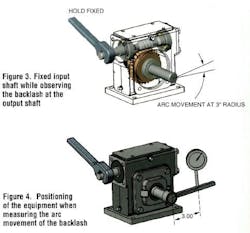
Today’s PAG lubricants and improved bronze materials have changed performance expectations. Helical inline and bevel gearboxes have also benefited from more precise gearing and synthetic lubricants, decreasing losses that used to be taken for granted.
The lubricant is really the biggest factor in improving efficiency, according to Perkins. PAG lubricants, in particular, transform worm‑gear performance. Across other gearbox types, synthetic oils have had a similar impact. Planetary, helical‑bevel and helical‑inline drives typically use PAO‑based synthetics, which offer far better efficiency and stability than older mineral oils.
When it comes to materials, Perkins says that housing material choices have a negiligible impact on efficience, regardless of whether aluminum or cast/ductile iron is used for structural integrity.
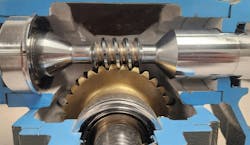
For efficiency, what matters most is the gear material itself. Perkins noted that C917 bronze is widely used in worm gears because it strikes a balance between strength and low friction. This helps boost system efficiency.
System Integration Decides Where Gearboxes Will Fail or Function
A commonly overlooked mistake happens not at the gearbox, but around it. Perkins noted that system integration of the gearbox, load and control systems can expose gaps. This is often due to insufficient design collaboration early on and can result in performance conflicts, unexpected resonance or efficiency losses. He explained that when components are optimized in isolation, the interactions between mechanical components (gearbox/load) and electrical subsystems (motor/control) often create unforeseen issues.
“One horsepower in doesn’t always mean one horsepower out,” he said. When engineers ignore this, they likely will be forced to size up both the motor and the gearbox, and this may not be possible if space hasn’t been planned for.
READ MORE: What’s the Difference Between a Metric Gear and an Imperial Gear?
The mismatch between expected torque and actual output is where gearbox integration issues start to show. “You can’t always size the motor up without sizing the gearbox up,” he explained. “If you don’t leave enough space for that, you’re painted into a corner and you’re left with some tough calls that you need to make.”
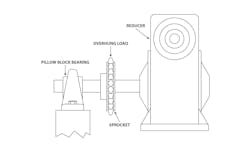
If it’s a motorized unit that has the motor directly mounted to the gearbox, that feature needs to be rigidly and accurately positioned to avoid noise issues at the output end of the gearbox. Getting the alignment right is critical, he said, because misalignment can cause noise, vibration or inconsistent torque transmission. When the gearbox drives a sheave, pulley or chain, engineers also need to account for overhung load on the output shaft.
Perkins noted that even when customers size a gearbox correctly for torque and horsepower, they sometimes overlook the forces acting on the shaft. This is an oversight that can compromise the integrity of both the shaft and the housing. And, not surprisingly, it leads to problems down the line.
Thermal Limits, Duty Cycles and Service Factors
Like their automotive counterparts, industrial gearboxes have their recommended operating temperature range to perform optimally. Ignoring ratings, Perkins said, accelerates degradation, increases wear and shortens seal life. “As the temperature increases in the oil, its viscosity decreases and you’ll have an accelerated wear condition on the gears.” This is true for bearings, too.
While catalogs provide detailed thermal limits, not every engineer is apt to factor the operating conditions into their calculations. Duty cycles and service factors have never been more relevant, he said, especially as design standards move away from the “build it to last forever” mindset of the past.
The American Gear Manufacturers Association (AGMA) sets national gearing standards and leads the development of ISO gearing standards.
Uptime is a Design Responsibility, Too
As temperature and vibration sensors become increasingly accessible, even mid-range OEMs are turning to predictive approaches. Watching changes in temperature and vibration over time will reveal misalignment developing in the field, said Perkins. And in high-criticality environments, oil sampling and trend analysis help operators and maintenance staff calibrate lubrication schedules to actual conditions, as opposed to following generic recommendations.
He added that application conditions are always going to dictate the lube-change frequency. “So, monitoring the gearbox, if it’s just temperature and vibration, is a good start,” he said.
About the Author
 Rehana Begg
Rehana Begg
Editor-in-Chief, Machine Design
As Machine Design’s content lead, Rehana Begg is tasked with elevating the voice of the design and multi-disciplinary engineer in the face of digital transformation and engineering innovation. Begg has more than 24 years of editorial experience and has spent the past decade in the trenches of industrial manufacturing, focusing on new technologies, manufacturing innovation and business. Her B2B career has taken her from corporate boardrooms to plant floors and underground mining stopes, covering everything from automation & IIoT, robotics, mechanical design and additive manufacturing to plant operations, maintenance, reliability and continuous improvement. Begg holds an MBA, a Master of Journalism degree, and a BA (Hons.) in Political Science. She is committed to lifelong learning and feeds her passion for innovation in publishing, transparent science and clear communication by attending relevant conferences and seminars/workshops.
Follow Rehana Begg via the following social media handles:
LinkedIn: @rehanabegg and @MachineDesign
YouTube: @MachineDesign-EBM
Voice Your Opinion!
To join the conversation, and become an exclusive member of Machine Design, create an account today!
 Leaders Logo
Leaders relevant to this article: