Transverse‑Flux Motor Breakthroughs Go Industrial with Graco’s Backing
Key Highlights:
- Transverse flux motors redirect magnetic flux sideways, offering superior torque density compared to traditional designs.
- ETM has mass-produced these motors, supporting industries like robotics and industrial pumps with lighter, more efficient solutions.
- The technology’s ability to eliminate gearboxes simplifies powertrain systems, leading to better efficiency and reduced maintenance.

Enjoying Machine Design’s Motion Control content? Be sure to check out the rest of our Takeover Week coverage here.
In 1890, W.M. Mordey sketched his transverse flux generator that redirected magnetic flux sideways for more efficient torque than conventional linear designs.
The concept was simple, but ahead of its time. He could neither have imagined that his idea would only find its footing a century later, nor that the principle would be the drive behind a resurgence in high-density electric motors.
The principle sparked interest in academic journals but resisted straightforward manufacturing and lay dormant for decades. In 1937 engineers adapted transverse flux technology, not for propulsion, but to combat gravity for a suspension railway. Engineers revived the concept in 1971, reimagining it as a linear motor and aligning with the early Transrapid maglev (magnetic levitation) system developed by German firms Siemens and ThyssenKrupp.
But it wasn’t until the 1980s that Mordey’s geometry found its first killer application. That’s when researchers reengineered it as the foundation for a new breed of direct-drive motors or electric machines capable of delivering exceptional torque density. Even then, progress stalled.
READ MORE: Motion Systems Enter a New Era as AI and Software Transform Design
That changed in 2007, when ETM engineers in Flagstaff, Ariz. stumbled on a motor concept without realizing they had reinvented transverse flux. “It took a few years to figure out that’s what we were doing,” recalls Scott Reynolds, technology commercialization director at ETM. The breakthrough came simply from arranging familiar components in a different geometry inside the motor. Thereafter, ETM made a significant investment in both the design and manufacturability of the TFM motors. The goal, says Reynolds, was to capture the early promise of torque density while producing machines that were practical to manufacture. And that effort “took a lot of years.”
Today, ETM has high-volume in place, producing these motors at much higher volumes, says Reynolds.
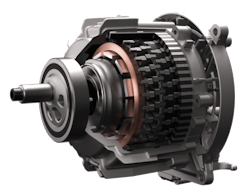
Why Geometry Trumps Physics
Understanding the renewed interest in TFMs starts with exploring the unique geometry that makes them unique.
Despite the fits and starts, TFMs are proving their worth with superior torque density and the potential for creating direct-drive motors or electric machines that offer superior performance in low-speed, high-torque and high-duty cycle applications, such as industrial pumps and robotics.
READ MORE: Q&A: How Integrated Mechatronics is Reshaping Actuator and Motion System Design
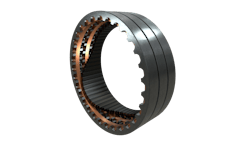
The key lies in unconventional geometry, explains Reynolds. In a traditional stator, the coils are threaded through narrow slots. TFMs depart from this approach and rely on standalone copper rings wrapped around the motor axis. Reynolds notes that the standalone ring design carries far less resistance, which in turn sheds less energy lost as heat.
Pole Density: The Low-Speed Advantage
Another edge is pole count. In TFMs, each tooth corresponds to a single pole. This configuration allows for exceptionally high pole counts. For example, in one stator, engineers fit in as many as 60 poles in a footprint that would max out at 4 or 8 in a radial flux machine.
This design enables engineers to target operation around 100 RPM without compromise—a range where conventional radial-flux designs lose steam. “That gives you a lot of high torque performance at low speed, along with efficient operation even at very low RPMs,” says Reynolds, noting that TFMs uniquely sustain efficient operation to 100 RPM. He calls this threshold “unheard of” and one where conventional radial-flux designs fall short.
With those design improvements, TFMs gained a significant advantage to function as direct-drive machines.
Supporting Direct‑Drive Performance
With years of R&D under the belt, ETM now churns out tens of thousands of TFMs annually on automation production lines, supporting a growing roster of applications, says Reynolds.
The momentum is upending motion-system design. OEMs are ditching complex gear-transmission assemblies for direct drives, enabled by TFM’s low-speed torque. “We have examples where transverse‑flux technology has replaced a two‑stage gearbox—something like a 20:1 or 30:1 reduction—and taken the system all the way to direct drive,” Reynolds says.
READ MORE: Engineering for Extremes
Gearboxes slow high-speed motors to deliver the torque for tough jobs, such as pumps or robot joints. For instance, a 20:1 ratio means the motor spins 20 times faster than the output. Effective, yes, but it is heavy and wear-prone. TFMs reverse that by generating high torque at low speeds. It enables the motor to connect directly to the load, and no gears are needed. The result is simpler, lighter and more efficient.
“That’s not an easy thing to do, even with transverse flux,” says Reynolds, “but we have commercialized cases where it has been achieved.”
Powertrain Efficiency Redefined
That simplification pays dividends across the entire powertrain. New rules measure full-system efficiency, not just motors. Incremental IE2-to-IE5 motor upgrades chip away at margins, says Reynolds, while gearboxes—rated at 90% peak efficiency—often dip below 50% in real conditions. By minimizing transmissions, TFMs deliver system-level gains that meet ESG mandates, he said.
Licensing Model Pitch for Robotics OEMs
ETM extends this edge to robotics OEMs through licensing. As a technology provider, not a product vendor, ETM hands over designs and supply options, letting customers own their supply chain and operational destiny, Reynolds explains.
How ETM Caught Graco’s Eye
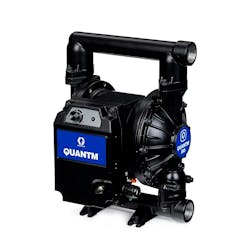
The story of how ETM was acquired by Graco is compelling in its own right. In 2018, a Graco engineer casually flipping through a trade journal noticed an advertisement for ETM’s transverse-flux technology. Intrigued, he called the number, arranged a conversation and ultimately issued a challenge: Prove that it works. Build a prototype.
The demonstration did much more. It sparked a partnership that, by 2020, led to Graco acquiring ETM. Graco, with 3,700 employees, $1.6 billion in sales in 2020 and a market capitalization touching $13 billion by close of 2021, didn’t just absorb ETM. It handed them the keys to a manufacturing powerhouse.
A hundred years on, Mordey’s geometry hack is reshaping motion systems and breathing new life into powertrain efficiency. The resurgence is proof positive that forgotten ideas can set new direction for engineering innovation.
About the Author
 Rehana Begg
Rehana Begg
Editor-in-Chief, Machine Design
As Machine Design’s content lead, Rehana Begg is tasked with elevating the voice of the design and multi-disciplinary engineer in the face of digital transformation and engineering innovation. Begg has more than 24 years of editorial experience and has spent the past decade in the trenches of industrial manufacturing, focusing on new technologies, manufacturing innovation and business. Her B2B career has taken her from corporate boardrooms to plant floors and underground mining stopes, covering everything from automation & IIoT, robotics, mechanical design and additive manufacturing to plant operations, maintenance, reliability and continuous improvement. Begg holds an MBA, a Master of Journalism degree, and a BA (Hons.) in Political Science. She is committed to lifelong learning and feeds her passion for innovation in publishing, transparent science and clear communication by attending relevant conferences and seminars/workshops.
Follow Rehana Begg via the following social media handles:
LinkedIn: @rehanabegg and @MachineDesign
YouTube: @MachineDesign-EBM
Voice Your Opinion!
To join the conversation, and become an exclusive member of Machine Design, create an account today!
 Leaders Logo
Leaders relevant to this article: