Designing With Polymer Bearings and Motion Plastics: A Practical Guide for Engineers
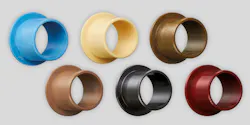
Engineers replace thousands of greased bronze bushings with self-lubricating polymer bearings. While many of those new bearings outlast the metal they replaced, others fail within months. The difference between the two outcomes almost never comes down to the polymer itself. It comes down to whether the engineer treated the bearing as a drop-in substitution or as one element within a larger tribological system.
For example, the shaft material and surface finish, housing corrosion protection, thermal path for frictional heat, chemical environment and manufacturing process all influence how long the bearing lasts and how it eventually fails. Even engineers who have worked with metals for most of their careers can underestimate how much these factors interact in an application.
The material selection, process decisions and failure modes all behave differently than they do in metal, and the design strategies that account for those differences are what separate reliable polymer bearing applications from costly experiments.
What Semi-Crystalline and Amorphous Mean for Your Design
One of the first factors to consider is whether your base polymer is semi-crystalline (nylon, POM, PEEK, PPS) or amorphous (polycarbonate, PEI, PSU).
In semi-crystalline polymers, the crystalline zones give the material higher strength, better chemical resistance, lower friction and greater fatigue life. They also cause the material to behave differently during processing: higher shrink rates, a distinct melting temperature and greater sensitivity to cooling rate during molding.
READ MORE: Tribology: The Quiet Force Behind Industrial Automation
Amorphous polymers machine predictably, hold tight tolerances and resist warping. However, they also exhibit higher friction, lower chemical resistance and poor fatigue performance under cyclic loading. As a result, amorphous polymers rarely perform well as wear surfaces and are better suited to structural or housing applications where bearing contact is not required.
For bearing and motion plastic applications, semi-crystalline materials dominate for a reason, as their crystalline regions provide natural lubricity and wear resistance at the molecular level. When evaluating a polymer for a bearing, one of the first questions to answer is whether the base resin is semi-crystalline because that single characteristic correlates with enhanced friction, chemical resistance and long-term dimensional stability under load.
Choosing the Right Polymer: Beyond the Data Sheet
Material selection for a polymer bearing is not a matter of picking the strongest or most temperature-resistant option on the chart. In practice, the bearing material that survives longest is often softer than the one that instinct might suggest. Harder, glass-filled structural polymers can wear faster than purpose-formulated bearing compounds because they lack embedded solid lubricants and generate more abrasive contact against the mating surface.
During the selection process, start with these four parameters:
Pressure-velocity (PV) value. The product of bearing surface pressure—load divided by projected area—and sliding velocity generates frictional heat. Every polymer bearing material has a limiting PV above which wear accelerates and the material softens or fails. Calculating PV for the application and selecting a material with a limiting PV above that value is a key sizing step.
Heat dissipation matters here, too. A steel housing conducts heat away from the bearing much faster than a plastic housing, so the same PV can produce different outcomes depending on the surrounding structure.
Operating temperature. Both the ambient temperature and frictional heat generated during operation contribute to the bearing’s thermal environment. Be sure to account for the glass transition temperature (Tg) and, for semi-crystalline polymers, the melting temperature (Tm). Between Tg and Tm, a semi-crystalline polymer loses stiffness in its amorphous regions but retains structural integrity from its crystalline zones.
Operating above Tg is possible with the right material, but it changes load capacity and wear behavior. It can also lead to a loss in press fit, which can be addressed by adding mechanical securing or adhesives during installation.
In addition, shipping conditions are easy to overlook, but sea freight can exceed 80°C, making it important to account for the bearing’s full thermal history, not just its operating environment.
Chemical and environmental exposure. Moisture, solvents, cleaning agents and UV radiation all affect polymer performance, though not uniformly across materials. Some formulations absorb water and swell, changing clearances and fit. Others resist aggressive chemicals but cannot tolerate UV exposure.
In wet or submerged applications, low-moisture-absorption compounds maintain dimensional stability, whereas hygroscopic materials like standard nylon would swell and bind.
Mating surface hardness and finish. A polymer bearing is only half the tribological system. The shaft or pin surface roughness and hardness directly affect wear rate. Softer shafts or rough surface finishes accelerate bearing wear. Hard-chromed or hardened stainless-steel shafts typically produce the lowest wear rates, though very smooth chromed surfaces can sometimes cause stick-slip behavior at low speeds.
Injection Molded vs. Machined: The Manufacturing Decision
The choice between injection molding and machining a polymer bearing is not just about cost and volume. It affects the material’s microstructure and, consequently, its wear performance.
During injection molding, the molten polymer contacts the cooler mold surface and quickly solidifies, forming a fine-grained crystalline skin. The interior cools more slowly, producing larger crystalline structures. This skin-core morphology is a natural advantage for bearing applications, as the fine-grained surface resists fatigue wear while the coarser core provides structural support.
In addition, injection molding supports complex geometries, integrated retention features and consistent part-to-part dimensions across long production runs. The tradeoffs are significant upfront tooling cost, higher shrink rates that must be accounted for in mold design and minimum practical order quantities.
READ MORE: Why Crossed Roller Bearings Dominate Precision Robotics and Automation
For semi-crystalline polymers, shrink can run 1.5% to 3% depending on the material and wall thickness. Fiber-filled compounds add another layer of complexity because fibers orient themselves in the direction of flow, making shrink rates and mechanical properties anisotropic.
Machining wins on flexibility. There’s no tooling investment, lead times are short and tolerances can be tighter because there is no need to compensate for shrinkage. For prototypes, low volumes under 1,000 pieces or bearings with very tight tolerance requirements, machining is often the practical choice.
Useful guidance: If annual volumes exceed 5,000 pieces and the bearing geometry allows it, injection molding may deliver better per-unit economics and superior wear performance. Below 1,000 pieces, machining is usually more practical. Between those numbers, the decision depends on the application’s performance requirements and the expected program life.
Common Design Mistakes
Years of bearing application engineering point to recurring patterns where designs can go wrong. These include:
Designing without concern for the production method. An engineer designs a geometry that works in CAD, then hands it off for manufacturing. The part’s wall sections are too thin for reliable mold fill or the tight tolerances specified cannot survive molding shrinkage. Every production method has limitations. Design for the process from the start, not as an afterthought.
Mechanical property tunnel vision. Glass-filled nylon 6/6 appears in countless structural applications, and for good reason. But if you carry that default into bearing design, you may end up with a strong part that wears faster than a softer, purpose-formulated bearing compound. High-performance polymers such as PEEK and PAI are rarely necessary unless the application involves extreme heat or aggressive chemical exposure. Specifying them “just to be safe” adds cost without adding bearing life.
Ignoring the mating surface. Swapping a greased bronze bushing for a dry-running polymer bearing eliminates the need for lubrication, but it does not eliminate the need to protect the shaft and housing from corrosion. Grease previously served as a barrier between steel surfaces and the environment. Remove it without adding corrosion protection, and the steel surfaces degrade.
Conflicting material requirements in a single part. A part that needs flexibility at one end and rigidity at the other drives complex geometry and compromised material selection. When a single polymer cannot satisfy all the functional requirements of a part, the better approach is often to split the design into multiple components, each optimized for its role.
Reading the Clues of a Failed Bearing
When a polymer bearing fails, the debris and damage pattern tell the story. Learning to read these clues can help you diagnose root causes instead of guessing.
- Powdered debris around the bearing indicates gradual abrasive wear from two surfaces grinding against each other over time. This is the expected wear mode for a properly loaded bearing reaching end of life. If powder appears prematurely, look at the mating surface condition, or check whether the PV limit has been exceeded.
- Large chunks or fragments of material signal brittle mechanical failure, not wear. The bearing was overloaded, subjected to shock or impact, or the material was wrong for the application. Check whether the load case included dynamic or impact forces that exceed the material’s capacity. This failure mode also appears in stick-slip applications, where material tears off during the “slip” phase. Squeaking is the key symptom to listen for.
- White stress lines or visible plastic deformation mean the material was strained beyond its elastic region. The bearing experienced loads high enough to permanently deform the polymer but not high enough to cause immediate brittle fracture. This is a warning sign that the safety factor on load capacity is insufficient.
- Melted or smeared material points to excessive heat from either high PV operation, inadequate heat dissipation or chemical attack that softened the polymer. Check the thermal path from the bearing to the surrounding structure and recalculate PV.
- Concentrated damage on one side usually indicates misalignment or edge loading. The bearing was not carrying load uniformly across its surface, concentrating stress and wear in a small zone.
Multiple failure modes are present.
- Bearing failures often cascade. Corrosion roughens a shaft, which accelerates abrasive wear, which generates heat, which softens the polymer, which increases deformation and friction. The first failure in the chain is the root cause. Trace backward from the most severe damage to find it.
Clearance, Fit and Installation
Polymer bearings are not drop-in replacements for metal bushings and require their own approach to fit and clearance.
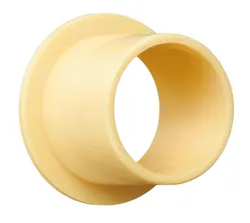
Most self-lubricating polymer bearings are designed for a press fit into a standard H7 bore. The press-in interference, typically 0.1 mm to 0.25 mm depending on nominal diameter, compresses the bearing’s outer diameter and slightly reduces the inner bore. The inner diameter reaches its final dimension only after installation. Specifying clearances based on the bearing’s free-state dimensions, before it is pressed into its housing, leads to interference with the shaft.
Thermal expansion also differs from metal. Polymers expand roughly substantially more than steel per degree of temperature change. In applications with significant temperature swings, initial clearances must account for differential expansion to avoid binding at elevated temperatures or excessive play at low temperatures.
For machined bearings from bar stock, internal stresses from the extrusion or compression molding process can cause dimensional changes over time. Annealing at or near the material’s Tg relaxes these stresses and stabilizes dimensions. This step is often skipped for cost reasons and just as often regretted.
Thinking in Systems, Not Components
The recurring theme across material selection, manufacturing, failure analysis and installation is the same: a polymer bearing operates within a system. The bearing material, mating surface, housing, thermal environment, chemical exposure and manufacturing process all interact. Optimizing one element while ignoring the others produces the kind of failures that make engineers distrust polymer bearings altogether.
Fortunately, the tools available to you today make this systems-level thinking easier to execute. Online bearing life calculators support quick iteration across material options for a given load, speed and temperature profile. Material databases with filterable PV values, temperature ranges and chemical resistance charts accelerate the selection process. Purpose-formulated bearing compounds, available in both standard catalog dimensions and custom-molded geometries, have also broadened the application space where polymers outperform metal.
Polymer bearings are not universally better than metal. They have clear limits. For example, temperatures above roughly 260°C, surface pressures above 150 MPa and rotational speeds over 1,000 RPM in dry-running conditions push polymer bearing materials beyond what they can reliably handle.
But within those boundaries, if you design for the system rather than the component, you can eliminate lubrication, reduce weight, resist corrosion and cut maintenance cost in ways that metal bearings cannot match.
Anatomy of a Maintenance-Free Pivot
The agricultural equipment industry illustrates what a systems-level approach to polymer bearing design looks like in practice. A common pivot joint in field machinery consists of three components: a bushing, housing and pin. Legacy designs use a metallic bushing with grease grooves in a steel housing, requiring daily lubrication during operation. The grease attracts dirt and crop debris, creating an abrasive slurry that accelerates wear on the bushing and pin.
A common first attempt at eliminating maintenance replaces the bushing with a dry-running polymer. This “traditional maintenance-free” approach addresses one component but neglects the other two. Without grease acting as a corrosion barrier, the housing bore rusts. Corrosion flakes contaminate the bearing interface, and the housing shrinks around the bushing as oxide layers build.
Meanwhile, thin corrosion inhibitors on the pin (zinc, nickel or chrome plating) wear through during normal operation, exposing the base steel to the environment. After one idle season, the pin surface can roughen to the point where no plain bearing can run on it without accelerated wear.
A true maintenance-free design addresses all three components as a system.
- First, the dry-running polymer bushing itself is injection molded from a compound of thermoplastic base resin, reinforcing fibers and solid lubricant. The fibers provide edge-load resistance and structural strength while the solid lubricant particles, embedded in microscopic chambers throughout the matrix, release continuously to the bearing surface.
- Second, a synthetic wax-based corrosion inhibitor applied to the housing bore prevents rust formation and maintains the press fit.
- Third, a pin with a diffusion-based corrosion-resistant surface treatment penetrates into the base metal rather than sitting as a thin coating on top. Salt spray testing per ASTM B117-16 has demonstrated 300 hours without red rust on treated pins, compared to conventional zinc or chrome plating that wears through within a single operating season.
As a result of this approach, the bushing becomes the sole wear surface and sacrificial component. It wears predictably and gets replaced when clearance exceeds the application’s tolerance. The housing and pin also survive the full service life of the equipment.
About the Author
Cody Hovdet
iglide National Sales Manager, igus Inc.
Voice Your Opinion!
To join the conversation, and become an exclusive member of Machine Design, create an account today!
 Leaders Logo
Leaders relevant to this article: