Reference Guide: Updates on Custom Actuators
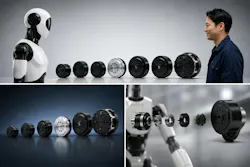
As the humanoid robotics sector grows, the actuator—an integral motion control component in robotics and other automated applications—continues to evolve.
Actuators, which merge the motor, driver, encoder and communication systems into a single unit, allow robotic engineers to design joints that reduce system weight, eliminate wiring failure points and drastically shorten prototyping and manufacturing times. As the CEO of Korea-based HIGEN RNM stated at CES 2026, “AI is making the robot’s brain dramatically smarter, but the point where that intelligence ultimately meets the physical world is the joint…[with] movement that is responsive, precise and safe.”
Some humanoid robot developers are using specialized standard actuator options from companies like HIGEN RNM and Schaeffler. The other two approaches involve customization.
In-House Customization
Big players in the humanoid robot sphere are opting for in-house customization and manufacture of actuators. For example, in an August 2026 update, Tesla Optimus development team members describe some of hundreds of actuators used in the design (e.g., 25 in each hand enabling over 3,000 discrete manipulations), but also noted that in some cases, “unlike most industrial robots that use off-the-shelf motors, Tesla designed custom actuators from scratch.”
READ MORE: Robot Hardware Reset: Fall 2026 Trends Every Mechanical Engineer Should Watch
OpenAI also confirmed in September 2026 that in forming its humanoid robot development team, it’s seeking four engineers to fill positions solely focused on actuators, signaling to some in the industry that OpenAI is building proprietary hardware.
Custom actuator building is also part of the Berkeley University Berkeley Humanoid Lite open-source, sub-$5,000 humanoid robot project, “designed to democratize and advance humanoid robotics research.” The custom actuators presented in the project feature BLDC motors paired with 3D-printed gearboxes and encoders to achieve the precise, high-torque joint motion required. There are text and video instructions for building the actuator, from preparing the magnetic encoder and motor to assembly.
Still other engineers are opting for outsourced customized actuators.
Custom Actuators: A Guide to the Process
When actuators are customized for humanoid robots, other robots such as AMRs or automated machine tasks, they are assembled from six components chosen carefully and incorporate the mechanical components, sensors and drive electronics specific to the application.
In a humanoid robot joint application, Synapticon explains that custom actuators must address different joint requirements. Hips and knees, for example, need high torque, while shoulder and wrist joints need actuators customized to be compact and light weight.
Norck Robotics further explains that customized actuators for specific motion control movements must be designed around “exact load and motion requirements, space and weight constraints, environmental conditions (heat, dust, moisture, vibration), control and feedback needs.” The design therefore “very often requires non-standard features, materials or integration requirements that commercial components can never cover.”
READ MORE: What’s Moving at igus? From Motion Plastics to AMRs
Here’s a quick review of the six components and the broad strokes of how they are selected during customization:
Bearing – select type, size, material etc. to meet load requirements, stiffness and space constraints
Motor – choose specific pole configuration, custom connectors and so on to achieve the required performance
Gear box – choose planetary, strain wave, cycloidal (or direct-drive without gearbox for specific torque-to-speed ratios) to address backlash, torque, service life
Brake – choose clutch brake, static friction brake, microcoil etc.
Encoder – select optical, magnetic, bit resolution, single-turn or multi-turn
Housing – can be CNC-machined or die cast with custom flange and mounting geometries
Finer Customization
Torque sensor integration, including the use of dual-channel architecture, can also be part of customized robotic actuators.
There can also be tailoring to meet special torque-speed combinations, bearings and more through custom‑winding of stators, rotors and armatures.
Magnet wire is another customization option. For example, fine‑gauge magnet wire produces higher slot fill and torque density.
Housing, extension tubes, rods and mounting brackets, and integration of absolute encoders, incremental encoders, potentiometers, limit switches, torque sensors and other components can also be customized.
Steps in Actuator Customization
After selecting a technology partner, these are the typical steps:
- Work together on the initial actuator concept. Conduct analysis of motion profiles, load cases, installation space constraints, etc.
- List and verify design requirements, e.g., torque, speed, interfaces, safety level, service life
- In the design phase, design the entire system in parallel. That is, select motor topology, transmission type and drive as mechanical, electronic and wiring systems are developed
- Prototype phase
- Sourcing of components
- Testing stage and transition to mass production
Examples of Customization
Here are two brief examples of customization from 1X Technologies. Their X Apex Series “modular smart rotary actuators” can be customized for multi‑degree‑of‑freedom applications such as humanoid robot joints, collaborative robot arms and mobile manipulators. The core architecture of these rotary actuators includes integrated high‑resolution absolute encoders, torque sensing, three‑axis IMU and an onboard motor controller.
Customization can occur through making high‑torque configurations for full-size humanoid joints, and ruggedized versions with internal pressure compensation for outdoor or dirty environments. For applications requiring extreme accuracy under load, these actuators can be customized through precision harmonic gearing with zero backlash and ultra‑high torque density.
Another example is their 1X Titan Series High‑Force Electric Rod Actuators, suitable to applications such as humanoid torso extension/retraction, linear spine drives, high‑force gripper actuation, industrial pressing, clamping, lifting, etc. Their core architecture includes integrated servo or stepper motor options, planetary roller screw or ball screw mechanisms, and rod‑style construction.
Customization can include the use of stainless‑steel construction with IP69K for hygienic, washdown or corrosive environments. The use of integrated motor‑and‑drive packages are well-suited for space‑constrained applications.
About the Author
 Treena Hein
Treena Hein
Treena Hein is an award-winning science and technology writer with over 20 years’ experience.
Voice Your Opinion!
To join the conversation, and become an exclusive member of Machine Design, create an account today!
 Leaders Logo
Leaders relevant to this article: