What’s Moving at igus? From Motion Plastics to AMRs
A towering running-man statue, designed to resemble a humanoid robot, greets visitors to the igus booth. Its conspicuous placement is no accident. With 110,000 visitors and about 3,000 exhibitors converging on Hannover Messe, igus has plenty of competition for visitors’ attention.
Alexis Heinzelmann greets me with the familiar ease of someone I have worked with for several years. In the past, she has typically handed me off to igus subject matter experts so Machine Design could get a closer look at new developments, ask questions and dig into where technologies are headed.
But today’s tour is different.
Heinzelmann, now Head of International Corporate Communications at igus GmbH, has stepped into an expanded role since the last time we met. That makes her a particularly useful guide for this tour. She knows the people behind the displays, the technologies they are developing and the questions engineers are asking. Her fluency in both German and English is an added advantage, making it easier to move between conversations as she takes me through the igus booth and its latest engineering developments.
READ MORE: The Robots Are Getting Real: Lessons from Hannover Messe’s Industrial AI Reality
She starts us at the center of the booth, where the imposing statue serves as a visual introduction to one of the major themes running through this year’s show. It also gives Heinzelmann a way to show, rather than simply tell, where igus components could be used in a humanoid robot. She points to examples throughout the figure, from the joints and moving mechanisms to the fingers, each representing another point where movement creates an opportunity for motion plastics.
The examples also point to why igus sees humanoid robotics as a natural application for its high-performance polymers. With so many points of movement, lubrication-free, low-maintenance components can be useful where reliability and long service life matter.
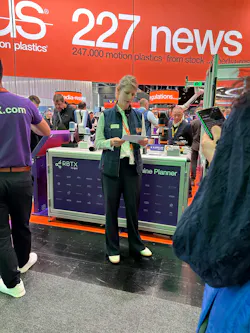
From there, Heinzelmann shifts the conversation from individual components to the bigger automation picture. At the RBTX display, she introduces igus’ approach to making automation more accessible by bringing robotics and automation components from hundreds of manufacturers together on a single marketplace. The platform gives engineers a way to find and combine robot arms, grippers, cameras, controllers and other accessories that have been tested for compatibility.
The progression is deliberate; Heinzelmann’s examples start to build a larger picture of how manufacturers can assemble readily available components into automation systems without adding the cost and complexity that often come with integration.
From there, she takes me deeper into the materials behind the motion, starting with a question that is relevant to bearing selection: what can engineers use when PTFE is no longer the preferred choice?
PTFE-Free Bearings
Lars Butenschön of igus’ iglide bearings business explains that PTFE has long been a common choice for plain bearings because it combines chemical and temperature resistance with good sliding properties. But in applications ranging from automotive to beverage filling and fluid handling, engineers are increasingly looking at what other materials can offer.
That starts with understanding the requirements of the application rather than simply defaulting to PTFE. igus develops its own polymer compounds and tests them against specific performance criteria, including wear and friction. The PTFE-free bearing materials include iglide JPF, along with PTFE-free versions of iglide G, X and H. In developing these materials, igus is giving customers more options for selecting bearings based on the demands of the application and matching the material to the conditions in which it will operate.
Cleanroom Energy Supply
The next stop moves from bearings to energy supply, where Heinzelmann and her colleague Sascha Labouvie introduce igus’ cleanroom solutions.
The company’s e-skin family for cleanroom applications is designed to guide cables while limiting abrasion and particle generation, an important consideration in production environments such as semiconductor and battery manufacturing. Labouvie draws attention to the travel distance the system can accommodate. “We can realize up to 30 meters of travel length,” he explains, adding that the system can be certified for ISO Class 1 to 4 depending on speed and acceleration.
Within the e-skin family is e-skin soft ESD, a dissipative version designed for cleanroom applications where electrostatic charging is a concern. An igus press release earlier this year said the material prevents the formation of electrostatic fields and abrupt discharge caused by movement of the energy chain. For engineers working around ESD-sensitive products, the approach can reduce the need for additional shielding or greater separation between the energy supply system and the product.
ReBeLMove Pro: A Larger Platform for Intralogistics
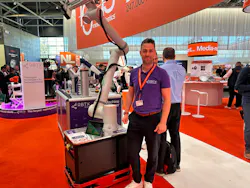
By the time we reach the ReBeLMove Pro, Heinzelmann is called away to attend to other matters. In keeping with the way this booth tour has unfolded, she hands me over to Kai Schmitz, a technical sales consultant, who takes over to walk me through igus’ larger autonomous mobile platform.
The ReBeLMove Pro is designed for heavier and more flexible material-handling applications. Schmitz tells me it can carry loads of up to 250 kg and tow up to 900 kg, while its modular top structure can be configured for different tasks. At the booth, that includes a conveyor for moving boxes and a robot arm that turns the AMR into a mobile handling system capable of picking up and transporting parts.
READ MORE: Are Humanoid Robots Ready for Industry? Hannover Messe Thinks So (Maybe)
For anyone considering an AMR for production, mechanical payload is only part of the equation. Can it run through a shift, navigate safely around people and equipment, and communicate with the systems already running the operation? Schmitz points to the ReBeLMove Pro’s rated eight-hour operating time, integrated navigation and sensors for autonomous operation, and support for REST API and IoT interfaces. Its optional fleet manager is compatible with VDA 5050, allowing the platform to operate alongside other AMRs in a mixed fleet.
The idea is to make the mobile platform adaptable to the job rather than build the workflow around a fixed-purpose vehicle, Schmitz says. Here, the ReBeLMove Pro becomes a base that can be configured with the equipment a particular material-handling task requires.
From Hannover to Chicago
By the end of the tour, we had moved from the components inside a humanoid robot to the systems guiding cables in cleanrooms and the autonomous platforms moving materials through a factory. That range was reflected in igus’ 227 new products showcased at Hannover Messe. At Automate and IMTS in Chicago, robotics, motion technologies and efforts to make automation more accessible continued to shape discussions on the show floor.
More content from Takeover Week: Automation & Robotics.
About the Author
 Rehana Begg
Rehana Begg
Editor-in-Chief, Machine Design
As Machine Design’s content lead, Rehana Begg is tasked with elevating the voice of the design and multi-disciplinary engineer in the face of digital transformation and engineering innovation. Begg has more than 24 years of editorial experience and has spent the past decade in the trenches of industrial manufacturing, focusing on new technologies, manufacturing innovation and business. Her B2B career has taken her from corporate boardrooms to plant floors and underground mining stopes, covering everything from automation & IIoT, robotics, mechanical design and additive manufacturing to plant operations, maintenance, reliability and continuous improvement. Begg holds an MBA, a Master of Journalism degree, and a BA (Hons.) in Political Science. She is committed to lifelong learning and feeds her passion for innovation in publishing, transparent science and clear communication by attending relevant conferences and seminars/workshops.
Follow Rehana Begg via the following social media handles:
LinkedIn: @rehanabegg and @MachineDesign
YouTube: @MachineDesign-EBM