How AI, Automation and Design Could Expand Additive Manufacturing
On paper, additive manufacturing should be booming. Aerospace, medical, automotive and industrial buyers all want lighter parts, shorter lead times and more flexible supply chains. In practice, however, far fewer shops are converting that interest into dependable production volumes. The result is an industry that is growing—but not evenly.
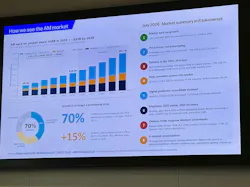
According to Wohlers Report 2026, global additive manufacturing revenues reached US$24.2 billion in 2025, up 10.9% from the previous year. Printing services grew 15.5%, outpacing sales of systems and servicing, which rose 3.6%.
François Minec, HP’s Vice President of Worldwide Sales and Business Development, highlighted those figures during an additive manufacturing market overview ahead of Machine Design’s interview. The numbers point to a shift in demand from equipment sales to actual part production.
For machine builders, service providers and manufacturers, the test now is whether the economics hold as volumes rise—and whether engineers can design parts that make the most of additive manufacturing’s strengths. Minec sees the answer in consistent quality across machines and production batches, tighter integration with factory systems, materials that improve productivity and cost, and less manual effort in designing for additive manufacturing.
During the HP media event, the company highlighted the Multi Jet Fusion 1200 as a more accessible entry point to the technology. Priced at around $60,000, suggested Minec, it makes the technology more affordable, especially those with R&D and design centers.
“They want to develop designs and carry out small initial production runs before scaling up to larger printers,” said Minec, who sees AI-assisted design as a potential turning point, allowing engineers to specify a part’s requirements and have CAD tools help optimize its geometry for additive manufacturing.
In the Q&A that follows, he explains what it will take to move more applications from promising demonstrations to production at scale, and why lowering the cost per part remains central to that shift.
[The transcript has been edited for clarity and context.]
Machine Design: HP has positioned its additive manufacturing technologies around production at scale. From an engineering standpoint, what does scaling actually require?
François Minec: I think it’s a bit of everything. Our largest printer, the 5600, is all about manufacturing at scale. But there are several elements involved.
One very important element is repeatability and reliability. We want to ensure that when customers print on several machines, even at different locations, they get the same part quality. That consistency also needs to be maintained from batch to batch.
The second element is obviously cost per part. That is what drives scaling. We’re always looking at the threshold between additive manufacturing and injection molding or other technologies. Cost per part helps determine the production volumes at which a particular technology makes sense, which is why we work so much on it.
MD: Beyond the printer itself, what does it take to integrate additive manufacturing into an existing production environment?
FM: At the end of the day, our customers want parts. They don’t really care whether those parts are made by additive manufacturing or injection molding. They want the parts.
They also have an existing manufacturing setup, with manufacturing execution systems (MES) and other equipment. Producing a part involves more than the additive manufacturing equipment itself. There is post-processing, such as dyeing, improving the surface finish and painting, along with other equipment.
Our printer needs to be a good digital citizen in that environment. That’s why we have application programming interfaces (APIs) to connect the printer to the other systems. It should not operate independently of the rest of the manufacturing process.
READ MORE: As Automation Speeds up, a New Focus Falls on Component Handling
I’m a plastics engineer, and I’ve worked in plastics processing throughout my career. Three-dimensional printing of plastics is just another way to melt plastic and give it a shape. It should not feel fundamentally different from the rest of the manufacturing process.
MD: What are you learning from customers as they become more experienced with additive manufacturing? Are they finding applications that might not have seemed practical a few years ago?
FM: I’m learning a lot from customers every day. Their inventiveness and professionalism have developed, and today that is allowing them to win bigger and bigger contracts—things that a few years ago we didn’t think were possible.
MD: Can you give us a concrete example of an application that has particularly impressed you?
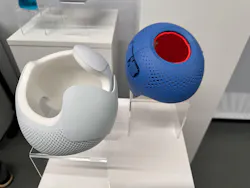
FM: One example I really like is the cranial helmet.
For babies with cranial deformities at birth, the process used to be very manual. The baby needed to be immobilized, and a plaster cast had to be made around the head. That took time—I think around 30 minutes—and it was quite a traumatic experience.
Now the baby just needs to sit for a one-minute scan and come back two days later to get the helmet. The process is beautiful and easy, but there is a huge amount of scale behind it. We have customers with many printers, and they need to automate the process extensively, including all the post-processing.
What’s also very important is the software. In orthotics and prosthetics, the question is: How do I take a scan and make a part directly? I think scan-to-part automation is very important.
MD: That example illustrates the value of integrating scanning, design, printing and post-processing. As additive manufacturing becomes more industrialized, where do CAD and manufacturing execution software need to evolve?
FM: I think it starts with designing for additive manufacturing. It sounds basic, but that’s the fundamental requirement. And it’s not only a question of software; it’s also about know-how. New technologies will help develop that capability. We’re seeing technologies that connect with CAD systems, including workflows in which a design is placed on the build platform. These are the kinds of things that help people adopt the technology faster.
Manufacturing execution systems also need to take additive manufacturing into account. The printers need to connect better to the systems, but the MES software itself needs to accommodate the process.
Compared with injection molding, which is a much more continuous process, additive manufacturing is a batch process. Some adaptation is needed in the software to account for that difference.
MD: Materials remain an important consideration in additive manufacturing adoption. Which developments will have the greatest impact on what engineers can design and manufacture?
FM: I’m a materials person at heart, so that’s an important question. Materials enable new applications.
I’ve talked about the flame-retardant material we’ve introduced, the new PA11, which has better mechanical properties than PA12, and another PA12 material with improved surface properties. Materials are critical. However, one of the beauties of additive manufacturing is that if you need higher toughness or stiffness, you can often change the design to adapt the part to the material.
READ MORE: Making Prosthetic Arms for Those in Need
When I entered the industry 10 years ago, I also thought there would be so many new materials. But I’ve always been amazed by how many applications can be fulfilled with a relatively small number of materials. You can take a stiff material and make a part flexible through its design. You can take a flexible material and make a part stiff by adapting the design. That’s the beauty of lattice structures and hierarchy.
There are certainly material developments, but I think the critical point is getting materials that enable a better cost per part. Cost per part is what enables production at scale. That can come from the cost of the material itself, but it can also come from how quickly the material can be processed in the machine, improving productivity or whether it allows a better refresh rate and greater reusability of unused powder.
These are areas in which we are investing with our material-provider partners, particularly Evonik and Arkema.
MD: AI is increasingly being applied to additive manufacturing. Beyond optimizing print parameters and predicting maintenance needs or failures, where do you see the greatest opportunities?
FM: Optimizing the process, predictive maintenance and detecting failures are the obvious applications, and those are areas where we and our competitors are working.
I think it’s very important that the customer knows before a part is finished—even when production is just starting—that the printer doesn’t need to finish it because the part is going to be bad anyway. The printer should be able to tell the customer that.
But where I see the most potential is cost per part, which I’ve mentioned several times. It’s the biggest enabler. We did some studies with external companies showing that each time we reduce the cost per part by, let’s say, 50%, the total addressable market for additive manufacturing increases by a factor of 10.
That’s because you gain access to larger production series, and there are more of those series. As those production volumes increase, there’s an exponential effect. We see it, and that’s why we’re seeing this acceleration right now.
However, what’s slowing adoption is the ability to design for additive manufacturing. It’s a very manual process based on people’s know-how. We’re not far from having AI tools where you can tell the system, “Take this part and redesign it for MJF. I want a part with these dimensions.” You would talk to the CAD system and tell it to optimize the part for additive manufacturing.
I think that technology is going to happen in 2027, for sure, and that’s going to accelerate additive manufacturing a lot. I’m very confident.
Have a question, comment or idea? Get in touch with the Machine Design editors at [email protected].
About the Author
 Rehana Begg
Editor-in-Chief, Machine Design
As Machine Design’s content lead, Rehana Begg is tasked with elevating the voice of the design and multi-disciplinary engineer in the face of digital transformation and engineering innovation. Begg has more than 24 years of editorial experience and has spent the past decade in the trenches of industrial manufacturing, focusing on new technologies, manufacturing innovation and business. Her B2B career has taken her from corporate boardrooms to plant floors and underground mining stopes, covering everything from automation & IIoT, robotics, mechanical design and additive manufacturing to plant operations, maintenance, reliability and continuous improvement. Begg holds an MBA, a Master of Journalism degree, and a BA (Hons.) in Political Science. She is committed to lifelong learning and feeds her passion for innovation in publishing, transparent science and clear communication by attending relevant conferences and seminars/workshops.
Follow Rehana Begg via the following social media handles:
LinkedIn: @rehanabegg and @MachineDesign
YouTube: @MachineDesign-EBM