AVEVA World 2026: Kim Custeau on AI, Hybrid Operations and Industrial Digital Twins
At AVEVA World 2026, Kim Custeau, executive vice president of portfolio, AVEVA, discussed the company’s evolving strategy for industrial operations software, including the value of hybrid applications, the broader role of pragmatic AI deployment and the operational digital twin and its relationship with engineering.
Custeau, whose day-to-day role focuses on AVEVA’s industrial intelligence platform, CONNECT, highglighted a key customer: Starbucks. With more than 35,000 stores across 80 countries, the coffee company started off with AVEVA’s HMI and SCADA software and has expanded offerings using AVEVA’s manufacturing execution software (MES).
The approach gave Starbucks enterprise-wide visibility across its operations while also providing plant-level insight, noted Custeau, and it is helping employees make more informed operational decisions across its global manufacturing footprint.
New Solutions to the AVEVA Platform
Custeau announced the arrival of Flows in June 2026, a solution gained through the low-code solutions provider, Crosser, that will allow users to build and deploy pipelines to clean, filter and transform industrial data in real time.
Combined with Twin Builder (software that combines engineering models, operational data, real-time sensor information and simulation analytics) and the industrial knowledge graph (a mapping of the relationships between industrial data, assets, systems and processes), alongside CONNECT’s existing cloud-based industrial intelligence, visualization and AI capabilities, Flows boosts the development of AI-ready industrial digital twins.
READ MORE: How AI Transforms Fragmented Data into Actionable Engineering Intelligence
Flows will significantly expand the range of data sources CONNECT can integrate with and simplify DataOps across hybrid environments. “We’re getting a set of technology that will enable us to have low code, no code integration, interoperability and the ability to do edge AI, creating a foundation for the remainder of what we’ll be delivering for our data ops strategy,” said Custeau.
CONNECT is AVEVA’s cloud-based industrial intelligence platform that unifies operational data, 3D engineering models, AI and analytics into a single digital hub.
Machine Design spoke with Custeau following the keynote presentation. The edited transcript below captures her perspective on operational decision-making, connecting engineering through hybrid infrastructure, digital twins and AI-assisted workflows.
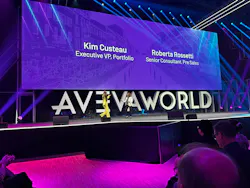
Machine Design: An insight raised by AVEVA CEO Casper Herzberg’s presentation was the convergence of sustainability, efficiency and resilience. Organizations are challenged to pursue all three simultaneously. I pause on resilience because he framed it as an imperative in today’s political environment. What does that mean for AVEVA, and how you help manufacturers use industrial data and software to improve energy performance and build adaptable operations?
Kim Custeau: Resilience is really about having access to the information you need, when you need it, so you can do your job effectively. That means no cyber disruptions, no government-related barriers, and the ability to deploy systems wherever customers need them while ensuring they can access those systems reliably.
On the industrial intelligence side, bringing data together is a critical part of the equation. It’s about making sure we have access to the right information and bringing that data together in context.
One of the biggest challenges in industry today is the lack of structured data. You can build all the AI, visualization and user experiences you want, but if the data isn’t right, you won’t get the outcomes you expect.
That’s why the data foundation matters just as much as the applications built on top of it. When you combine trusted data with software that helps users move through workflows and solve problems, that’s where industrial intelligence really starts to happen.
At that point, you can make decisions based on the data—and trust those decisions.
MD: AVEVA has long been associated with process industries, but discrete manufacturing and advanced automation are evolving quickly. What emerging opportunities do you see around digital twins, industrial intelligence and even robotics for machine design? That’s really where our engineering audience is focused.
KC: I’m assuming that when you look at machine design, you also think about the software associated with it, right? And it’s the combination of those things that adds value for the end customer.
I think that can be quite significant. But we also know where our software handles the requirements of discrete manufacturing well, and where we still need to evolve. Part of what we have to do is continue improving the things that already work well, while also infusing AI into those systems and creating digital twins around them.
When you talk about machine builders, especially in an OEM context, I definitely think onboarding software to those machines is critical. It gives manufacturers centralized visibility so they can analyze performance not just by machine, but by plant, use case and even operating environment.
To me, having the data onboarded and pipelined into a common environment is instrumental for improvement. That includes operational improvement, but also engineering improvement, because some of that operational data can ultimately help reengineer the machine itself.
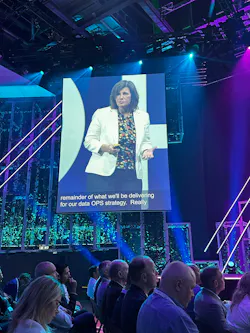
MD: As industrial platforms collect larger volumes of contextualized operational data, are you seeing OEMs rethink machine architecture itself? For example, what trends are you seeing in sensor placement, controls and overall machine design?
KC: Exactly what you said. Someone can look at an individual asset and make an assessment, but when you combine data across many assets, you start to see patterns that are very different.
You can begin asking questions like, “Why did this fail here and not there?” Sensor placement is one example, but it could also be the way the machine was built in the first place.
READ MORE: Harnessing Low-Code Platforms for Rapid Industrial Automation
That can lead to recommendations around reliability engineering. OEMs can also create new service models around that data because they understand their machines extremely well.
Some manufacturers may not have the internal resources to do all that analysis themselves, but companies like Schneider Electric or Tetra Pak deeply understand their own equipment. Providing them with operational data, allowing them to make recommendations and feeding those insights back to customers is really a core tenet of CONNECT.
It’s about taking information, using it for its original purpose and then extending those use cases so the data becomes even more valuable over time.
MD: Are there particular machine categories, industries or regions where you’re seeing faster adoption of operational intelligence and digital twins?
KC: There’s activity across all of our major regions, but in my opinion, Europe is probably the fastest-growing market for digital twins right now, followed by the Americas.
A lot of that comes down to how long customers have been using some of these tools. But it’s also important to understand that a digital twin is not the same thing for everyone.
In a food plant, for example, the focus may be on collecting operational data, visualizing it in dashboards or pie charts and connecting packaging systems or palletizers to online systems.
That’s very different from a refinery, where they absolutely need access to detailed engineering data. In refining and power, the engineering-to-operations digital twin is much more mature.
I think other industries will get there eventually, but they’re not all at the same stage yet. Some facilities may not even have original engineering models anymore. In those cases, we can laser-scan the plant and use that as the operational visualization layer instead.
So, the maturity and use case for digital twins really varies by industry.
MD: My final question stems from Artie Garg, AVEVA’s chief technologist’s keynote presentation. She talked about the shift from humans being operators to humans becoming supervisors. It’s interesting framing because workforce skills are a concern. What do you think advanced technology means for, not only the next generation entering industry, but for the current workforce that also has to adapt and learn new things?
KC: It’s very hard to do.
I think Artie made a really good point. Data science has traditionally been a highly specialized skill—and it still is. Artie herself is a data scientist.
But more and more people in the OT world—plant supervisors, operators and process engineers—are going to become much more capable of drawing conclusions from the data they see.
If we make it easy for operators and engineers to interact with data and apply analytics without even realizing they’re doing advanced analytics, then you get to the point Artie was talking about. They’re no longer just turning a crank. They understand: “If I do this, I’ll get that result.” The human still makes the final decision, but software has to become easier and more intuitive to use.
And honestly, this shift is less about people at the end of their careers and more about the next generation coming in. They have completely different expectations for how software should work, how they interact with it and what they expect it to do. They grew up swiping through experiences. Their expectations are fundamentally different.
About the Author
 Rehana Begg
Rehana Begg
Editor-in-Chief, Machine Design
As Machine Design’s content lead, Rehana Begg is tasked with elevating the voice of the design and multi-disciplinary engineer in the face of digital transformation and engineering innovation. Begg has more than 24 years of editorial experience and has spent the past decade in the trenches of industrial manufacturing, focusing on new technologies, manufacturing innovation and business. Her B2B career has taken her from corporate boardrooms to plant floors and underground mining stopes, covering everything from automation & IIoT, robotics, mechanical design and additive manufacturing to plant operations, maintenance, reliability and continuous improvement. Begg holds an MBA, a Master of Journalism degree, and a BA (Hons.) in Political Science. She is committed to lifelong learning and feeds her passion for innovation in publishing, transparent science and clear communication by attending relevant conferences and seminars/workshops.
Follow Rehana Begg via the following social media handles:
LinkedIn: @rehanabegg and @MachineDesign
YouTube: @MachineDesign-EBM