How Weidmüller SNAP IN Enables Faster, Automated Cabinet Wiring
This article was featured in Machine Design’s Automation & Robotics Takeover Week (July 13-17, 2026).
Control cabinet wiring was a central focus at Weidmüller’s Automate 2026 booth. The company demonstrated how its SNAP IN connection technology allows conductors to be terminated without tools or ferrules before showing the same process performed by a robotic cell.
The demonstrations coincided with Schneider Electric’s announcement that it is incorporating the technology into its TeSys motor control portfolio, beginning with TeSys Deca contactors, manual motor controllers and control relays. The collaboration brings a toolless contactor to the U.S. market that can cut motor control installation time by up to 75% for OEMs and panel builders.
READ MORE: The Connection Point is the Bottleneck Nobody Designs Around
Spring-clamp connections have long offered an alternative to traditional screw terminals. Weidmüller’s focus at Automate was on using the technology to simplify manual wiring while making automated wire termination practical.
Demonstrating Tool-Free Termination
During a live demonstration, Hannah Witopil, product manager for rail-mounted components at Weidmüller USA, inserted a stripped, fine-stranded conductor directly into a terminal without a ferrule or screwdriver. Once seated, Witopil explained, the connection provides audible, tactile and visual confirmation that the wire is properly terminated. “It gives you a ton of feedback that leaves no uncertainty of the state of the termination,” she said.
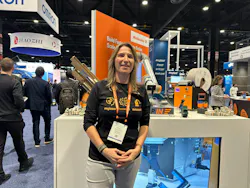
The system uses a preloaded spring mechanism that requires very little insertion force. Witopil described it as a “digital” connection because installers know immediately whether the wire is properly seated. “It’s either zero or one—it’s terminated or not. There is absolutely no question about it,” she said.
Because the connection relies on spring force rather than screw torque, it also eliminates the periodic retorquing that is often associated with conventional screw terminals.
Extending Automation to Cabinet Wiring
Witopil then demonstrated the same technology in a robotic wiring cell. The system cut, stripped and measured wire before routing it to a power supply and SNAP IN-equipped terminal blocks. With virtually no insertion force and no screwdriver torque sequence required, the wire termination process can be automated.
READ MORE: Pluggable Terminal Blocks: Simple and Secure
“SNAP IN technology has for the first time made automated wiring a possibility,” Witopil said. “It takes almost zero insertion force to land that wire, and that’s what makes it possible.”
The robotic cell builds on Weidmüller’s existing automation for DIN rail assembly, component placement and marking, extending automation into one of the most labor-intensive stages of control panel assembly.
About the Author
 Rehana Begg
Rehana Begg
Editor-in-Chief, Machine Design
As Machine Design’s content lead, Rehana Begg is tasked with elevating the voice of the design and multi-disciplinary engineer in the face of digital transformation and engineering innovation. Begg has more than 24 years of editorial experience and has spent the past decade in the trenches of industrial manufacturing, focusing on new technologies, manufacturing innovation and business. Her B2B career has taken her from corporate boardrooms to plant floors and underground mining stopes, covering everything from automation & IIoT, robotics, mechanical design and additive manufacturing to plant operations, maintenance, reliability and continuous improvement. Begg holds an MBA, a Master of Journalism degree, and a BA (Hons.) in Political Science. She is committed to lifelong learning and feeds her passion for innovation in publishing, transparent science and clear communication by attending relevant conferences and seminars/workshops.
Follow Rehana Begg via the following social media handles:
LinkedIn: @rehanabegg and @MachineDesign
YouTube: @MachineDesign-EBM