Q&A: Turning CAD Into a Manufacturing Plan
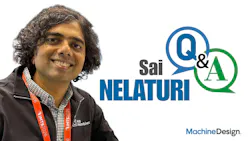
Artificial intelligence is generating plenty of buzz on the factory floor. For Sai Nelaturi, the opportunity lies in a problem he has spent nearly two decades studying: how to turn a digital design into a manufacturable product.
The co-founder and CEO of C-Infinity earned a PhD at the University of Wisconsin-Madison in CAD and model-based manufacturing, with research focused on spatial planning. He later developed process-planning technology at Xerox PARC, where he met his co-founders; their work was acquired by Sandvik. He went on to contribute to DARPA-funded research on CAD and advanced manufacturing before joining Carbon, where he applied those ideas to 3D printing production.
That background informs his view that CAD software can describe what a product looks like, but not necessarily how it should be built. Assembly sequence, tooling access, clearances and manufacturing constraints often remain locked in the heads of experienced engineers or buried in spreadsheets, workarounds and institutional knowledge.
READ MORE: How Engineering Leaders Can Avoid AI Pilot Purgatory
“The CAD design isn’t a complete spec for you to be able to do automated manufacturing planning,” he said. “It’s like a blueprint or a drawing that a human engineer has to apply mechanical intuition for.”
C-Infinity’s AutoAssembler platform aims to make that knowledge computable. The AI software converts CAD models into manufacturing plans and work instructions, analyzes engineering changes and generates process plans that account for real factory constraints. Nelaturi describes it as a “manufacturing compiler”: design goes in, executable production logic comes out. At IMTS 2026, he spoke with Machine Design about why the path from CAD model to factory floor is ripe for automation.
Editor's Note: This Q&A is an abbreviated transcript. It has been edited for length and clarity.

Machine Design: For readers who may not know C-Infinity, what problem are you solving?
Sai Nelaturi: We are solving a problem that is universal in manufacturing, which is basically, how do you convert the digital designs and the product structure into the physical steps that actually are used to manufacture the product?
This conversion of the digital design into the physical product process steps is quite a challenging problem. Manufacturing today is mostly dealt with by people doing manual work. They're looking at Excel sheets, they're looking at exploded views and things like that, and it takes a really, really long time.
This is a really good area for artificial intelligence to speed up the iteration cycles and get products to market faster.
MD: What does AutoAssembler actually do?
SN: If you just have a subassembly in CAD or an assembly in CAD, what can you tell about the design? How can it actually be made? Do you have all the clearances that you need? Do you have a sequence in which you can actually put things together?
We can simulate that and show it to the user so they can verify before they actually build. That becomes AutoAssembler's primary use case.
MD: Why is that difficult to do from CAD data alone?
SN: When we look at CAD designs from real manufacturers, they’re usually very noisy. They are designed with the designer assuming that another human, a manufacturing engineer, is going to look at it and interpret certain things from it.
The CAD design isn’t a complete spec for automated manufacturing planning. It’s sort of like a blueprint or a drawing that a human engineer has to apply mechanical intuition for.
The source data is incomplete. What AI has to do is look at that source data and, like a manufacturing engineer, understand what the designer’s intent was.
MD: What does that “mechanical intuition” look like in practice?
SN: When you join parts together, they have relative motions between them, and the relative motions between them imply how they should be assembled. Extracting that information just purely from geometry is a very hard problem.
We understand the intuition behind how parts move relative to each other, and that becomes a layer of design feedback. Hey, you want this bolt to be assembled this way, but you need a clearance of three millimeters, and you don’t have that right now, so you want to fix the design.
MD: Where does AutoAssembler fit into existing engineering workflows?
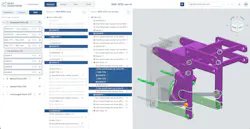
SN: Every time an engineer or a designer makes a change in a design, it goes into the PLM system as an engineering change order. The manufacturing engineer now has to see whether this design, as proposed by the designer, can actually be made in the assembly factory.
You're looking at the before and you’re looking at the after, and you’re sort of comparing it by visual inspection. You're saying, okay, these are the parts that have changed, and if I have to accommodate this change, this is how my process has to change. You’re doing all that mentally as a manufacturing engineer.
With AutoAssembler, the engineering change order in the PLM system triggers AutoAssembler to identify those changes. We give you an audit of all the changes, and then we build you a process plan from the previous plan.
READ MORE: Why Faster Design Needs a Better Path to Production
MD: How does the software determine what changed and what can be reused?
SN: We provide each part in an assembly a unique signature, like a DNA. It’s a property of the shape, where it's located in the assembly, how it’s connected to other parts. Every single part has a unique signature.
When you change a part, when you change the geometry, that’s an immediate signal change. The manufacturing engineer can then say, “I replaced this subassembly with that other subassembly, but I preserved the interfaces so I can use the existing plan.”
Being able to automate that kind of intelligence is a capability that doesn’t exist today apart from AutoAssembler.
MD: You describe AutoAssembler as a “manufacturing compiler.” Why?
SN: The compiler analogy is strong because it is actually true at many levels of detail.
Given the shapes of these parts and the mechanical intuition we’re extracting from the design, it leads to a set of constraints. You cannot install this before you’ve installed that.
The manufacturing engineer gives us additional constraints, which is, here’s how my factory is set up. These parts must be assembled in this station. Those parts must be assembled in that station.
That is what translates what needs to be built into how it needs to be built, because the how is a function of not just what needs to be built, but where it needs to be built.
MD: What role does this play in digital twins and virtual commissioning?
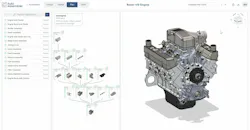
SN: One of the direct use cases of this is creating a virtual build, a digital twin of the actual process step. You have your tools, your fixtures. You can show your assembly sequence, and you can simulate the digital twin of the process and the product evolving. Without this capability, I don’t think it is possible to actually accomplish that level of automation.
MD: Why is this a particularly important moment for AI in manufacturing?
SN: We’ve talked about the technology and what it can do, and that’s wonderful, but it’s not useful unless people can use it in their business processes. One conscious decision we made was to expose all of the AI capabilities through an integrated and harmonized set of APIs.
When we talk to our customers and their IT departments, and we offer them APIs, it gives them so much more flexibility. The integration with their existing workflows becomes much easier when you offer them the lower-level capabilities without the stack on top of it.
More content from IMTS 2026.
Have a question, comment or idea? Get in touch with the Machine Design editors at [email protected].
About the Author
 Rehana Begg
Editor-in-Chief, Machine Design
As Machine Design’s content lead, Rehana Begg is tasked with elevating the voice of the design and multi-disciplinary engineer in the face of digital transformation and engineering innovation. Begg has more than 24 years of editorial experience and has spent the past decade in the trenches of industrial manufacturing, focusing on new technologies, manufacturing innovation and business. Her B2B career has taken her from corporate boardrooms to plant floors and underground mining stopes, covering everything from automation & IIoT, robotics, mechanical design and additive manufacturing to plant operations, maintenance, reliability and continuous improvement. Begg holds an MBA, a Master of Journalism degree, and a BA (Hons.) in Political Science. She is committed to lifelong learning and feeds her passion for innovation in publishing, transparent science and clear communication by attending relevant conferences and seminars/workshops.
Follow Rehana Begg via the following social media handles:
LinkedIn: @rehanabegg and @MachineDesign
YouTube: @MachineDesign-EBM



Voice Your Opinion!
To join the conversation, and become an exclusive member of Machine Design, create an account today!
 Leaders Logo
Leaders relevant to this article: