How Engineering Leaders Can Avoid AI Pilot Purgatory

Engineering AI has shifted from a technology that came with high expectations but limited realized value, to one that is being increasingly integrated directly into design exploration, simulation workflows and technical decision-making. And this shift has happened in the space of 12-18 months.
According to a 2026 survey of 350 senior engineering leaders by SimScale, 100% of respondents are now prioritizing AI integration. The industry has moved from asking whether AI matters to asking how to operationalize it responsibly at scale.
However, the same survey reveals uneven adoption across engineering organizations. The number of businesses managing to convert AI pilots into mature, scaled projects is much smaller than those able to launch initial pilots. As engineering AI is already demonstrating a return on investment (ROI), this could mean big trouble for those organizations falling behind.
In this article, I will look at what is working, the barriers to progress and the signs and implications of uneven AI adoption. I will also examine how engineering leaders can avoid falling into pilot purgatory and successfully mature and scale AI programs, as well as what these leaders should be looking out for in the new future.
What’s Working
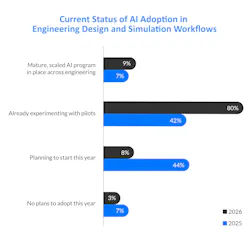
The engineering industry has made clear strides in AI adoption over the last year, with teams rapidly moving from planning AI initiatives to active pilots. 80% of survey respondents said their organizations are currently experimenting with AI pilots, nearly doubling from 42% in 2025. This data suggests that many of the same organizations that said that they were planning to begin AI initiatives (44%), as part of the same survey in 2025, have now started testing AI within their engineering environments.
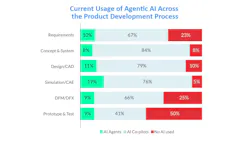
The use of agentic AI is increasing, with 90% of respondents reporting some use of agentic AI co-pilots or autonomous agents within their design and engineering workflows in 2025. And it is starting to appear across the product lifecycle, concentrated in three key areas: in simulation and computer-aided engineering (CAE, 19%), followed by design and computer-aided design (CAD, 11%) and requirements engineering (10%).
Simulation tells a particularly successful story, in that 19% of respondents said their simulation workflows now involve some kind of experimentation with autonomous AI agents. This is significant given the complexity of these engineering tasks. And 36% of design and simulation projects in the past 12 months used AI or agentic engineering approaches, marking a tipping point for the industry.
Organizations are also seeing return on investments (ROI) from using AI. On average, AI-enabled workflows are delivering 3x faster turnaround times for request for quotes (RFQs), and—in 11% of cases—i these AI workflows are turning them around in less than a day. While most deadlines are fixed, this speed means teams can explore more design options, refine proposals and present the most competitive quotes, presenting a significant commercial advantage.
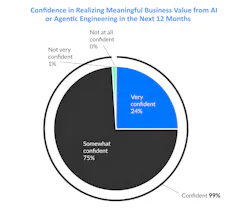
And this is an area where there is almost full unanimity across the industry. 99% of respondents say they are confident their organization will realize meaningful business value from AI or agentic engineering within the next 12 months. The results are already being seen by first-adopters.
Looking specifically at simulation, where conventional requests take up to 17 hours, whole AI workflows are being completed within just six. Introducing AI into workflows is increasing simulation iteration speed from as low as once a week to multiple times a day, and increasing the number of design variants explored from as low as 1-5 to more than 200.
As a result of this progress, trust in AI is now strong. The 14% of respondents in 2025 who said AI was not a current priority have completely disappeared, and there is a clear focus on shifting to how quickly and effectively AI can be integrated into engineering processes. This demonstrates a growing level of trust in AI-driven tools and methods.
There is undoubtedly a lot to celebrate but, as with all new technology adoption, there is some way to go before engineering organizations are harnessing the full potential, and commercial value, of AI.
Where More Work is Needed
The stark figure from this survey, and the figure I keep going back to, is that 80% of engineering companies are stuck in AI purgatory. There is a clear gap opening up between those organizations experimenting with AI and those fully extracting its competitive advantage.
Of the engineering leaders surveyed, only 9% have a mature, scaling AI program in place and 80% are working on limited deployment pilots. While we have seen good progress with companies that were planning AI initiatives launching pilots—most companies planning to start AI projects last year (44% in 2025) have now taken the next step and started pilots (80% in 2026) —companies are stalling at the next step. In 2025, 7% of organizations had mature, scalable AI programs. In 2026, that number has only increased to 9%.
The speed at which engineering organizations are scaling AI into engineering workflows is also raising a red flag. The survey reveals that the average deployment time frame from pilot to mature AI (or agentic AI) is eight months, but over half of respondents (55%) said it was taking between 7-12 months, and 9% over a year. The fastest moving organizations are shrinking this timeline down to just 3-6 months.
And while agentic AI is making an appearance, many organizations are still experimenting cautiously with autonomous engineering. 83% say that agentic AI deployments are limited and only 7% of organizations report extensive use of agentic AI across engineering workflows. Trust issues still loom here: There is genuine interest in agent-based systems, but remaining concerns around governance and control is holding adoption back.
How to Avoid Pilot Purgatory
The tremendous amount of work involved in operationalizing new technologies cannot be overlooked, but there are a number of practical steps engineering leaders can take to help avoid AI programs stalling.
1. Understand the barriers and stop waiting for “perfect” data. As more engineering organizations experiment with AI in design and simulation, understanding the barriers that prevent pilots from scaling and learning from those who have successfully scaled their own initiatives is critical to successfully turning early experimentation into lasting results.
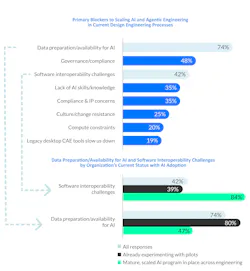
Data preparation and availability for AI was flagged as a primary barrier by 74% of survey respondents but this is less of a risk in practice. Engineering AI applications, including agentic assistants, workflow automation and design exploration support, can begin delivering value with far less data preparation than commonly thought, demonstrating it is not a prerequisite for all AI initiatives.
2. Prioritize cloud-based infrastructure now. 55% of survey respondents flagged cloud-native technology stacks as an important enabler for AI and agentic engineering and 75% of engineering organizations who reported mature AI adoption have this infrastructure in place. Leaders should prioritize cloud-native infrastructure now to remove the computational and physical barriers that prevent AI from scaling across teams.
3. With agentic AI, focus on succeeding in one area. Focus on implementing agentic AI into one product development lifecycle workflow. If you start with simulation, you can leverage its structured nature to prove ROI and then use these results to quickly expand it across less procedural domains.
4. Set key performance indicators (KPIs) and benchmark progress. KPIs are used to track progress across all aspects of business performance and AI adoption should not be an exception. For example, most engineering organizations fall within a 26-50% AI adoption rate, indicating that many are actively integrating AI into a significant portion of their work while relying on conventional approaches for the rest.
Set a KPI to standardize AI usage as the default for at least 50% of your upcoming portfolio to bridge the gap between niche pilots and enterprise value. And you can also set KPIs for specific tasks to drive this overall goal. For example, target at least one simulation iteration a day to ensure technical rigor informs every design direction in real-time.
Engineering leaders should benchmark pilot-to-production targets every six months to prevent stalling and to stay competitive, and leaders also need to track the business value being unlocked by requesting clear evidence within a 12-month window.
5. Train your team. 100% of engineering organizations are preparing for universal AI expansion. AI and agentic engineering are no longer viewed as optional or experimental tools, but as technologies that will play a growing role in how engineering teams design, test and optimize products. Engineering leads need a comprehensive strategy to upskill their teams on systems thinking and agent governance.
Looking to the Future
By looking at both the breakthroughs and the barriers of AI adoption, engineering leaders can use the successes and learning to optimize AI pilot programs—moving them away from isolated experiments to operational, integrated Engineering AI.
Among the engineering community, willingness to embrace AI is not an issue. 2025 research data showed massive appetite and openness for AI adoption within mid-level engineers, and that these engineers consider AI pilots as an opportunity for engineering innovation at pace, not job removal.
Provided with the right technology infrastructure, AI tools, training and C-level support, the engineering industry has the opportunity to demonstrate what successful AI adoption looks like. And, at the same time, innovate at speed.
About the Author
 David Heiny
Co-Founder and CEO, SimScale
David Heiny is the Co-Founder and CEO of SimScale, a cloud-native computer-aided engineering (CAE) platform.
Voice Your Opinion!
To join the conversation, and become an exclusive member of Machine Design, create an account today!
 Leaders Logo
Leaders relevant to this article: