Is Text-to-Code a Precursor to Text-to-CAD?
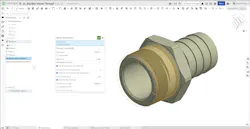
There are good reasons to believe that text-to-CAD—the ability to generate parametrically editable 3D geometry using natural language prompts—is the design software sector’s next quest. Within the last few years, numerous startups and R&D efforts to realize this vision have appeared.
Whether they can be deployed in a real project in their current form is debatable. While most of them can generate simple parts with little or no hiccups, their outputs for complex parts leave some users scratching their heads and grinding their teeth. The challenge is, in part, describing complex geometry in everyday language.
In parallel to these initiatives, many mainstream CAD and simulation programs have also begun adding agents and copilots with natural language support. At present, their primary function is to help users find suitable commands and tools or provide step-by-step modeling instructions. But some software makers have hinted—and many users are hoping—that the technology will eventually be sophisticated enough to perform modeling tasks based on natural language input.
This August, PTC released the Onshape FeatureScript MCP (modeling context protocol) Server from Onshape Labs. The move allows Onshape users to use popular AI programs like ChatGPT, Claude and Gemini to generate code that executes modeling tasks in Onshape. PTC describes the workflow it enables as “text to code to CAD.”
Darren Henry, PTC’s Senior VP of General Operations, sees this as the preparatory step to text-to-CAD. But he also explains why a wholesale text-to-CAD adoption—with a UI featuring a text prompt and a microphone for input—is not likely in the design software sector.
Text-to-CAD as it Stands
Text-to-CAD is a “growing area of interest” among CAD software users, “but it’s a bit of a novelty, not heavily used in production,” Henry noted. “We’ve seen successes in generating simple parts, or a system of parts, but you may not get deterministic results.”
LLM-driven chatbots tend to offer slightly different answers even when the same question is repeated. The phenomenon is not a flaw but a feature of LLMs, which are built to juggle probabilities and randomness. But in engineering, the hallmark of reliability is repeatable outcomes based on rigid mathematical formulas. Reconciling this difference is part of the challenge for R&D teams working on text-to-CAD solutions.
READ MORE: Design Brief: Using AI to Build Reusable CAD Tools
“As the LLM models and the AI models learn more CAD techniques, they’ll become better,” Henry assured. However, this is not the only issue. “Well-versed CAD engineers will, in many cases, constrain the sketches so they capture design intent and build geometry with feature dependencies.
“They don’t build in reference planes,” he continued. “They sketch on surfaces. The current LLM models don’t have the level of expertise that human CAD engineers do in that area. So, while you might get a nice conceptual model, it might not be built in the way a human engineer will do it,” he added.
Text-to-CAD is unquestionably an easier way to produce geometry, but Henry warned something could be lost in the pursuit of efficiency. “You have a more intimate relationship with the model and understand how to update it if you build it yourself,” Henry said.
Figuring Out the Role of Text-to-CAD
Mainstream CAD tools have made certain routine modeling tasks, such as adding chamfers and rounded edges, extremely easy. For these instances, manual approaches are much more straightforward than describing the desired outcome in text. “These are the areas where human-led design is much more efficient,” Henry pointed out.
While text-to-CAD’s role currently remains murky, Henry sees a place for it in product design development. “If you’re doing conceptual design and you want to just see a number of ideas or variations…or, if you want to do some quick variations or simplifying a design for simulation, you may want to use AI to help you,” he reasoned.
A Precursor to Text-to-CAD
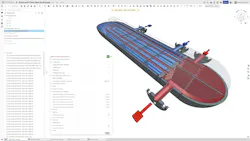
Onshape uses FeatureScript, a proprietary programming language, to describe how the software parametrically builds geometry. The company published the FeatureScript library and documentation as open source.
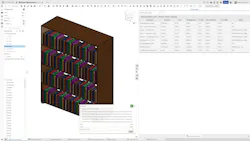
“Our intent was to let users program Onshape, much like our own engineers do, and customize Onshape to suit their needs,” Henry explained. “And many do. We have bicycle manufacturers that have written custom features to run cables within the frames, and modular home builders that have created custom features to build wall-stud layouts.”
Manufacturers tend to have product-specific parts and components they routinely produce with minor variations, perhaps in width, thickness or hole patterns. Their preferred manufacturing methods may also dictate the design of such parts. The ability to customize Onshape with FeatureScript allows them to generate these designs in a standardized template-like UI. However, the coding skill required was a barrier for average users. But this is no longer the case.
READ MORE: CAE Automation: From AI Prompt to Simulation
“It turns out AI can program very well,” said Henry. With Onshape’s release of the Onshape FeatureScript MCP Server in August, users no longer need to write FeatureScript code themselves. They can ask popular AI chatbots to generate FeatureScript code for a range of modeling tasks.
“Whether you’re an educational user, a hobbyist or a commercial user, you can access Onshape's FeatureScript MCP,” Henry said. In his demonstration of the workflow, Henry used Claude, but he assured, “Any LLM that supports the MCP will do.”
Henry said that, since the FeatureScript MCP’s launch, he had seen “an explosion of custom features,” suggesting the natural language-driven workflow has significantly expands the pool of users creating custom features. “We’ve seen people using it to create equations to optimize the acoustics of a room. We’ve seen people automating the rudimentary tasks that they do over and over.”
Due to the inherent imprecision in natural language, generating 3D objects through text and voice prompts might produce unpredictable results. However, with custom features created using the text-to-code-to-CAD workflow, “they produce deterministic results,” Henry noted.
IP Considerations
Because of the engineering knowledge embedded in detailed CAD models, manufacturers often treat these files as intellectual property. With the text-to-code-to-CAD workflow, the custom features produced by code would likely become part of a company’s closely guarded IP, Henry pointed out.
“Now users can actually build intellectual property (IP) with customized CAD tools that they utilize,” Henry added. However, he raised one IP concern about the anticipated workflow.
READ MORE: CAD Heading into Stormy Waters
“We have a Claude Enterprise license, so the prompts that we use are kept private, segregated from the others,” he said. LLM-based AI programs like ChatGPT, Claude and Gemini are also widely available to the public. However, data protection and segregation agreements for individual subscribers are vastly different from those for enterprise account holders.
Looking Ahead
Henry revealed that Onshape is planning to foster a FeatureScript community space so users can create, share and find Onshape-compatible custom features. The company is also developing a Quick Render tool with natural language support.
“Imagine you have a CAD model; maybe it’s some type of eye-diagnostic equipment and you can say, ‘let’s put it in a doctor’s office with a patient,’ and the software will render that very quickly for you,” he said.
Henry noted AI-driven advisors are becoming “the table stake” for all CAD vendors—the bare minimum they need to provide to be a player. If so, in the next phase of the game, you can expect CAD software developers to start offering agents that are intelligent enough to execute basic tasks, such as swapping out materials or estimating the total cost and weight of assemblies. “You’ll be able to stack commands and have them execute for you. They’ll be working alongside human engineers,” he predicted.
At first glance, AI agents that can execute a wide range of well-defined modeling tasks seem to minimize the human engineer’s role, but in Henry’s view, it’s quite the opposite. The human needs to be in the loop “because [the humans] need to not only validate but also edit what the AI has generated…and the AI needs to build that geometry within the production-level CAD system that the humans are using today,” he reasoned.
If AI agents get better at modeling tasks due to improvements in text-to-CAD technology, then humans will need to become much more proficient at evaluating how machine-generated geometry affects manufacturability, production costs and end-user experience.
Have a question, comment or idea? Get in touch with the Machine Design editors at [email protected].
About the Author
Kenneth Wong
Kenneth Wong is a freelance editor, writer, blogger and webcast moderator. He has been covering the engineering software sector for more than two decades. He is a former editor of Cadence, Game Developer and Digital Engineering 24/7.



Voice Your Opinion!
To join the conversation, and become an exclusive member of Machine Design, create an account today!
 Leaders Logo
Leaders relevant to this article: