SPIROL’s Heat-Insertion Tech Ensures Repeatable Threaded Insert Placement

SPIROL’s yoyo puck assembly station was a crowd pleaser for nostalgic players visiting their booth at MD&M West 2026. It was also a great way to lure the crowds to observe demonstrations based on threaded heat-insertion systems.
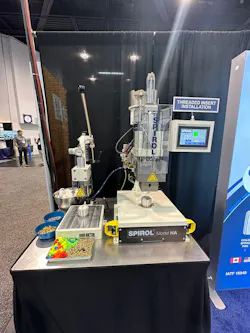
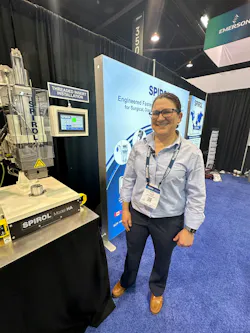
Christie Jones, director of marketing and vice president, SPIROL, demonstrated the mechanism behind the controlled thermal process using both a manual heat inserter and a fully automatic heat inserter for threaded inserts in plastics. Both produce uniform melt flow and mechanical bond where the insert and surrounding polymer fuse into an integrated structure.
Jones’s demonstration focused on the installation of threaded inserts, which reinforce plastic components by providing a durable, reusable thread within a bolted assembly. They ensure proper seating torque and guard against plastic creep, which could compromise the performance of the assembly over time.
The heat insert process, developed by the engineered fasteners, installation machines and parts feeding equipment manufacturer, is typical across industries in applications ranging from medical housings and automotive sensor brackets to consumer electronics.
Watching Jones demonstrate the sequence close-up, it was clear that this was not a simple fastening method, but in fact a finely tuned integration of the materials.
Manual Insert Method
At the manual machine (Model HM Heat Insert Driver), an operator loads the insert into the plastic assembly. They pull the handle, which transfers heat from the heated tip to the insert and into the plastic, softening the plastic around the insert.
The machine is equipped with an internal air spring, so the operator cannot cold-press the insert into the plastic. It installs inserts ranging from M2-M6 metric threads and #2-1/4 unified threads. According to the Spirol’s product notes, as much as 75% of an insert’s performance is directly related to the quality of installation. It underscores why all factors influencing installation must be meticulously managed.
READ MORE: Joining Plastics: Smarter Welding, Better Designs, Stronger Assemblies
At the demo bench, when the arbor press lever is pulled all the way down, it makes contact with the insert and dwells for a couple of seconds, until the plastic is sufficiently melted so that the insert installs at the right temperature.
“I’m pulling this down,” explains Jones. “I’ve made contact, it’s dwelling and now the insert is installing into the plastic assembly. I know it’s fully installed because there’s a mechanical stop here with a micrometer adjustment to ensure installation at the exact depth and location.”
Automatic Insert Method
Performing the same task at the automatic heat machine (Model HA Automatic Heat Insert Driver), Jones pointed out that inserts are contained in a vibratory bowl feeder. Inserts are simply loaded into the feeder, so the operator doesn’t have to touch the inserts.
The inserts then travel through a feed tube and are preheated to the correct temperature. “It’s going to transfer heat from the heated tip to the insert, soften the plastic around the insert, and the machine is equipped with an internal air spring, which means that as hard as [the operator] pulls down on the lever, the insert will not install into plastic until it’s sufficiently softens the plastic around the insert,” Jones explained, adding that the insert is fully installed into the plastic, automatically dialing in time, temperature and pressure.
READ MORE: An Application Engineer’s Insights on Fastening and Joining Components
“When I actuate the machine using the dual opto-touch sensors—which keep me safe and ensure I don’t burn myself—you’ll see that installation appears almost instantaneous, because the inserts are already at temperature.
The machine handles threaded inserts from M2 to M8 metric and up to #2 to 3/8 unified threads. “This machine is currently installing one insert at a time, but it can be configured to install two, three or four inserts simultaneously,” said Jones.

Two Methods, One Outcome
The distinction between the two methods is essentially how heat is controlled and when it enters the process. With the manual insertion, heat is applied at the point of contact and held for a controlled dwell. The automated system moves the thermal step earlier by preheating the insert.
But the goal remains the same: Hit the interface temperature so the insert seats securely and becomes a strong, load-bearing part of the plastic assembly.
About the Author
 Rehana Begg
Rehana Begg
Editor-in-Chief, Machine Design
As Machine Design’s content lead, Rehana Begg is tasked with elevating the voice of the design and multi-disciplinary engineer in the face of digital transformation and engineering innovation. Begg has more than 24 years of editorial experience and has spent the past decade in the trenches of industrial manufacturing, focusing on new technologies, manufacturing innovation and business. Her B2B career has taken her from corporate boardrooms to plant floors and underground mining stopes, covering everything from automation & IIoT, robotics, mechanical design and additive manufacturing to plant operations, maintenance, reliability and continuous improvement. Begg holds an MBA, a Master of Journalism degree, and a BA (Hons.) in Political Science. She is committed to lifelong learning and feeds her passion for innovation in publishing, transparent science and clear communication by attending relevant conferences and seminars/workshops.
Follow Rehana Begg via the following social media handles:
LinkedIn: @rehanabegg and @MachineDesign
YouTube: @MachineDesign-EBM
Voice Your Opinion!
To join the conversation, and become an exclusive member of Machine Design, create an account today!
 Leaders Logo
Leaders relevant to this article: