What are the Best Strategies for Reducing Thermal Distortion in Welding?
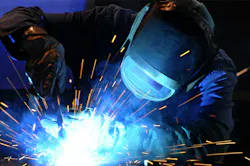
Thermal distortion remains one of the most challenging obstacles in precision welding. Heat input creates temperature gradients that drive uneven contraction during cooling, warping assemblies out of tolerance despite meticulous planning. Managing weld distortion is essential for achieving tight tolerances.
While strategies like optimized fixturing, robotic precision and thermal tensioning can minimize these effects, they cannot eliminate them entirely. For precision components, post-weld machining serves as the final and nonnegotiable step in achieving microinch precision.
How Key Parameters Influence Thermal Distortion
Heat input levels directly influence how quickly temperatures change and how much thermal distortion occurs during cooling. Higher heat input is equivalent to a lower welding speed, since heat input decreases as welding speed increases. This accelerates both heating and cooling rates within the workpiece.
During cooling, the temperature gradient across a sheet’s upper and lower surfaces causes greater contraction on the upper surface. This disparity causes warping, which becomes more pronounced as heat input rises.
READ MORE: Hybrid Welding of Complex 3D Parts
Key process parameters shape distortion outcomes. Heat input, preheat temperature, external constraints and welding speed impact the heat-affected zone expansion, warping intensity and residual stress levels.
As heat input increases, the heat-affected zone expands, deformation intensifies and residual stresses elevate. Material selection matters as well. Aluminum and stainless steel, two commonly used metals, are far more affected by weld shrinkage than carbon steel, making parameter control critical.
Using Preheating and Clamping to Manage Warping
Optimal preheating reduces thermal distortion by creating a more uniform temperature distribution in welded plates. By creating more uniform temperatures, preheating minimizes the steep gradients that drive uneven contraction. Increasing preheat temperature can reduce warping, offering a practical method to manage weld distortion and achieve tight tolerances.
External clamping during cooling delivers even more consistent results. Regardless of heat input levels, it is among the most effective control methods. Research shows companies can reduce distortion by up to 55% with properly applied clamping. When dimensional precision is nonnegotiable, this technique becomes essential. The combination of preheating and an external constraint generate temperature coupling, resulting in a more uniform heat distribution and reduced thermal gradients that cause warping.
Letting Robots Mitigate Real-Time Issues
Robotic welding systems eliminate human error while algorithmically optimizing temperature parameters to mitigate thermal distortion. Because they operate without the variability inherent to manual welding, they significantly accelerate production speeds without compromising structural integrity. Advanced robotics uses sensor feedback and adaptive control algorithms to compensate for joint geometry variances and alignment deviations in real time.
This adaptive capability fundamentally changes how manufacturers manage warping. Rather than relying on static process parameters, robotic welding continuously adjusts heat input, travel speed and torch positioning based on live thermal data.
These platforms can dynamically compensate for thermal distortion. The result is more consistent dimensional outcomes across production runs, particularly valuable for high-volume manufacturing where process repeatability determines profitability.
Introducing Stress to Counteract Distortions
When applied simultaneously with the welding operation, a line-based forming process helps counteract thermal distortion by introducing compensating stresses. The technique involves using auxiliary propane torches alongside welding torches to introduce compressive stresses that offset warping. Torch position and heat power considerably reduce out-of-plane deformation in T-joints. This occurs when operators apply high-temperature thermal transient tensioning.
Optimal torch configuration determines effectiveness. Temperature and position must be calibrated for each application. Higher temperatures reduce more warping but may trigger metallurgical transformations that limit the technique’s use with certain materials. Thermal tensioning works best when engineers control auxiliary heat sources precisely and understand material behavior under thermal stress.
Minimizing Heat Input by Optimizing Weld Design
Well-engineered fixtures play a foundational role in distortion control by constraining movement during welding and cooling. Optimizing material selection and distribution can considerably improve thermal distortion resistance before a torch ever touches the workpiece. Thicker sections near weld zones, for example, provide greater thermal mass to absorb heat and reduce localized temperature spikes.
Weld sequence planning also influences final dimensional accuracy. Welding from the center outward allows residual stresses to dissipate more evenly across the assembly. Similarly, using intermittent welds rather than continuous beads reduces total heat input. These sequencing strategies work particularly well for large fabrications where cumulative heat buildup drives significant deformation.
READ MORE: Process Considerations
Design decisions extend to post-weld machining for precision components. If the dimensions of a weld structure are critical, such as mounting holes or mating surfaces, machine those features after welding to maintain accuracy.
Allowances for post-weld machining on precision components ensure sufficient material remains to machine away distorted areas. Planning for post-weld machining acknowledges that some warping is inevitable and works accordingly, rather than attempting to eliminate deformation through process control alone.
Post-Weld Machining Precision Components
For applications requiring tight tolerances, managing weld distortion is key. However, for precision components, post-weld machining represents the only reliable method to guarantee precision. That final step is nonnegotiable for ultimate accuracy.
While preheating, clamping, robotic control and thermal tensioning all reduce warping during welding, they cannot eliminate it. Machining after welding corrects residual deformations and restores dimensional precision to specifications that welding processes alone cannot achieve.
Leaving machining allowances on critical surfaces ensures sufficient material remains to accommodate thermal warping. Once the weldment has cooled and stabilized, Computer Numerical Control (CNC) machining removes distorted material and restores features to tolerance. Machining becomes essential for components where mounting interfaces, bolt patterns or mating surfaces must align within thousandths of an inch.
Manufacturers can perform post-weld heat treatment after machining to reduce remaining residual stress and enhance mechanical properties. The general rule is to ensure one hour of heat treatment for every 25 millimeters of base material thickness. This practice can help prevent corrosion, fatigue and creep.
Aerospace, medical device and semiconductor equipment manufacturing rely heavily on this combined approach. These industries demand tolerances measured in ten-thousandths of an inch, where even minimal thermal warping exceeds acceptable limits. The precision that post-weld machining delivers enables these sectors to use welded fabrications in applications that would otherwise require far more expensive solid billet machining or casting.
Taking a Holistic Approach to Weld Distortion Control
Minimizing warping during the welding phase is absolutely critical and the strategies outlined above deliver measurable improvements. Each technique offers distinct advantages depending on material, joint design and tolerance requirements.
Eliminating thermal distortion is impossible, given the physics of welding. Instead, workers should manage warping through optimized parameters, fixturing, robotic precision and thermal techniques, then achieve true dimensional accuracy through post-weld machining of precision components. Integrating both processes recognizes that welding and machining are complementary. Each plays a distinct role in delivering components that meet demanding tolerances.
About the Author
 Emily Newton
Emily Newton
Emily Newton is a technology and industrial journalist. She is also the editor in chief of Revolutionized. She has over five years covering stories about warehousing, logistics and distribution.
Voice Your Opinion!
To join the conversation, and become an exclusive member of Machine Design, create an account today!
 Leaders Logo
Leaders relevant to this article: