Platform Thinking Accelerates Access to Humanoid Robots
The high cost of mass producing a humanoid is an overarching prohibitive factor for many industrial companies.
Yet tech experts consider cost limitations—ranging from access to robotic operating systems that integrate with AI, hardware and sensors to energy shortages, as well as safety and regulatory concerns—as factors that can be overcome.
For many, including igus, the question is no longer whether we need humanoids in the industrial workforce, but when. Their focus is on having robots that can augment tedious tasks and provide flexible assistance exactly where support is needed.
Amid a severe shortage of skilled labor, humanoid robots offer a distinct advantage: They can be used across a wide range of environments and applications. When developed to work alongside humans, general-purpose humanoids can boost productivity and help mitigate the impact automation may have on some roles.
READ MORE: Humanoid or Not? How Robot Design is Challenging Our Notions of the Humanoid
“It is crucial that the integration of complex automation solutions becomes possible for users without expert knowledge or vast expenses,” noted Alexander Mühlens, head of the Low-Cost Automation Business Unit at igus. “We are therefore currently working on new AI-based control systems, among other things, which we will be presenting at Hannover Messe 2026.”
To this end, the plastics specialist plans to harness its RBTX marketplace, which is geared toward low-cost options. Specifically, when it comes to humanoids, the company is leaning into building its own humanoid fleet, as well as becoming a one-stop shop for partner companies.
A large part of this plan hinges on expanding its RBTX ecosystem by developing it into a service hub for complete automation solutions and connecting users with other integration partners.
By the time Hannover Messe starts in April, the online platform is expected to offer the largest range of humanoid robotics, with 95 robot models from 35 manufacturers, said Sebastian Thorwath-Kienbaum, Technical Internal Sales – Low Cost Automation, igus.
How RBTX is Extending Access to Robotics Solutions
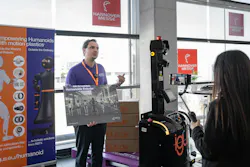
During a demo at the Hannover Messe press preview, Thorwath-Kienbaum highlighted three areas the company will showcase at this year’s trade fair in Germany.
First, is that igus has evolved from supplying individual components to delivering components that fit into fully working applications.
“You may know RBTX as a company that traditionally sold components only,” said Thorwath-Kienbaum. “However, based on feedback from our customers, we’ve learned that they want more. As a result, we’re transforming into a company that provides complete application solutions.”
Expanding a Modular, Cost-Efficient AMR Fleet
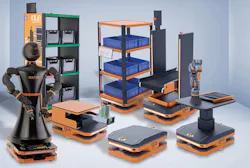
The second area is the expansion of the company’s autonomous mobile robot fleet. Igus started with the introduction of the ReBel Move for material handling and is now expanding its offering with the ReBel Pallet Mover, an autonomous forklift that’s available with payload capacities of 300 kg, or 1,500 kg, and can be customized to suit application requirements.
“We realized early on that we needed a different type of fleet, because in Cologne alone we operate more than 800 injection molding machines,” said Thorwath-Kienbaum. “We use out own AMR fleet internally.”
The ReBel Move Pro, for example, is designed for flexibility and features a base platform that can be customized with different modules depending on the application. For pallet transport, igus offers the ReBeL Pallet Mover, which is dedicated entirely to moving pallets within production environments. The outdoor ReBeL Move is designed for transporting goods outdoors, making it possible to connect different production halls.
READ MORE: AI Takes Center Stage at Hannover Messe 2026 Preview
“One of our biggest advantages is flexibility,” said Thorwath-Kienbaum. “Our goal is to offer the right AMR for every application. We’re also highly cost-efficient, with prices typically 10–15% lower than comparable competitors.
According to Thorwath-Kienbaum, “self-integration” is a notable advantage. In other words, customers can install and commission the systems themselves, eliminating the need for external service providers and reducing deployment complexity. The AMRs are delivered with the required software already included, without recurring annual licensing fees and each system comes with a charging station.
Intelligent Orchestration: Humanoids À La Carte
The third area is the expansion of its humanoid program. This includes in-house humanoid robots as well as humanoid robots developed in partnership with others. igus offers lubrication-free components such as spherical bearings and energy chains as well as complete humanoid robots on the RBTX marketplace.
Designed as a “test-before-you-invest” program, the IggyRob is a wheeled platform for straightforward automation tasks. The humanoid stands at about 1.7 meters (67 in.) and can operate autonomously for up to eight hours on a single battery charge. It is equipped with two ReBeL cobot arms, bionic hands, a lidar sensor and 3D cameras for advanced navigation and reliable object detection.
Igus will unveil their latest version of IggyRob at this year’s show, said Thorwath-Kienbaum.
About the Author
 Rehana Begg
Rehana Begg
Editor-in-Chief, Machine Design
As Machine Design’s content lead, Rehana Begg is tasked with elevating the voice of the design and multi-disciplinary engineer in the face of digital transformation and engineering innovation. Begg has more than 24 years of editorial experience and has spent the past decade in the trenches of industrial manufacturing, focusing on new technologies, manufacturing innovation and business. Her B2B career has taken her from corporate boardrooms to plant floors and underground mining stopes, covering everything from automation & IIoT, robotics, mechanical design and additive manufacturing to plant operations, maintenance, reliability and continuous improvement. Begg holds an MBA, a Master of Journalism degree, and a BA (Hons.) in Political Science. She is committed to lifelong learning and feeds her passion for innovation in publishing, transparent science and clear communication by attending relevant conferences and seminars/workshops.
Follow Rehana Begg via the following social media handles:
LinkedIn: @rehanabegg and @MachineDesign
YouTube: @MachineDesign-EBM
Voice Your Opinion!
To join the conversation, and become an exclusive member of Machine Design, create an account today!
 Leaders Logo
Leaders relevant to this article: