Q&A: RaaS—The Subscription Model That’s Steadily Rewiring Robotics
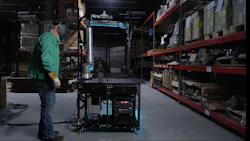
Robotics-as-a-Service was supposed to make automation easier to buy. But after more than two decades of experimentation, the model has transformed in ways that reach well beyond how a robot is financed.
Commonly known as RaaS, Robotics-as-a-Service replaces large upfront capital purchases with a subscription-based model that bundles robotic systems, software and support into an ongoing service.
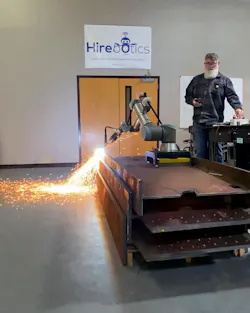
Hirebotics, which Matt Bush co-founded in 2015, initially deployed robots across a wide range of manufacturing applications on a service basis. The company has since moved toward standardized, application-specific systems for welding, cutting and painting, while retaining RaaS as part of its business. “We now focus primarily on satisfying labor shortages through providing robotic tools to the industry,” Bush said.
Hirebotics’ approach reflects how the definition of RaaS has broadened. Increasingly, the subscription includes continuous software updates, fleet-level data and service-level agreements (SLAs) tied to outcomes rather than simply providing access to hardware. To succeed, providers must build repeatable systems that can be deployed, maintained and updated across many sites.
The implications for machine designers are far-reaching. When the provider remains responsible for uptime and support, component availability, standardization and serviceability become as important as the initial system cost. At the same time, software is becoming the layer that turns a robot from a programmable machine into a tool that a wider range of workers can use.
Software may be the smaller of the changes still to come. Bush argues physical AI and machine vision could allow robots to adapt to less structured environments, reducing the need to engineer the factory floor around the robot.
In this conversation, Bush discusses what RaaS could mean for the next generation of industrial robots and explains how these shifts are reshaping the model’s economics, engineering and deployment.
Machine Design: How has RaaS changed the attributes that you look for when selecting or developing robotic systems? What design characteristics have become more important?
Matt Bush: What you’re seeing in a lot of the robots-as-a-service providers is that they’re really starting to standardize more on the solution. They are going after a single niche in the market and looking at how do you deploy a product into the application.
You know, you go back 11 years, when we started this, we came out of the gate saying, “Anything we can make a cobot do, we’ll go do as a service.” We had robots that were machine tending and doing vision inspection systems and putting rivets in, putting screws in, running presses. We literally joked that we did everything from managing metal parts to playing with dough at pizza producers, and kind of everything in between.
And what you see today, as the industry has really evolved—and I think it’s really an evolution of the entire automation industry—is more solutions-focused. It’s, how do we take a “tool” and deploy that into an application space where we have a known problem that we’re trying to solve, and we’re solving it with more of a tool than a custom solution?
READ MORE: Q&A: Robco on Robotics-as-a-Service and the Move Toward Physical AI
We got into that about 2019-2020, when we first developed the welding solution. It really opened our eyes to: We could have a single product that could now impact many more customers than what we were able to do by custom deploying every solution.
Go back to 2017, 2018, every system we put into the field was custom-built for that exact employee space, employer, manufacturer—how they ran their plant, what their exact process setup was. We’d have, no joke, two machine-tending robots that looked kind of similar, but were vastly different cells, and took engineering effort, took programming effort. Versus today. We’re deploying a product into the field that is a known product that everyone—you know, it’s kind of a cookie cutter. They all look the same. The users are able to adapt the tool to their process.
MD: What have manufacturers learned about when it makes sense to rent automation rather than own it? And where is there still a shortfall in the RaaS market?
MB: When we first launched years ago, we thought this would be a massive uptake thing. [As in,] everybody wants to rent everything. Like, you saw Uber becoming a thing, you saw Airbnb becoming a thing. And what you’ve found with manufacturers, especially smaller manufacturers, they still like to own capital equipment.
But what we’re starting to see is an emergence in the last few years, especially larger organizations, where they have an eye towards CapEx versus OpEx, and what can they convert off their CapEx into their OpEx? What can they take as a variable operating expense versus a fixed asset sitting on the floor?
And so what’s been interesting is we see this dichotomy between what I’ll call the very small customers and the very large customers. And kind of in the middle, there’s this chasm of people that have enough cash flow that they would just prefer to own the capital, and so they buy the capital.
But [businesses] in the end generally don’t have enough cash sitting in the bank that they can just fork over six figures to buy a piece of equipment. And they’re interested in alternative models around ownership, whether that is pure financing, historical financing or some other model. And then the guys at the top end, where there are decisions to be made around capital availability, maybe they have very onerous capital cycles.
Whereas, we had one customer, they were like, “Hey, I can quickly spend OpEx dollars, whereas CapEx dollars require me to go up to the parent corporation and get approval. “But I can drop it onto my OpEx, because I have a discretionary budget every month.”
And so, for customers like that, what they find is it’s very easy to get started with the systems. And then maybe long-term, they do decide, “Hey, we would rather roll this into a capital purchase at some point in the future,” or maybe they keep it on their OpEx and keep it as an operating expense long-term.
And so we’ve seen this weird dichotomy between the two sides.
MD: Having said that, can we roll the conversation into another theme, which is how software-defined automation is also muddying the water. How has software become a differentiator compared with mechanical hardware in RaaS?
MB: It has, in that you see so many of the providers today that are doing solutions, and we’re all going after, whether it’s a palletizing solution, or a welding solution, or a machine-tending solution, right? We’re trying to get it where it’s not a robot, it’s not a programming challenge. It is, “I have a tool that I know how to use.”
And so a lot of us are spending a lot of time and effort and energy to make—to basically abstract the robot away from the software. So, if you take our Beacon platform, it runs on a smartphone. We like to joke with people, “If you can use Facebook, you can program a robot.” And we’ve been able to do that because we’ve abstracted away actual programming of the robot. You’re not really programming the robot, you’re just teaching it what you want it to do in a very defined application envelope.
I think it’s finally come to the point where we’re getting into that mainstream adoption where you don’t have the tinkerers, you don’t have the science-fair-project guys that have got the time, the patience, the knowledge to go out there and build their own thing, you know, the do-it-yourself kind of thing. And as solutions become a bigger thing, a lot of that is driven by the software.
So, it’s not like you can take a welding robot and, through our Beacon software, make it a machine-tending robot. It is a very specific application design. And same as when we’re seeing in the palletizing side. The guys that are going after palletizing have a relatively simple-to-use interface that is sitting between the robot and the human. I saw that at Automate this year, walking around...where I saw people not only displaying solutions, but people there to find solutions.
Historically, we quit exhibiting at Automate a few years ago because people weren’t there to find a solution. They were there to find piece parts. You know, the things that make automation, whether it was motors, servos, whatever. And this year, we actually saw a big shift, and I talked to some of the other vendors that were there, literally there to find a solution.
I think it’s finally come to the point where we’re getting into that mainstream adoption where you don’t have the tinkerers, you don’t have the science-fair-project guys that have got the time, the patience, the knowledge to go out there and build their own thing, you know, the do-it-yourself kind of thing. And as solutions become a bigger thing, a lot of that is driven by the software. And how do you make the software such that the solution becomes not a robot, not a machine, but a tool that the average layperson can use.
As we look around, we kind of compare robotics to a lot of the other things that have emerged over the last, call it 20 years—3D printing, or computers. Think back to the ’70s with Apple. You know, Apple’s big change in the industry was instead of selling a kit, they actually sold a computer that was put together. And suddenly, you didn’t need to be an electronics aficionado to assemble your own computer. You could buy a computer.
READ MORE: An Injection Molder Embraces Emergent Technology with Robotics as a Service
Same with 3D printers. When I first started seeing 3D printers 20-something years ago, they were all kits. You printed your parts, you made your system, the community kind of supported itself. And now you can buy a $500 printer off Amazon, and it is hands down better than anything I bought commercially 10 years ago. We just bought one recently. We paid less than a grand for it, and it is hands down better than any printer I’ve ever run.
Suddenly, my 11-year-old can run a 3D printer. So how do we continue taking automation down that path?
As we think, as machine designers, it’s on us to think about it differently and realize we internally have the skill set, we have the roboticists, we have the industrial engineers and the controls engineers that can make all of this stuff work together. How do we get it such that it can be mass adopted by the layperson, the guy that was holding a welding torch yesterday, or was running the CNC machine yesterday, and give them a tool that just allows them to be more productive at their job? That welder can now weld more than just one part at a time. Now he can weld four parts at a time.
But that is a change in mindset, and it’s thinking, how do I do the job differently as either an integrator or a machine designer? And where does that software layer really begin to play a factor?
As we think, as machine designers, it’s on us to think about it differently and realize we internally have the skill set, we have the roboticists, we have the industrial engineers and the controls engineers that can make all of this stuff work together.
And that is one of our big differentiators: We have been software-focused since day one. All of our products have always been cloud-connected. Because we’re cloud-connected, that gives us a big advantage when it comes to the software, in that we’re able to make sure that all of our systems globally run the exact same version of software. All of our teaching interfaces are running the exact same version of software.
So, when we need to support something, we’re not having to ask them, “Well, what version are you running? Have you tried updating to the latest version?” We know what’s going on. We can quickly debug issues and roll out to global fleets updated software so that when we find a bug on one system, every system in the world is at the same time relieved of that bug, whether they’ve seen it or not.
And so, as we see more and more software focus coming into the industry, I think you’re going to see a lot more of that. Versus, I can still remember going back, you know, 10 years ago, or five years ago, even, and just seeing the entire list of, “Here’s all these robots in the field that are all running different versions of software at the robot level.”
Our take is software’s really going to drastically change how automation’s deployed into the field. As we think about physical AI, and I know it’s still really a buzzword today, but as we really think about how does AI start to play a role in the future, I think you’re going to see systems that suddenly become much easier to program, because there is no real programming. You’re kind of showing it what you want it to do, and it is through learned skills, or through just repetitious work at your facility, it’s finding better ways to do things.
No different than humans, right? Today, we train an employee how to do a job on the floor. And if you come back six months later, they’re probably not doing it the exact same way they did it day one. They have learned more efficient ways to do certain parts of the task, and they’re gaining efficiencies over time. What we see coming out in robots over the next few years will be the same thing, where the robots are able to get more efficient over time, and you’re able to make more production, be more productive, be faster, things like that.
MD: Is physical AI expanding the types of applications that can realistically be offered through a RaaS model, or is it primarily improving the performance and economics of existing automation?
MB: I think it’s both. Especially as we get to the point where vision becomes lightweight enough that we can do it at the end of arm, in real time. You can suddenly have a robot that can adapt to its environment. And so that if something changes in the environment, it can adapt, just like a human does.
I can remember—prior to Hirebotics, when we were first starting to use UR—we had an application where we were heat shrinking motor wires on the end of a motor. The robot was picking up the motor and holding it under a heat gun. Well, depending on how the line placed the wires, we may or may not heat shrink them, because they may not be in the same spot that we thought they were. And so, we had to have tooling. We had to design the cell such that the robot could physically move the wires to where they needed to be through some mechanisms.
Whereas today, with physical AI and cameras on board and smart vision, we could have just said, “Oh, well, the wires are there, therefore put it here under the heat gun.” I think that’s gonna be a big player. I think that’s going to open more applications to where fixturing is not as important.
READ MORE: When the Cloud is Just Not Enough: the New Focus on SaaS
I’ve always told people, when you integrate a robot, the hardest part is not programming the robot. The hardest part is presenting the world to it in a uniform way. Because robots are very good at doing the exact same thing over and over. They’re not very good at adapting to things. I think that’s where physical AI is going to play a role in that. We’ll be able to put robots into human environments that are built for humans with our adaptability, our eyes, our hands, and we’ll suddenly be able to adapt, but then it will also give us better ability to get better over time.
So as you’re running that task, as a, you know, I program a certain path, I may not program the most efficient path to do the job. Can the robot, over time, figure out there is a more efficient path of motion between the two points? I think the answer to that is yes. I don’t think we’re there yet, but I think we’re getting there. And that will continue to increase productivity.
That was one of the things we always dealt with with our customers when we were doing the machine-tending stuff: Over time, how do we make the robots get better and better? If we launched day one and we had a 30-sec. cycle time, how do we improve that cycle time over learning to get to a 15-sec. cycle time? So that we had a cell that we put in that we’re very proud of, that when we first put it in, we did about 25 assemblies an hour, and by the time we pulled it out three years later, we were doing 50 assemblies an hour.
And it wasn’t through no effort, right? There was a lot of effort that went into understanding where we were losing time, but we were having to do that as humans. With the AI tools today, I think it’d be interesting to see how does that improve performance over time by just the robot learning, “Look, I can do this better. I can be more efficient. Waiting here, taking a little bit of time out there, this wait timer doesn’t need to be this long, the machine cycles faster than that.”
Things like that, and just looking for where it can very slowly, incrementally get better.
More content from Takeover Week: Automation & Robotics.
About the Author
 Rehana Begg
Rehana Begg
Editor-in-Chief, Machine Design
As Machine Design’s content lead, Rehana Begg is tasked with elevating the voice of the design and multi-disciplinary engineer in the face of digital transformation and engineering innovation. Begg has more than 24 years of editorial experience and has spent the past decade in the trenches of industrial manufacturing, focusing on new technologies, manufacturing innovation and business. Her B2B career has taken her from corporate boardrooms to plant floors and underground mining stopes, covering everything from automation & IIoT, robotics, mechanical design and additive manufacturing to plant operations, maintenance, reliability and continuous improvement. Begg holds an MBA, a Master of Journalism degree, and a BA (Hons.) in Political Science. She is committed to lifelong learning and feeds her passion for innovation in publishing, transparent science and clear communication by attending relevant conferences and seminars/workshops.
Follow Rehana Begg via the following social media handles:
LinkedIn: @rehanabegg and @MachineDesign
YouTube: @MachineDesign-EBM
Voice Your Opinion!
To join the conversation, and become an exclusive member of Machine Design, create an account today!
 Leaders Logo
Leaders relevant to this article: