Q&A: Robco on Robotics-as-a-Service and the Move Toward Physical AI
Factory floors have a labor problem that is not going away. One way robotics companies are trying to close the gap is by building robots that learn a task by watching a worker perform it, rather than requiring a programmer to code every step.
RobCo is among them. The company got its start in 2020 as a spinout from the Technical University of Munich and calls its approach “Physical AI” (a mix of perception, motion planning and self-learning layered onto modular hardware). The argument RobCo makes to manufacturers is that a process change shouldn’t mean a costly reprogramming job. Instead, when a process changes on the line, the robot should adjust on its own, instead of sending someone back to reprogram it from scratch.
READ MORE: Q&A: RaaS—The Subscription Model That’s Steadily Rewiring Robotics
RobCo packages all of this into one vertically integrated stack—hardware and software together—and sells it as a subscription, letting manufacturers treat automation as a monthly operating cost rather than a big upfront capital expense. The company says its robots have logged millions of operating hours across hundreds of customers worldwide, backed by a team of more than 200 people out of Munich and Austin. Investors are betting on the approach too. Earlier this year, RobCo closed a $100-million Series C co-led by Lightspeed Venture Partners and Lingotto Innovation, the investment arm of Exor.
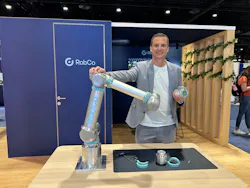
Machine Design caught up with Arjan Van Staveren, RobCo’s Chief Revenue Officer, to talk about how that RaaS and OpEx model changes the math for smaller manufacturers, what Physical AI looks like on the factory floor and how RobCo’s autonomous robot, Alfie, is meant to change the way robots get programmed and taught.
Machine Design: How is autonomous manufacturing evolving, and where are you seeing demand?
Arjan Van Staveren: We’ve been thinking about the different levels of autonomy for quite some time now; everyone in this industry feels comfortable building things. What’s exciting to see on the trade show floor right now is that everybody’s moving beyond those levels. That shift is being pulled by the market—by what our customers actually want—but it’s also being enabled by the technology itself, through physical AI.
That shift shows up in our own product development, too. About five years ago, we started out building integrated, build-to-sell solutions end-to-end. We’d deploy the robot along with the full working cell behind it. What we’re seeing now is that evolving into physical AI, which is what led us to develop Alfie, our autonomous industrial robot.
We’re excited to see that come to life, based on the feedback we’re getting from the market. Our customers and prospects are super-excited about what we’re building.
MD: What is the biggest technical bottleneck to autonomous systems?
AVS: Getting autonomy to actually work is probably the simple answer. We’ve been working on humanoids and so on for quite some time now, but if you look at what’s actually solving a true pain point or a true problem for a customer on the factory floor, those deployments are still very, very limited. That’s the journey we’re on right now—seeing that actually come to life in things that are being deployed, things that are working.
MD: What is holding mid-sized manufacturers back from automation?
AVS: High upfront costs are obviously a big challenge if you want to automate, particularly when you’re a mid-sized company. It’s difficult to pay hundreds of thousands, or sometimes even millions, to automate—and that’s a big bottleneck.
We’re seeing high cost pressure in the market right now, and on top of that, labor shortages popping up everywhere. So, it’s not really a question of whether we need to automate; the question is when we’re going to automate, and how we’re going to afford it.
MD: How does robotics-as-a-service address those challenges?
AVS: Robotics-as-a-service is a commercial model where you essentially rent a robot for a couple thousand dollars a month, depending on the complexity of the solution—anywhere from a simple palletizing setup to something much more complex. There’s a monthly rate, and everything is included in that rate.
READ MORE: What High-Mix, Low-Volume Automation Really Requires
That means we build the solution, we deploy the solution and we service the solution. It’s a full-circle, all-around service model, so as a customer, you don’t have to worry about anything. It’s turnkey, and there’s only one contact person you ever need to address if something goes wrong. And that’s us. We take full responsibility for the cell, the root and the deployment, and all of that is included in the RaaS rate.
So essentially, there are no hidden costs, nothing on the side. You have a monthly rate—that’s what you’re paying.
MD: What applications are the strongest entry points for manufacturers beginning their automation journey?
AVS: Standard pick-and-place applications are what we see most—palletizing, machine tending, combining older machines with new robotics. That’s the kind of entry point we see very often: You have an existing system already running and you want to attach an automation solution to it.
Where we see it evolving right now is in autonomy—tasks we haven’t been able to automate up until today can suddenly be automated, thanks to evolving physical AI.
MD: Has the conversation with manufacturers changed as AI has moved toward the boardroom?
AVS: I think the first thing is feasibility. Feasibility checks, requirement workshops…those have been part of the process, and they’ll continue to be part of it going forward. In the end, it’s not about whether it’s physical AI or not. It’s about whether we can solve the problem for a customer. If we can do that with physical AI, great—in the past, we’ve done it with different solutions.
READ MORE: What’s Moving at igus? From Motion Plastics to AMRs
It always starts with understanding what the customer wants to solve, what metrics matter to them, and how we get into the process of solving that. The process itself hasn’t necessarily changed; the conversation has shifted in that we can now look at different use cases, but the feasibility piece hasn’t changed much.
At the board level, though, physical AI has reached a level of maturity where—and this is my personal opinion—you can try to ignore it for a while, but just like AI in general, it’s there. I think that’s the board-level conversation that’s going to keep happening: How do we build scalable physical AI solutions that actually work, function, and can be deployed and distributed?
MD: What can you tell us about Alfie, RobCo’s autonomous industrial robot?
AVS: What’s unique about Alfie is that it’s our autonomous industrial robot—it has two arms, it has vision and we can teach it a task rather than program a motion. That means we’re moving into different levels of autonomy with Alfie, and we can solve use cases we hadn’t been able to solve before.
That’s what gets me excited: We can look at a real-world task and teach a robot to do something like it. It’s exciting to me that we can teach robots what to do just by showing them, and then they can start solving problems for our customers.
MD: Finally, what does RobCo mean by “software-defined automation”?
AVS: We were founded as a software and hardware company first. We didn’t buy hardware and then figure out what software to deploy on it, and we didn’t build software and then go looking for a piece of hardware to run it on. We’ve been software from day one—meaning a no-code platform that makes robotics accessible, with the right interface into the different systems inside an organization, including enterprise systems, and now moving into physical AI.
In the end, that’s a software play. How we program and how we teach the robot, that’s a software discussion. The majority of our engineers are software engineers, because the problems we’re solving are mainly software problems the customer runs into. The robots themselves aren’t necessarily the limiting factor—it’s the software that needs to steer the robot in the right direction so it can actually solve those problems.
More content from Takeover Week: Automation & Robotics.
About the Author
 Rehana Begg
Rehana Begg
Editor-in-Chief, Machine Design
As Machine Design’s content lead, Rehana Begg is tasked with elevating the voice of the design and multi-disciplinary engineer in the face of digital transformation and engineering innovation. Begg has more than 24 years of editorial experience and has spent the past decade in the trenches of industrial manufacturing, focusing on new technologies, manufacturing innovation and business. Her B2B career has taken her from corporate boardrooms to plant floors and underground mining stopes, covering everything from automation & IIoT, robotics, mechanical design and additive manufacturing to plant operations, maintenance, reliability and continuous improvement. Begg holds an MBA, a Master of Journalism degree, and a BA (Hons.) in Political Science. She is committed to lifelong learning and feeds her passion for innovation in publishing, transparent science and clear communication by attending relevant conferences and seminars/workshops.
Follow Rehana Begg via the following social media handles:
LinkedIn: @rehanabegg and @MachineDesign
YouTube: @MachineDesign-EBM