IMTS 2026: What Machine Design Will be Watching
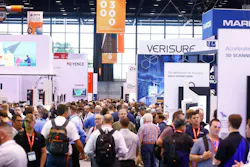
What to Expect at IMTS 2026
The show will cover more than 1.2 million square feet with more than 1,800 exhibitors. That is a lot of ground to cover. But the announcements leading up to the show point to two themes: the continued push to get more productivity from machine tools, and the growing presence of AI, software and data across the manufacturing process.
The machine tool remains at the center of the show. New multitasking, multifunction, hybrid and five-axis machining centers are planned from companies including Okuma, Index, Tsugami, Mazak, Matsuura, Haas, JTEKT, Marubeni Citizen-Cincom and DN Solutions. Across these machines, the emphasis is on doing more in one setup, reducing extra operations and getting more cutting time out of the machine.
Okuma, for example, will launch its Multus U1000 and U2000 multitasking machines, while Index will debut the G160. Mazak’s Integrex i-350S Neo adds grinding to turning and milling in a single setup. Elsewhere, pallet pools, bar feeders and automated part handling are being positioned as ways to extend machine utilization, including in high-mix, low-volume production.
Bringing AI to the Shop Floor
Industrial AI will have a more prominent place at this year’s show. IMTS has added an Industrial AI Arena with 32 exhibitors and a full-day Industrial AI Conference focused on applications such as predictive maintenance, quality, data readiness and edge-versus-cloud deployment.
More significant for engineers, AI will not be confined to a dedicated exhibit area. The show organizers point to AI embedded in CNC programming, machine controls, vision systems, inspection, CAM and machine diagnostics. Examples include AI-assisted process planning, automated inspection and reporting, vision systems that distinguish product types and CNC technologies aimed at reducing programming and setup time.
The same trend extends into additive manufacturing. AI-enabled tools are being used for build preparation, part orientation and support generation, while simulation can identify potential distortion or failure before a build begins. During production, sensor and melt-pool data can be monitored for anomalies, with machine learning then used to refine process parameters.
EOS will also introduce its M4 Onyx laser powder-bed-fusion platform to North America, aimed at industrial-scale production.
Education Gets Its Own Footprint
The show has a strong education program. IMTS has announced nine conferences and more than 90 sessions, including the new Industrial AI Conference. The comprehensive program covers machining, automation, software, metrology, materials, tooling, workholding and alternative manufacturing. Dedicated events will focus on job shops, aerospace and defence, industrial lasers, investors, women in manufacturing and the Spanish-speaking manufacturing community. (See for example, the Student Summit at IMTS 2026.)
The conference program also gives some indication of where manufacturers are wrestling with practical engineering questions: model-based design, in-spindle automation, CNC programming, workholding, additive manufacturing, micro machining, 3D scanning and vision-based quality inspection are among the subjects on the agenda.
What Machine Design will be Watching
Taken together, the announcements point to a show where established production technologies and newer digital tools are being presented as parts of the same system. The machine tool remains at the center but software, automation, AI, data and additive processes are extending what that equipment can do.
For Machine Design, the question is what that integration means for the engineers designing the machines.
As we walk the floor, we’ll be asking three questions:
- How are machines becoming more automated and less dependent on manual intervention?
- How are AI, software and data changing what machines can do?
- How is greater integration across design, manufacturing and inspection changing machine design?
We’ll be looking beyond the individual product launch to the engineering decisions behind it: what has been integrated, what has been automated, what data is being generated and used, and where the machine builder or design engineer has to rethink the architecture of the system.
IMTS runs Sept. 14-19 at McCormick Place in Chicago.
Watch this video featuring Control Design Editor-in-Chief Mike Bacidore and Doug Woods, President of the Association for Manufacturing Technology (AMT)
About the Author
 Rehana Begg
Rehana Begg
Editor-in-Chief, Machine Design
As Machine Design’s content lead, Rehana Begg is tasked with elevating the voice of the design and multi-disciplinary engineer in the face of digital transformation and engineering innovation. Begg has more than 24 years of editorial experience and has spent the past decade in the trenches of industrial manufacturing, focusing on new technologies, manufacturing innovation and business. Her B2B career has taken her from corporate boardrooms to plant floors and underground mining stopes, covering everything from automation & IIoT, robotics, mechanical design and additive manufacturing to plant operations, maintenance, reliability and continuous improvement. Begg holds an MBA, a Master of Journalism degree, and a BA (Hons.) in Political Science. She is committed to lifelong learning and feeds her passion for innovation in publishing, transparent science and clear communication by attending relevant conferences and seminars/workshops.
Follow Rehana Begg via the following social media handles:
LinkedIn: @rehanabegg and @MachineDesign
YouTube: @MachineDesign-EBM
Voice Your Opinion!
To join the conversation, and become an exclusive member of Machine Design, create an account today!
 Leaders Logo
Leaders relevant to this article: