Washer Types and Applications: An Engineering Reference Guide
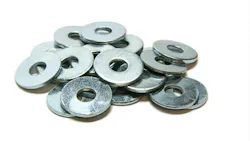
What are the differences between washer types? What types of washers are used in specific applications? What is the difference between a countersunk and spherical washer? In mechanical engineering, washers serve as critical load-bearing interfaces that help mitigate a wide range of problems. Here is a reference guide for today’s common types of engineered washers and their applications.
Thrust Washer
Thrust washers reduce friction between rotating and stationary parts and absorb axial loads. They are typically installed between a rotating component such as a shaft and a stationary surface/housing to ensure the moving part stays in place. Thrust washers can also be one component of a thrust bearing structure, such as serving as a raceway for rolling elements in thrust ball or roller bearings. Thrust washers may also replace thrust bearings in low-speed, light-load systems to reduce costs and simplify design.
Bimetallic Washer
Bimetallic washers are made from two different metals (commonly aluminum and copper or copper and steel) with different coefficients of thermal expansion. They are used to ensure a precise fit through compensate for differences in thermal expansion between the two components/structures in the application. Bimetallic washers are also used to prevent galvanic corrosion, which occurs when certain metals come into contact with each other in the presence of moisture.
Countersunk Washer
Countersunk washers, also known as finishing washers, have a bowl shape that allows screws to sit flush with the surface, when a flush surface is required to prevent rotation or other movement. They provide a clean look and enhance structural integrity in assemblies that include softer materials such as plastics.
READ MORE: Materials Selection in Precision Mechanical Components
Spherical Washer
This washer has a concave spherical cap on one side and a flat surface on the other, allowing for limited angular or rotational adjustment in applications where two components cannot be perfectly aligned. The design helps ensure the required contact and load distribution.
Lock Washers
Lock washers exert a load while partially deforming and locking a fastener down in applications where rotation or loss of friction can be expected.
Double Tab Lock Washer
This washer is designed to prevent nuts or bolts from loosening in applications where vibration or torque is present. Double tab washers feature two tabs that can be bent against the sides of a nut or bolt, or into a keyway.
External or Internal Tooth Lock Washers
These washers feature “teeth” on the outer or inner edge that “bite” into the head of the fastener and against another flat surface, securing it against rotation or loss of friction. They are sometimes used alongside flat washers to provide locking action while the flat washer distributes the fastener load and helps prevent deformation of the assembly.
Helical Spring Washer (Split Lock Washer)
These thin-width washers have a split at one point, with each “end” of the washer pointing up or down. These ends “bite” into the fastener and the surface, increasing fastening strength, but they are not generally chosen for high-vibration environments where a stronger grip is required.
Shoulder (Step, Flange) Washers
Shoulder washers have a raised circular area surrounding the central hole. They resemble a flat “top hat,” so they’re also called top hat washers. This design enables them to fit into a specific cutout or to segregate the fastener from the material it is secured to. Step washers are generally plastic (nonconductive) and used primarily in electronics assemblies.
Flat Washers
These simple washers spread load and protect surfaces. Their external shape and/or the shape of the central hole may be round, square, hexagonal, rectangular, and either symmetrical or non-symmetrical depending on the application. They can also come in a C-shape (called c-washers or slotted washers), which allows easy installation in applications that require frequent adjustments or component swaps.
Fender Washers
Fender washers are a type of flat washer with a large diameter in comparison to the inside hole diameter, spreading load over a wider surface area of soft material. To be called a fender washer, the outer diameter must generally be more than three times the inner hole diameter.
Spring Washers
Also known as disc springs, spring washers have irregularities that allow them to compress with a proportionate resistance to the return to their original shape. They are found in applications where assembly tension must be maintained, where there is expansion/contraction of materials, and where there are intermittent, dynamic shock loads.
Curved Washers
Also known as crescent or bowed washers or cylindrically curved washers, curve washers offer the most uniform spring constant over the widest deflection range of any type of spring washer. Their spring rate is basically linear throughout their entire deflection range. These washers are used in lighter loads in flexible, load-cycling applications.
READ MORE: Why Text-to-Geometry AI Keeps Failing on Simple Parts
Conical Washers (Belleville Washers)
Belleville washers help fasten heavy loads and withstand vibrations or thermal expansion without loss of torque. They are a type of heavy-duty spring washer with a convex shape that maintains optimal axial loading. They are suited to spring applications in tight spaces, where vibration is a factor, where the fastening application is subject to thermal changes and where bolt creep (the loss of tension from high-stress applications that permanently deform hardware) must be minimized.
Wave Washers
Also called wave springs, wave washers have three, four or six “waves” in their design. The waves are uniform because the load/deflection rate starts only after all waves are evenly loaded. With more waves present, the washer thickness can be reduced for a given load, but only by decreasing the amount of deflection and increasing the radial stress. Wave washers are ideal for application where the load is static or the working range is small and axial space is limited.
Finger Spring Washers
These washers have an outer, intermittent ring of three “fingers” that flex when compressed. This spring tension enables the washer to absorb vibrations and provide a stronger fastening.
Keyed Washers
The keyed or slotted design of this washer enables it to fit into a corresponding keyway or slot on a shaft, preventing its rotation or shifting in applications where there is rotational or other types of component motion.
Crush Washers
A crush washer is a type of seal washer, made of soft metal or composite, designed to deform when tightened. This creates a reliable, conforming seal between two mating surfaces. They are commonly used in brake, hydraulic, fuel or brake lines and in any application where a leak-proof fastening is required but the mating faces are not perfectly flat or have minor surface irregularities. They often have a beveled or tapered profile that concentrates compression as required.
About the Author
 Treena Hein
Treena Hein
Treena Hein is an award-winning science and technology writer with over 20 years’ experience.
Voice Your Opinion!
To join the conversation, and become an exclusive member of Machine Design, create an account today!
 Leaders Logo
Leaders relevant to this article: