Siemens Lays Out Vision for Digital Manufacturing at Automate 2026

For more Automate 2026 coverage, be sure to visit our Tradeshow Takeover event hub.
According to Siemens, manufacturing currently faces unprecedented challenges. Labor shortages, supply chain disruptions, geopolitical instability and other pressures cost manufacturers approximately $1.6 trillion in annual revenue growth annually, the company says. At Automate 2026, Siemens laid out its prescription for the future of manufacturing, a data-centric vision that spans a spectrum of industry hot-button phrases including industrial AI, digital twins, digital threads and software-defined automation.
Exploring the last one first, the idea of software-defined automation (SDA) has been around in industry for roughly 30 years, championed early on by companies like Beckhoff and CodeSys, among others. Over that time, its definition has blurred but, in the strictest sense, SDA refers to the decoupling of control logic software (PLC firmware/runtime and programming code) from the hardware controller designed to execute it.
In practice, this often translates to a soft PLC runtime executing atop a real-time operating system installed on commodity IPC hardware. In its latest evolution, soft PLC code is containerized in a Docker or Podman container so that more than one virtual PLC (vPLC) can run on the same hardware controller simultaneously.
Three decades on and what may have once been considered a “fringe” idea has increasingly become commonplace. In fact, only a handful of automation controller vendors adhere exclusively to the traditional hard PLC business model. Even a dominant player like Siemens, long vaunted for the quality of its S5 and current S7 PLCs, is the latest to dip its toe in the modern SDA paradigm.
In April 2023, the company launched the SIMATIC S7-1500V, a fully virtualized and hardware-independent controller. In contrast to the company’s flagship S7-1500 hardware, the virtual, containerized version executes on an IPC running a real-time kernel Linux OS which hosts the Siemens Industrial Edge platform. (As an aside, the S7-1500S is also a software PLC but it is tied to Siemens proprietary hardware such as a SIMATIC IPC, thereby undermining the SDA concept.)
Admittedly, the 1500V is merely one SDA example, amid the dozens to hundreds of traditional micro, advanced and distributed hardware controllers the company sells and supports. Even so, that option does suggest that an automation firm like Siemens has felt sufficient customer pressure to adapt, despite requiring a pivot away from the hardware-based business model it, and other dominant players, have relied on for more than 50 years.
For Siemens, one of those influential customers is Audi. In 2022, the German automaker began rolling out its Edge Cloud 4 Production (EC4P) initiative at its Böllinger Höfe plant in Neckarsulm, Germany. A part of Audi’s 360factory vision for the future of automotive manufacturing, the EC4P initiative looks to replace thousands of traditional PLC. IPCs, HMIs and other hardware controllers with their software-based virtual counterparts, running on rack servers housed miles away from the shop floor. To make this IT-centric approach a reality, Audi relied on Siemens’ virtual controllers as well as Cisco’s high-speed networking infrastructure and Broadcom’s hypervisor VMware software.
If EC4P proves a success at the Böllinger Höfe plant, it’s conceivable that same model would be replicated not only at other Audi plants but the hundred or so other facilities operated by its parent company Volkswagen. If that ripple does occur across the operations of the world’s second largest automaker, it would represent tectonic industrial shift and see a significant amount of OT hardware displaced by IT-centric software.
To explore this shift, Machine Design interviewed Jan Bajorat, Siemens’ senior director of software-defined automation, at Automate 2026 in Chicago to discuss the automation company’s approach to SDA and the industrial pivot away from hardware-bound automation. According to Bajorat, Siemens’ take on SDA is broader than simply offering a vPLC option and the software required to manage it at scale.
“The third dimension [of Siemens’ SDA approach] is how things are being engineered from a automation system engineering point of view,” he said. “This is where we see a big change towards a more IT-like or automation software engineering approach. This means, workflow-wise, we take the best from the software development space and bring it to the OT space. Reduced to one sentence, software defined automation is ultimately the basis for the next generation of automation and is the necessary foundation to implement industrial AI at scale.”
Industrial AI at Scale
Implementing industrial AI at scale has recently become a major initiative for Siemens. On June 1, at the company’s annual conference, Realize Live, the company announced the launch of Intelligence Center X. Billed as AI orchestration software, it is the latest addition to Siemens’ other stacks of “center” marketed solutions (e.g., Designcenter, Teamcenter, Simcenter, etc). Under the Intelligence Center X label, Siemens combines its Mendix low-code programming environment with its knowledge graph software, RapidMiner Graph Studio, and its ML/AI development software, RapidMiner AI Studio.
Unsurprisingly then, the importance of adopting industrial AI formed the central theme of Siemens’ keynote pitch at the Automate 2026 trade show in late June. That is, provided AI its paired with two of the company’s favored industry terms, digital twin and digital thread.
For the keynote, Chris Stevens, President of US Automation for Siemens Digital Industries, laid the groundwork by painting a dire picture of the US manufacturing landscape. Quoting a 2021 Deloitte and The Manufacturing Institute Manufacturing Talent study, he said US manufacturing is expected to have 2.1 million unfilled jobs by 2030, despite contributing roughly $3 trillion to U.S. GDP.
“Introducing automation is easier than ever before because of this number,” he said. “You used to have to justify [automation] with productivity gains, with quality metrics. Now, it’s justified because lines are shutting down.”
To this, Stevens asserted that the half-life for skills on the manufacturing floor has decreased from seven years down to 2.5 and that 90% of the world’s data has been created in the last two years but the majority of it sits in dashboards.
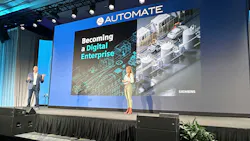
“The good news is you have more reports and dashboards than ever before,” he said. “The bad news is you have very little insight. And the reason is because that data needs context. It needs relationships. So when you want to feed these large language models everyone keeps talking about, if you don’t have that data context, they won’t provide the value that you’re looking for.”
Ultimately, Stevens said AI can provide the answer to the above pressures manufacturers face, but only if it has the right foundation. According to keynote co-presenter Annemarie Breu, Senior Director of Automation Software Development and Incubation, Siemens has been building that foundation for years. To illustrate, she anchored the keynote to three core themes: predictability, safety and orchestration.
For predictability, Stevens emphasized that the smart manufacturing digital thread starts with the digital twin of production. As an example, he referenced a PepsiCo presentation at CES during which the company recounted its experience with designing plants as digital models. Using AI simulation, PepsiCo was able to test thousands of potential layouts before committing to a final design. According to the company, it was able to increase throughput by 20% and identify 90% of potential issues before they reached the shop floor.
For safety, Breu also focused on AI and digital twin simulation but described a control loop scenario in which AI is used to predict the behavior of automation components. Depending on the quality of that prediction, the AI model can either be further refined or its output can be written to the control layer. As an analogy, she compared this process to the two channel evaluation common in failsafe IO modules.
“The idea is, how do we transfer this two-channel evaluation into the AI world, where AI can make a suggestion, but that suggestion is always evaluated against at least one more channel, which can be a simulation?” she explained. “It can also be policies because we need to govern when, where and how AI is actually allowed to write back to our control layer.”
To explore the third theme, orchestration, Roland Joseph, Senior Technical Director at Procter & Gamble took the stage to describe how the company used AI to spot production problems quickly. Despite its focus on data collection, Joseph said the company ran into two limitations: data resolution and latency.
To illustrate, he described a pilot project in which the company had a problem: the friction weld process on a Febreze nozzle. Initially, the company discovered that its PLC and data historians were collecting data too slowly. In addition, its AI was running in the cloud which incurred a latency delay. The solution was to install an edge industrial PC, sitting at the same level as the PLC, making it capable of capturing real-time data down to the millisecond.
To sum up the keynote, Stevens pointed to the Siemens’ Fort Worth manufacturing facility in which Siemens employed its digital thread and digital twin concepts to bring the site online in under 15 months. Referring to it as “customer zero,” Stevens said the Fort Worth facility has also using AI agent-to-agent technology to increase time to deployment.
Ultimately, he said, the most critical component for a successful AI initiative is getting users over the fear of new technology by getting users involved early and often in the roll-out process.
“That’s what we call strategy to execution to results, because strategy without execution is merely just a dream or a vision,” he said. “Execution without results is what we call a science project.”
About the Author
 Mike McLeod
Mike McLeod
Senior Editor, Machine Design
Mike McLeod, senior editor of Machine Design, is an award-winning business and technology writer with more than 25 years of experience. He has covered the full spectrum of mechanical engineering, from industrial automation, aerospace and automotive, to CAD/CAE, additive manufacturing, linear motion and fluid power.