Booth Drive-By Visits at Automate 2026 Highlight Motion and Automation Advances
For more Automate 2026 coverage, be sure to visit our Tradeshow Takeover event hub.
At Automate 2026, a brief circuit of the show floor revealed how advances in motion and automation are unfolding across the industrial stack, from mechanical assemblies to control electronics and precision components. Exhibitors, including Bell-Everman, Copley Controls and KHK USA, emphasized measured, application-driven improvements aimed at extending system performance, easing integration and giving engineers greater latitude in industrial automation and design.
1. Bell-Everman: ServoBelt for Multi-Carriage Automation
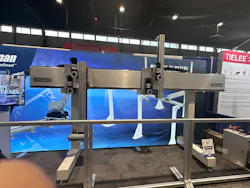
Motion-control specialist Bell-Everman showcased its proprietary ServoBelt linear-drive technology, designed to deliver long-travel precision motion without sacrificing stiffness, repeatability or speed.
“We are a manufacturer of precision linear motion stages and rotary stages out of Santa Barbara, Calif.,” said Scott Everman, National Business Director at Bell-Everman. “We’ve been in business for over 30 years building precision motion stages, multi axis systems and this is our flagship product, ServoBelt."
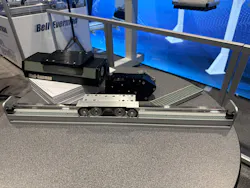
The company, which develops linear and rotary stages, actuators and custom electromechanical assemblies, says ServoBelt falls into a distinct class of linear motion technology. Unlike conventional belt drives, rack-and-pinion systems and ball screws, the design uses a patented arrangement consisting of a stationary, toothed steel belt that acts as the rack and a recirculating belt assembly integrated into the carriage.
“Many engineers know of the incumbent linear motion technologies of belt drives, rack-and-pinions and ball screws,” Everman said. “ServoBelt is its own category.”
He explained that the system employs “a base belt on the bottom of our stages, a static belt that serves as the rack of our rack and pinion,” while “this entire carriage here can basically be thought of as a different take on the entire pinion.” In the ServoBelt architecture, the stationary toothed belt functions as the rack, while the entire moving carriage assembly effectively performs the role of the pinion.
The carriage houses a recirculating belt that passes around idler bearings and engages with the stationary belt. “When your motor pinion tensions upward, it eliminates backlash by pulling the belt towards the middle of your drive line," Everman said. According to the company, this arrangement enables the system to maintain stiffness and repeatability over long travel lengths without relying on a conventionally tensioned recirculating belt.
“So, what ServoBelt allows us to [do is] go unlimited travel and without losing any of our repeatability, driveline stiffness or speed capabilities because we don’t have to keep a recirculating belt in tension throughout the travel of our stage,” Everman said. "We are simply adding more of our rack, more of our bearings and more of our chassis to make this the longer travels.
“The other great thing about ServoBelt is the ability to put multiple independently moving carriages on a single track,” he added. The approach enables a single gantry to carry multiple independently controlled end effectors, increasing throughput by allowing several tasks to be performed concurrently. “So, we’re thinking about increasing throughput and using one single system we can add many more end effectors to the same gantry and get the job done a little bit quicker.”
Bell-Everman also emphasized the modularity of its systems, which are built using T-slot aluminum extrusion platforms that can be configured to meet varying load and motion requirements.
“Everything we build is on T-slot extrusion, which gives us a lot of adaptability into every application,” Everman said. “We can decide how many bearing rails we’re using, which size of extrusion, where those bearing rails are placed so we can accommodate different loads and different axis of motion.
“And we build everything on a 20-ft granite slab to keep everything very precise and straight, especially when we are splicing together pieces of our chassis for longer applications,” he added.
Overhead Pick-and-Place Systems
The company also highlighted large overhead pick-and-place systems as a key application area for ServoBelt technology. Such systems often require travel lengths of 20 to 30 m. These applications historically have been assigned to rack-and-pinion systems because of their long-axis capabilities, Everman explained.
Overhead pick-and-place is an area where Bell-Everman's technology is especially well suited, said Everman. “The ability to go 20, 30 meters worth of travel oftentimes is an application that would have been given to a rack-and-pinion linear motion system.”
He noted that many of these applications do not require the heavy, precision-machined steel structures traditionally associated with long-travel systems.
“Because of that need for extra long length, we have found that there are plenty of applications for overhead pick-and-place where the requirements of the payload don’t warrant a lot of long precision-machined steel,” Everman said. “We utilize an aluminum composite beam that can span seven to eight meters unsupported without seeing noticeable deflection.”
The demonstration system at the booth featured a machine-tending application for automotive manufacturing.
"This application here was moving a 70-lb payload—picking up a 70-lb payload and doing machine tending in and out of lathes, mills, in an automotive application," Everman said.
He added that a larger version installed at a customer facility handles substantially heavier loads.
"The application in their actual factory is about 750 lb, moving three-and-a-quarter meters per second,” Everman said. “We can really get, you know, a decent amount of payload moving fairly fast and still keep all of that repeatability with our splicing technology, and with the inherent advantages of ServoBelt.”
2. Copley Controls: Compact Motion Control for Robotics and Mobile Systems
Machine Design had an up-close look at Copley Controls’ latest high-power, space-saving motion control technologies designed for robotics, AMRs and other automated equipment.
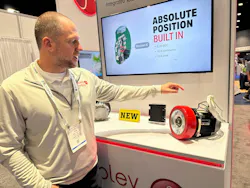
Dan Tripepi, U.S. Sales Manager, Copley Controls, highlighted the company’s integrated motor-drive technology, which combines the motor, drive electronics and encoder into a single assembly tailored to customer requirements. The demonstration unit replaces a traditional wheel-motor arrangement with a frameless direct-drive design featuring a single connector, reducing cabling and interconnects while shrinking the overall footprint and improving thermal management.
“Our module drive is embedded inside of the motor,” explained Tripepi. “This takes the place of a traditional wheel motor setup. What used to be a wheel, a frameless motor, a cable and a drive is now integrated into a frameless model with one connector.”
By integrating the drive and encoder inside the motor package, the design reduces cabling and interconnects, shrinks the overall form factor and simplifies installation while improving thermal management.
Copley further highlighted its ruggedized servo drive that delivers up to 70 A in a compact package while supporting EtherCAT communications. Copley also showcased its new High Power Nano drive, one of the most compact high-performance servo drives on the market, offering up to 140 A of continuous and peak current for space-constrained applications such as robotic joints and mobile robots.
3. KHK USA: Expanding Access to Metric Gearing for Industrial Automation
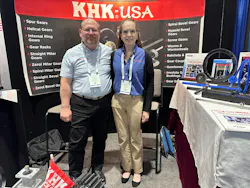
“On display will be some of KHK’s offering of over 200 styles of #MetricGears, in more than 27,000 product configurations, available for engineers to examine and inquire about," teased a social media post by Linda Dengel, Sales Manager, KHK USA.
KHK USA highlighted its extensive portfolio of metric gearing solutions aimed at industrial automation, offering more than 27,000 possible configurations across a wide range of motion and power transmission applications.
The lineup spans spur and helical gears; internal ring gear; gear racks with straight and helical tooth profiles; and bevel gears in straight, spiral and hypoid configurations, as well as screw gears; miter gears; worm and wormwheel sets; ratchets and pawl mechanisms; gear couplings; lubrication systems; and heavy-duty and right-angle gearheads.
The company supports these products with a broad materials offering that includes chrome-alloy steel, stainless steel, carbon steel, nylon, acetal, brass, bronze, cast iron and aluminum bronze, enabling engineers to match gearing selection to specific load, wear and environmental requirements.
Brian Dengel, General Manager, KHK USA Inc., said each component is supplied with detailed technical data, including torque capacity and service life ratings.
KHK USA also provides free access to downloadable 3D CAD models, real-time inventory visibility and 24/7 online ordering through its website, streamlining specification and procurement for design and manufacturing teams.
Mbodi Takes Top Prize in Automate 2026 Startup Challenge
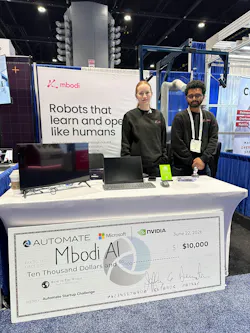
Taking home the $10,000 top prize, New York-based Mbodi was named grand-prize winner of the Automate Startup Challenge, underscoring its positioning in what the company describes as “physical AI” aimed at addressing real-world deployment challenges in robotics and automation.
Mbodi developed a cloud-to-edge system designed to integrate into existing robotics stacks. Its hybrid architecture combines cloud and on-site compute, using multiple AI agents that communicate to accelerate task learning for robotic systems.
The 2026 Automate Innovation Awards and Startup Challenge highlighted a broad cross-section of robotics and automation technologies—from core components and vision systems to fully autonomous platforms and emerging startups targeting next-generation industrial applications.
Recognizing cutting-edge technologies from exhibitors, the Automate Innovation Awards are presented as a live competition at the show. Each finalist gives a brief presentation at the show’s Automate Show Theater to explain the differentiating aspects of their technology.
The Automate Startup Challenge is sponsored by NVIDIA and Microsoft and brings early-stage robotics and automation companies to the stage for live pitch presentations.
About the Author
 Rehana Begg
Rehana Begg
Editor-in-Chief, Machine Design
As Machine Design’s content lead, Rehana Begg is tasked with elevating the voice of the design and multi-disciplinary engineer in the face of digital transformation and engineering innovation. Begg has more than 24 years of editorial experience and has spent the past decade in the trenches of industrial manufacturing, focusing on new technologies, manufacturing innovation and business. Her B2B career has taken her from corporate boardrooms to plant floors and underground mining stopes, covering everything from automation & IIoT, robotics, mechanical design and additive manufacturing to plant operations, maintenance, reliability and continuous improvement. Begg holds an MBA, a Master of Journalism degree, and a BA (Hons.) in Political Science. She is committed to lifelong learning and feeds her passion for innovation in publishing, transparent science and clear communication by attending relevant conferences and seminars/workshops.
Follow Rehana Begg via the following social media handles:
LinkedIn: @rehanabegg and @MachineDesign
YouTube: @MachineDesign-EBM